
Hours of Service (HOS) rules apply to some small trucks and not others, and the line between the two runs through one number: 10,001 lb GVWR. If you run or manage lighter commercial vehicles, that rating decides whether federal drive-time limits cover your operation. Get it wrong and you can face fines for rules that never applied to you, or skip records you were required to keep.
HOS is the set of federal rules that caps how long commercial drivers can stay on duty and behind the wheel before they must rest. The limits exist to reduce fatigue-related crashes.
Not every truck is covered. The Federal Motor Carrier Safety Administration (FMCSA) ties most HOS provisions to a vehicle’s gross vehicle weight rating (GVWR). A truck rated at 10,001 pounds or more falls under the federal rule; one rated below that line normally does not.
For small truck operators, logistics managers, and transport business owners, the threshold changes how they plan routes, schedule drivers, and document each day. Staying below it avoids a layer of federal compliance; crossing it brings the FMCSA back into the picture, along with federal oversight.
What the 10,001 lb GVWR Line Means
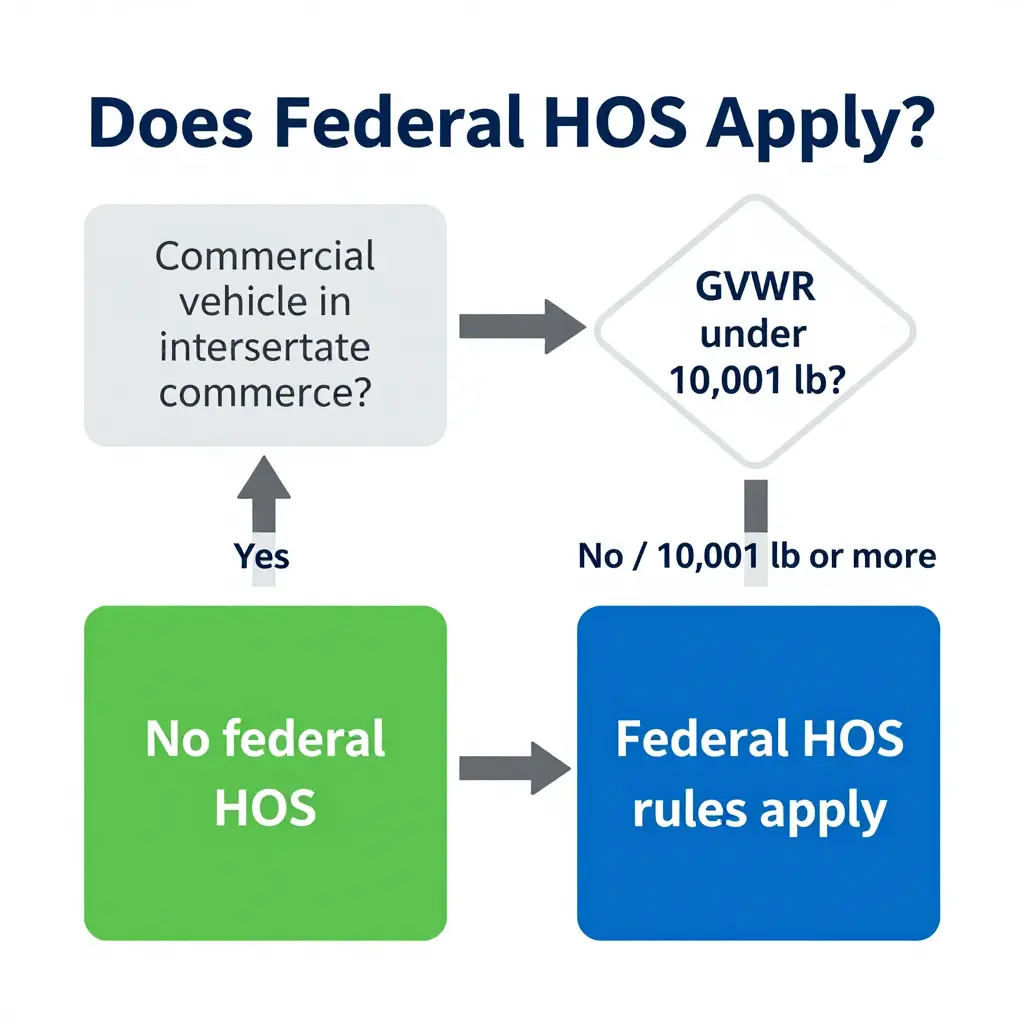
Under FMCSA’s definition, a commercial motor vehicle is one used in interstate commerce with a gross vehicle weight rating (GVWR) or gross combination weight rating (GCWR) of 10,001 pounds or more. Cross that figure and the full set of interstate operating rules applies.
That is where federal HOS applicability begins. Vehicles rated below 10,001 pounds are generally exempt from the federal limits on driving hours and rest breaks. At or above it, drivers must follow every FMCSA hours-of-service limit, from the 11-hour driving maximum to the 14-hour on-duty window. The rating decides which rulebook governs the day, not the trip.
The threshold is a rating, not a measured weight, and that distinction trips up many operators. GVWR is the manufacturer-assigned maximum describing a vehicle’s design capacity, not what the truck weighs on any given morning. A light pickup towing a modest trailer can be fully regulated if its combined rating tops 10,001 pounds, even when it runs nearly empty. A truck that is heavy under a particular load but rated below the line may stay outside federal oversight. For businesses sorting through interstate and cross-border regulatory issues, this rating-based test defines their obligations.
The rating, rather than the scale, is the test because it is fixed at the factory, printed on the door jamb, and identical for everyone running that vehicle.
Interstate vs. Intrastate: Why It Changes Everything
The 10,001 lb GVWR line is tied to one trigger: interstate commerce. A truck above the weight threshold falls under federal Hours of Service (HOS) rules only when it moves goods across state lines, or hauls cargo whose trip began or will end in another state. Otherwise, the FMCSA rulebook does not come into play.
When a vehicle stays within one state and never touches interstate commerce, the federal rules step aside and the state’s own regulations apply. Intrastate hours of service requirements are set by state legislatures and departments of transportation, not by Washington.
The state patchwork is uneven. Many states mirror the federal standard: the same 11-hour driving limit, the same 14-hour window, the same 60/70-hour caps. Others set their own weight thresholds above or below 10,001 pounds, carve out exemptions for local deliveries, agricultural haulers, or utility work, or allow longer driving windows for short-haul runs that never leave the state.
Geography can rewrite the rulebook. Crossing a state border, or simply accepting a load with an out-of-state origin, can turn a compliant intrastate truck into a federally regulated interstate vehicle overnight.
Routes that stretch across borders add another layer, as cross-border and jurisdictional rules come into play. The 10,001 lb number alone does not decide your obligations. Where the truck goes often matters as much as how heavy it is.
Driving-Hour Limits: Federal vs. Intrastate at a Glance
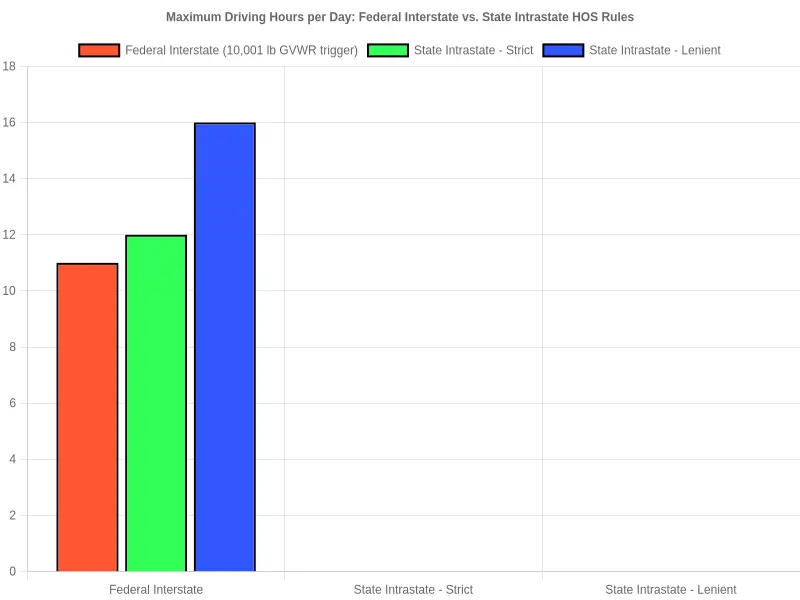
The chart shows the trade-off: once a small truck crosses the 10,001 lb GVWR trigger, the federal 11-hour driving cap replaces looser intrastate limits and can cut a lenient-state operator’s daily wheel time by five hours.
What the Numbers Show
| Rule Type | Max Driving Hours / Day | Typical Context |
|---|---|---|
| Federal Interstate | 11 | Applies at 10,001 lb GVWR and above |
| State Intrastate – Strict | 12 | States that hew closely to federal limits |
| State Intrastate – Lenient | 16 | States with relaxed intrastate flexibility |
A small operator running a 12,000 lb box truck feels this immediately. The vehicle moves from a state rule that might allow 16 hours behind the wheel to a federal ceiling of 11, a roughly 31% cut in daily driving capacity that shows up in delivery windows, driver pay, and route planning. Knowing where the 10,001 lb line falls can be the difference between a workable schedule and a costly roadside surprise. Operators weighing compliance costs against fleet investments may want to review broader economic trends shaping the trucking industry before locking in their fleet mix.
How to Determine Your Truck’s GVWR
The gross vehicle weight rating (GVWR) is the maximum weight your truck can safely carry: the vehicle, passengers, fuel, and cargo combined. It is the first thing to check when determining whether federal hours-of-service rules apply to you or whether you stay safely below the 10,001 lb line.
Check the door-jamb certification label
The certification label on the driver’s-side door jamb is the fastest source. It lists the GVWR, the gross axle weight ratings (GAWR) for each axle, and the VIN. Because the manufacturer affixes it, it is the legally authoritative figure.
Look up the VIN
If the label is damaged or missing, decode the vehicle identification number (VIN). A lookup through the manufacturer, an authorized dealer, or a commercial decoding service returns the factory GVWR and the original build details for that exact vehicle.
Consult manufacturer specifications
Manufacturer specifications give factory ratings for a given model and configuration. They help when comparing units before purchase or confirming numbers across a fleet.
When the effective rating changes
GVWR is not always the final word. Body configuration matters: adding a box, flatbed, or utility body raises curb weight and can push a truck over the threshold. Trailers complicate it further, since the combined weight of truck and trailer is governed by the gross combination weight rating (GCWR), and a heavy enough trailer can trigger a commercial motor vehicle classification regardless of the truck alone. Added equipment such as cranes, liftgates, generators, and toolboxes eats into payload and effective capacity.
Read the door jamb first, verify with the VIN, then account for how your build and trailer change the real number. Staying current on regulatory changes affecting carriers helps you plan ahead. Together, those steps tell you which side of 10,001 lb you stand on.
Federal HOS rules hinge on a vehicle’s GVWR, and the 10,001-pound line separates a lightly regulated small truck from a fully regulated commercial motor vehicle. The obligations diverge once that threshold is crossed:
-
Driving-hour limits: Trucks rated above 10,001 lb GVWR may drive no more than 11 hours after 10 consecutive hours off duty. Below the line, there is no federal cap on driving time.
-
On-duty windows: Larger trucks must finish all driving within a 14-consecutive-hour on-duty window. Small trucks below the threshold have no federally mandated on-duty window.
-
Required rest breaks: Drivers above the threshold must take a 30-minute break after 8 cumulative hours of driving. That requirement does not apply below 10,001 lb.
-
Electronic logging device (ELD) mandates: Most CMVs over 10,001 lb must carry a registered ELD. Small trucks are generally exempt from the electronic logging requirement.
-
Record-keeping obligations: Large-truck operators must maintain detailed records of duty status (RODS). Small-truck drivers typically rely on basic timecards, if anything.
-
Weekly on-duty limits: Vehicles above the threshold are bound by 60-hour (7-day) or 70-hour (8-day) caps. Those caps disappear below 10,001 lb.
-
Exemptions: The short-haul exemption within 150 air miles offers relief from some requirements, but it presumes the vehicle already crosses the 10,001 lb line that triggers federal oversight.
The 10,001 lb GVWR threshold works as a master switch. Below it, a small truck sidesteps the core HOS framework; above it, every one of these obligations applies. For fleets that also run international lanes, aligning these rules with other requirements matters just as much, as explored in our breakdown of cross-border regulatory issues.
Enforcement and Penalties
HOS rules matter only if someone is checking, and the checking differs by truck weight.
At or above the 10,001 lb GVWR line, HOS enforcement is largely a federal responsibility. FMCSA investigators run on-site compliance audits of driver logs, time records, and electronic logging device (ELD) data, while roadside inspectors at weigh stations and inspection points review hours daily. State troopers and DOT officers handle much of this work at the roadside under federal authority, which is why the mechanics of trucking oversight during a government shutdown can affect how consistently those inspections happen.
When a violation is confirmed, the consequences add up. FMCSA penalties include civil fines that now reach $19,246 for a non-recordkeeping violation and $15,846 for recordkeeping violations, out-of-service orders that pull a driver or carrier off the road until the problem is fixed, and long-term damage to a carrier’s compliance rating, the Satisfactory, Conditional, or Unsatisfactory score that shippers and insurers watch closely.
Below the 10,001 lb line, the picture changes. Vehicles under that threshold operating in intrastate commerce fall outside federal HOS and ELD mandates, so enforcement shifts to state agencies and local authorities. Penalties there depend on state law rather than the FMCSA’s federal schedule, and lighter trucks typically avoid federally driven out-of-service orders, though they still answer to state weight, registration, and general safety rules.
Cross the line and the full weight of federal enforcement follows. Stay under it and the risk moves to the states.
Frequently Asked Questions
Does a truck with a 10,001 lb GVWR need an ELD?
Yes. Once a commercial vehicle reaches 10,001 lb GVWR, the federal electronic logging device (ELD) rule can apply whenever the driver is required to keep records of duty status. A truck rated at exactly 10,001 lb GVWR sits on the trigger side of the line, not under it. If your operation stays at 10,000 pounds or less and no other trigger applies, you generally do not need to install an ELD.
Do personal vehicles fall under Hours of Service rules?
No. Federal HOS limits do not apply when you drive a personal car, or when you use a qualifying personal conveyance. The rules target commercial motor vehicles operated for business, so personal vehicles sit outside the definition. That said, if you drive a commercial truck for a personal errand, you may still need to log that time correctly as personal conveyance.
How are intrastate drivers affected by HOS rules?
Intrastate rules are written by individual states, and many set a higher weight threshold, often 26,001 pounds, before HOS kicks in. A truck at 10,001 lb GVWR could fall above the federal line yet below your state’s trigger. Always confirm your own state’s regulations, because the two sets of rules do not always match.
What happens when a vehicle crosses the 10,001 lb threshold?
Crossing into the 10,001 lb GVWR range pulls a vehicle into federal jurisdiction. Once a truck’s rating hits that mark and it operates in interstate commerce, the full federal HOS framework of drive limits, rest breaks, and recordkeeping can apply. If you re-rate a vehicle up or down, the official GVWR determines which side of the line you land on. Interstate carriers should stay alert to cross-border regulatory issues that can change how those limits are enforced.
Do trailers count toward a truck’s GVWR?
A trailer does not add to the GVWR of the truck that tows it, because GVWR is a rating assigned to a single vehicle. A trailer does carry its own GVWR, however, and the combined figure, the gross combination weight rating (GCWR), can push an operation over federal limits. Because the 10,001 lb GVWR line applies per vehicle, evaluate the truck and the trailer separately.
Do occasional or part-time drivers have to follow HOS rules?
Yes. HOS obligations depend on the vehicle and the trip, not on how many hours you drive each week. A part-time or weekend hauler whose truck reaches 10,001 lb GVWR while moving goods in interstate commerce must comply just like a full-time fleet driver. If you are unsure whether your setup crosses the line, check your vehicle’s official rating and how it is registered.
Key Takeaways for Small Truck Operators
If you operate a small truck, the federal Hours of Service rule is not automatically your rule. The federal HOS framework starts once a vehicle crosses the 10,001 lb GVWR threshold. Stay at or below that mark and the federal clock largely stays out of your day.
Weight is only the first trigger. The second is interstate commerce. A truck above the threshold that crosses state lines, or that hauls goods moving in interstate trade, falls squarely under federal jurisdiction. That is the combination regulators look at, not the size of your sticker or your logo.
For intrastate operators, the picture shifts. If your work stays within a single state, the federal rule does not apply on its own. Instead, you follow your state’s rules, which may mirror the federal standard, adjust it, or set their own limits on driving time and rest breaks.
What This Means in Practice
Small truck operators and logistics businesses should confirm two things before assuming which rules apply: the GVWR of the vehicle and whether the haul crosses state lines or involves interstate freight. Nail down both and the correct rulebook follows.
That clarity lets a small fleet plan routes, schedule drivers, and manage compliance without second-guessing which authority is watching. It also keeps the operation positioned to adapt as the wider freight market moves.
Compliance know-how is one piece of running a resilient operation. Pairing it with a clear view of broader economic trends shaping the trucking industry helps small operators make sharper decisions about growth, capacity, and cost.
Know your weight, know your lane, and know your rulebook. For most small truck operators, that discipline is what keeps the federal HOS rule where it belongs and the business moving forward.