
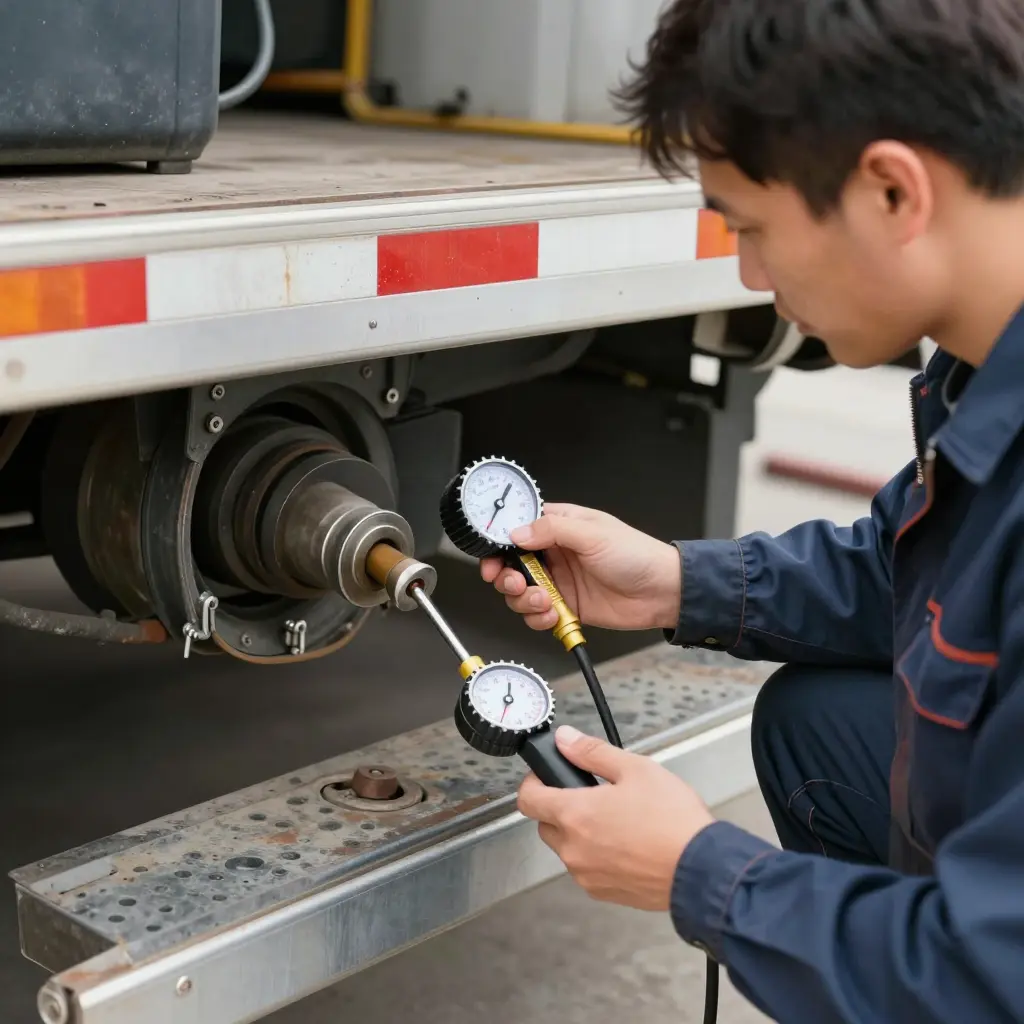
Introduction
Outsourced trailer service is the inspection, maintenance, and repair work that shops, fleets, and third-party providers handle on trailers they may not own or see every day. Two measurements decide whether that work is done right: an air leak-down test, which shows how fast a trailer’s air brake system loses pressure, and pushrod travel, which shows whether each brake chamber applies inside its legal stroke limit. Skip either one before sign-off and the risk leaves the bay with the trailer.
When a trailer rolls out without those numbers verified, liability spreads to everyone in the chain, from the shop that released it to the fleet that dispatched it. Writing both results down leaves an objective record of the trailer’s condition at handoff. That record is what protects the shop, the fleet, and the service provider if questions come later.
The rest of this article covers how to read air leak-down and pushrod travel results, what the numbers mean, and how to fold them into a consistent sign-off process. It also connects to the broader shift in how private fleets approach trailer maintenance.
Running the air leak-down test correctly
Run the test the same way every time so one reading can be compared with the next.
- Charge the system to governor cut-out. Run the engine until the compressor builds full pressure and the governor cuts out.
- Shut off the engine. Switch it off and release the service brake.
- Let the system settle. Wait a full minute before reading anything so the pressure can stabilize.
- Measure the drop over a timed window. Watch the gauge for a set interval, usually one minute, and record the service-side and parking-side readings separately.
Reading the result
Read the pressure drop on both sides of the system, and note which condition you are testing. With the service brake released, a single vehicle should lose no more than 2 psi in a minute; a tractor-trailer combination gets up to 3 psi. With the service brake fully applied, the limits are 3 psi for a single vehicle and 4 psi for a combination. Anything above those numbers, or a gauge that keeps falling instead of settling, points to a leak that needs repair.
For a shop that tracks these numbers over time, the readings become a baseline. Log both sides, then compare them with earlier runs. A slow leak shows up as a number that creeps long before it ever fails.
Acceptable vs. failing leak-down rates
Test with the engine off, the system fully charged, and the trailer warm and dry. Let the gauge settle before you start the clock, then hold the reading for a full minute. The out-of-service limits inspectors use depend on whether the brakes are released or applied, and on whether you are testing a single vehicle or a combination.
| Brake condition | Single vehicle | Combination vehicle |
|---|---|---|
| Service brake released | 2 psi/min or less | 3 psi/min or less |
| Service brake fully applied | 3 psi/min or less | 4 psi/min or less |
Anything above the limit fails. The same thresholds apply when you check individual circuits — service, supply/emergency, and parking/spring. In these numbers,
singlemeans the tractor by itself with a terminating plug in the gladhand, andcombomeans a coupled tractor-trailer. A reading over the limit means repair before sign-off, not a note on the work order.
Reading pushrod travel against the limit
A slack adjuster links the brake chamber pushrod to the foundation brake’s S-cam shaft and turns air pressure into the force that applies the brakes. As the linings wear, the adjuster has to take up the extra clearance.
Start the check with the system at full pressure, roughly 90 to 100 psi. With the brakes released, mark the pushrod where it meets the chamber face. Then make a full brake application and measure how far the mark moves. That figure, in inches, is the pushrod stroke, and it has to be compared directly with the chamber’s readjustment limit — the maximum stroke stamped on the chamber or listed in the manufacturer’s data.
Automatic slack adjusters reset themselves during normal braking; manual ones need periodic hand adjustment, a routine that many fleet maintenance programs still build into the PM schedule. When an automatic unit stops resetting within spec, the adjuster is usually a symptom rather than the cause. Look for a deeper mechanical problem.
An overstroke reading means the brake is drifting out of adjustment. Once pushrod travel passes the limit, applied force drops, stopping distance grows, and the vehicle fails a roadside inspection. Out-of-service criteria treat excessive stroke as a defect, so it has to be corrected before you sign off.

Failure points that fail an inspection
A cracked diaphragm is one of the most common reasons a leak-down reading fails. A tear in a chamber diaphragm lets air escape continuously; you may hear a steady hiss and watch the leak rate climb past the threshold. A cracked diaphragm is a mandatory repair.
Worn seals and loose fittings leak steadily and push the leak-down number up. Even a small seal failure at a valve, or a fitting that will not hold at full torque, keeps the circuit from holding pressure. Kinked or chafed hoses restrict airflow and can hide a leak, so replace them rather than bending them back into shape.
Seized slack adjusters and worn foundation brake parts cause overstroke. When an adjuster stops self-adjusting, pushrod travel climbs past the limit. Worn shoes, drums, and S-cam bushings add stroke that no adjustment can remove.
Any of these red flags means the trailer should not be signed off until the defect is repaired and the readings are retested. Write each one down, fix it, and confirm the numbers are back in spec. Keeping up with fleet maintenance trends helps a shop catch these failures earlier, before a trailer ties up a bay.
Pushrod travel: readjustment limit vs. measured stroke by chamber size
Every brake chamber has a readjustment limit — the most pushrod travel allowed before the slack adjuster must be reset. When a measured stroke creeps too close to that line, one hard stop can push the brake out of adjustment and turn a routine inspection into a roadside violation. The chart below plots a typical limit against a sample measured stroke for three common chamber sizes.
[chart]
Notice how the margin shrinks as the chamber gets bigger. A Type 20 at 1.32 in still leaves 0.43 in against its 1.75 in limit — plenty of room. The Type 30 sample, at 1.88 in against a 2.00 in limit, has only 0.12 in left. That narrow margin is exactly what a third-party provider should be documenting, and what you should verify before you sign off on their work.
| Chamber Size | Authorized Readjustment Limit (in) | Sample Measured Stroke (in) | Remaining Margin (in) |
|---|---|---|---|
| Type 20 | 1.75 | 1.32 | 0.43 |
| Type 24 | 1.75 | 1.60 | 0.15 |
| Type 30 | 2.00 | 1.88 | 0.12 |
Those limits are for clamp-type chambers with a standard stroke; long-stroke chambers carry higher limits, so check the stamp on the chamber or the manufacturer’s data before you judge a reading.
When you outsource trailer service, ask for both the measured stroke and the applicable limit on every chamber, not just a pass/fail checkbox. If you are weighing where trailer work fits into a broader maintenance plan, it helps to know where private fleet maintenance is heading so your standards keep pace with the equipment you actually run. A number that climbs between visits is an early warning. A number that sits flat just under the limit is a decision you have not made yet.
When to outsource the check and what to require
Whether to run trailer brake inspections in-house or hand them to an outside provider comes down to volume, equipment, and staffing. Both routes have trade-offs.
Turnaround is usually the deciding factor. In-house checks keep the trailer under your control but tie up a bay and a technician. An outside provider can work through a backlog faster when demand peaks, but you pay for it in scheduling and transport time.
Certification matters too. Your own techs need current air brake endorsements and documented procedures. An outside provider should be able to show that its techs meet the same bar, and fleets that track these requirements often mirror broader maintenance staffing trends.
Put documentation expectations in the agreement. Require measured leak-down results, pushrod travel readings, pass/fail notes, and a signed inspection record for every unit. It protects both sides and makes an audit far less painful.
Money shapes these choices, too. When freight softens and budgets tighten, some fleets consolidate work with fewer vendors, a pattern that has shown up in recent economic trucking trends.
Whichever route you choose, the people doing the work decide the result. Skilled inspectors produce consistent readings on either side of the in-house/outsource line, and training is the difference between a number you can trust and one you cannot.
Recording readings before you sign off
A finished brake inspection record should be detailed enough that another technician could reach the same conclusion from it. Every entry needs the inspection date, the trailer or unit identifier, and how long the system was allowed to settle before readings began.
The record should list the leak-down drop for each circuit and the measured pushrod travel for each chamber. Set every measurement next to its published limit, and close with the pass or fail result.
| Field | What to record |
|---|---|
| Date | Inspection day and time |
| Unit identifier | Trailer or unit number |
| Stabilization time | Minutes held before testing |
| Leak-down drop | Pressure loss per circuit |
| Pushrod travel | Stroke measured per chamber |
| Comparator | Measured value against the limit |
| Result | Pass or fail, with repairs noted |
Why these records matter
Good brake records are what carry a fleet through an audit or a roadside inspection. Numbers you can trace make each trailer service sign-off hold up under scrutiny.
Repeated entries also reveal trends. A chamber that drifts toward its limit from one inspection to the next is planning information, not just paperwork. Keep the records consistent and a single inspection becomes a usable service history that supports repeatable maintenance planning.
Frequently asked questions
How long should a leak-down test take?
Plan on one to two minutes once the system is fully charged and the engine is off. You hold the brake applied and watch the gauge until the reading steadies. Rushing it produces numbers you cannot trust, so let the pressure settle before you start counting.
What pressure drop is acceptable?
It depends on whether the brakes are released or applied. With the brakes released, the benchmark is 2 psi per minute for a single vehicle and 3 psi per minute for a combination. With the brakes fully applied, it is 3 psi for a single vehicle and 4 psi for a combination. A larger drop means a leak that has to be repaired before sign-off, and you should always compare the reading against the tolerance your shop specifies.
Can pushrod travel be read without a gauge?
Yes, a ruler works, but a dedicated brake stroke gauge is faster and more accurate. Measuring by hand is easy to throw off with a bad angle or parallax. For readings that stay consistent across the bay, use the gauge.
How often should leak-down and stroke checks be repeated?
At every preventive maintenance interval, and any time the air system is opened or repaired. Testing on a fixed schedule catches developing faults early, a discipline shared by private fleets that grow through smart maintenance.
Can an outsourced trailer service provider certify the result?
Yes, as long as the provider follows recognized procedures and issues written documentation. Confirm they use calibrated equipment and hand over records you can keep for an audit. A reliable partner makes your compliance job easier, not harder.
The sign-off standard: two readings, one decision
Two numbers make a trailer brake sign-off defensible: the air leak-down result, which shows the system holds pressure through the test period, and the pushrod travel reading, measured against the manufacturer’s limit.
Both have to pass before anyone authorizes the trailer. A clean leak-down cannot make up for excessive rod stroke, and a stroke within spec means little if the system is slowly bleeding air. The sign-off holds only when the two agree.
A structured outsourced trailer service process, backed by clear records, reduces that risk for shops and fleets alike. Dated inspections, documented readings, and consistent thresholds turn a judgment call into a decision someone can check later. Keeping up with trends in trucking maintenance keeps those thresholds realistic as equipment changes.
The rule itself is simple: confirm the leak-down, confirm the rod reading, and release the trailer only when both pass.