

Loading a camper onto a service bed truck is a skill that combines careful planning with the right equipment, particularly for manufacturing, distribution, and retail sectors. Ensuring campers are securely loaded contributes to the overall success of logistics operations, enhancing both safety and efficiency in their transport. This guide provides a detailed understanding of the loading process, including preparation, the right equipment and techniques, and securing loads for transport. Each chapter builds upon the knowledge necessary for successful loading, allowing professionals in various industries to effectively manage their camper transport needs.
From Ground to Bed: A Practical Path to Loading a Camper onto a Service-Body Truck

Loading a camper onto a service-bed truck is a task that tests both planning and restraint. It isn’t simply about lifting a heavy shell onto a platform; it is about translating a weighty objective into a controlled sequence where safety, weight distribution, and vehicle limits guide every move. The moment you step into that planning mindset, you begin to see that success hinges on more than a winch and a ramp. It hinges on clear expectations, measured risk, and a disciplined choreography that respects the capacities of the truck, the camper, and the road you will travel. Safety signs, level ground, and a calm pace are not optional add-ons; they are the baseline that makes the entire operation possible without damage or danger. The approach that follows is built not merely from a list of steps but from a sense of how force, balance, and friction interact when a rigid, box-like mass moves from the ground into a narrow, defined space within the belly of a service body.
Before you even touch the first strap, the conversation should move toward certainties: what is the camper’s weight budget, what is the truck’s payload margin, and how will the load be secured so that a sudden stop does not become a sudden shift? The payload capacity of a service bed truck is not a vague ceiling; it is a real, measured limit that includes everything on the truck—fuel, water, batteries, tools, and even the ramp system itself. Weight ratings come from the manufacturer, not from a rough estimate. A disciplined operator checks the truck’s payload capacity against the camper’s dry weight and the fully loaded weight. In many yards, the trailer or camper’s Gross Vehicle Weight Rating (GVWR) is the anchor point for the comparison, but the hitch, the bed, and the suspension all contribute to the practical limit. To ignore these numbers is to invite trouble on a bend, a downhill roll, or a crosswind. The safe route begins with a calculator’s attention to numbers and ends with a smoother pull up into the bed.
Compatibilty is not a single checkbox but a spectrum of measurements. Start with the basics: the camper’s length and width must fit within the bed’s footprint, and the height must clear any overhead structures along the planned route. The more muscular the camper, the more deliberate the plan must be. For heavier units, some service beds rely on hydraulic lift gates or integrated winches because manual loading becomes impractical or unsafe. Even with a lift system, the operator’s job is to coordinate the movement with the truck’s controls, ensuring that the camper does not bind on rails, overhangs, or the cab. A practical rule of thumb is to perform a precise weight check on both ends of the bed and to keep the center of gravity near the truck’s axle line. When a camper is off-center, the truck’s handling changes, the tires wear unevenly, and the risk of sway increases in wind or on uneven pavement.
This is where the equipment choice matters. A hydraulic lift gate or a winch provides the controlled vertical motion and steady horizontal alignment needed for larger campers. The lift gate’s job is to lift with a calm, predictable tempo, not to “win” the loading by sheer force. If a ramp is used, it must be anchored firmly, with a non-slip surface and an angle that preserves traction. The recommended ramp angle—typically in the 15-to-20-degree range—offers a balance between a manageable slope and a gentle contact patch that reduces the risk of skidding or buckling. For vehicles with integrated lifting or tie-down systems, use the built-in anchors as the primary restraint points. The underlying principle remains the same: controlled motion, steady tension, and avoidance of any sudden acceleration or deceleration that could jerk the camper or the truck.
As the vehicle begins to move, the moment of truth arrives: securing the camper inside the bed before it becomes a rolling projectile. The security plan begins with high-strength ratchet straps rated well above the anticipated load. A typical minimum is at least 1,000 to 1,500 pounds of working strength per strap, attached to trusted anchor points on the camper frame and the truck bed. The goal is to create a taut, even restraint that prevents shifting in any direction. Anti-slip mats or rubber pads under the camper are not cosmetic add-ons; they prevent micro-movement that could produce scrapes during transit and further reduce the risk of the camper sliding on a slippery bed. Padding also protects both surfaces from wear that, if left unchecked, would become a bigger problem over time.
The balance of the load is not a matter of vanity; it is a matter of vehicle dynamics. A centered load keeps the vehicle predictable in corners and on uneven pavement. If the camper is heavy and long, the temptation to shift weight forward or backward must be checked with deliberate lashings and, where possible, a light forward bias that keeps weight near the front axle without lifting the rear. This is not the same as cramming weight forward to “pull” the hitch. It is a careful distribution that respects the truck’s suspension and steering geometry. In practice, this means distributing the weight across the bed so no one point bears an excessive portion of the load. It also means checking that tie-downs do not collide with the truck’s cab, window lines, or any cab accessories. A single misstep—an anchor point too close to a corner, or a strap that runs diagonally across a strutted surface—can create uneven tension that compromises stability on the highway.
Before the journey begins, a thorough sweep of the workspace is essential. This includes confirming that hazard signs are in place and hazard lights are activated. The loading zone should be level, free of debris, and clear of bystanders. This is not a ritual of form but a practical shield against missteps that can occur even in familiar spaces. A quiet, methodical approach reduces the chance of hasty decisions—decisions that often lead to rushed drives, misrouted straps, or missed obstructions.
In keeping with a broader sense of fleet responsibility, the load’s management is not solely the operator’s concern. For fleets that maintain multiple service trucks and routinely carry large campers, the maintenance and trending of the loading system matter. One way to frame this is to consider private fleets’ maintenance trends. These trends reflect how serious operators invest in lift gates, winches, and bed protection to reduce downtime and extend equipment life. The pattern is simple: inspect, test, and document. Inspect the lift or ramp for wear or corrosion; test the winch under load conditions before a real loading; document strap wear and anchor integrity after each use. A well-run cycle of inspection and testing yields a safer operation and longer equipment life. For teams that manage such fleets, this ongoing discipline translates into fewer surprises and more predictable performance in the field. See how these maintenance practices are evolving in private fleets to understand the larger context of safe, reliable loading operations.
The actual step of bringing the camper onto the bed becomes almost ceremonial after the preparation. The operator must remain calm, focused, and patient. The vehicle’s engine should be used not to force the camper but to provide a steady, controlled motion that respects the load’s inertia. If a winch is employed, the operator watches the line closely for any fraying or a sudden snag and responds with measured adjustments. If ramps are used, the guides accompany the camper, maintaining a gentle, even pace to prevent tipping. The moment the camper sits squarely in the bed, the securing sequence begins in earnest: tighten each strap evenly, verify axle contact, and re-check the bed’s anchor points. A common mistake is to assume that once the camper is on the bed, the job is done. In truth, the securing process continues until the vehicle is on the road. It is the final step—and perhaps the most overlooked—that prevents surprises during transit.
The final checks are a ritual of confirmation. Everything must move with the vehicle as a single unit. The straps should be taut but not over-tensioned, which could damage the camper frame or the bed anchors. The chocks should remain in place until the moment you are ready to depart, at which point you remove them in a controlled sequence. The bed should be clean, and the camper should be centered so that no edges protrude past the bed’s boundaries. The tires of the truck and the camper should be checked for proper inflation, and the lights and reflectors must function if you are towing or if lighting is required by local regulations. The travel plan—speed, route, and anticipated stopping points—should be reviewed with the driver if multiple personnel are involved. A well-documented plan reduces the chance of miscommunication and ensures that everyone knows when and how the load will be secured and released for unloading at the destination.
All of these steps converge into a single, practical philosophy: loading a camper onto a service-bed truck is not an isolated mechanical act. It is a system of checks, balances, and controlled movements that honors the weight of the camper, the capabilities of the truck, and the safety of everyone involved. The process rewards patience, accuracy, and a clear mental map of how forces will interact as you move from ground to bed and, eventually, from bed to road. The truck’s payload capacity, often expressed as the maximum legal load that the truck can carry, is not a mere statistic; it is a boundary that defines what is possible and safe. In many contexts, the payload of a service-bed truck can range from 1,500 to over 3,000 pounds, depending on the chassis and configuration. Heavier campers require heavier, more carefully managed loading systems and more robust securing practices. Lighter, compact campers may still benefit from ramps and manual guidance, but even there the same principles apply: controlled motion, secure restraints, and thoughtful weight distribution.
The aim of this chapter is to render the loading sequence into a shared sense of certainty rather than a reliance on improvisation. That clarity arrives not only from following the steps but from understanding the why behind them. Why use a lift gate? Because it moves weight in a controlled vertical path and reduces the risk of slippage. Why pair anti-slip mats with straps? Because the combination limits movement and protects the surfaces. Why balance the load across the bed and the axle line? Because it preserves handling and minimizes tire wear. Why perform final checks at the door and along the road? Because small oversights become large problems at highway speeds. These are not abstract pluses; they are practical guardrails that keep people, equipment, and cargo safe.
In the context of broader industry practices, this approach to loading a camper onto a service bed truck aligns with a culture of careful planning and routine maintenance. The process is simpler and safer when the truck bed is designed with integrated lifting or tie-down points, and when the operator treats loading as a regular, repeatable operation rather than a one-off challenge. The value of a routine, well-practiced loading sequence extends beyond the immediate task. It reduces wear, lowers the risk of damage, and improves overall fleet reliability. It also allows the team to anticipate and manage risks in more complex scenarios, such as when the camper contains water tanks that increase mass or when the bed must be kept clear for other tasks. The ability to adapt the loading plan to different camper sizes without compromising safety is a hallmark of a mature, professional operation.
As you close the loop on this loading exercise, consider the broader implication for road safety and fleet efficiency. The National Highway Traffic Safety Administration offers official safety guidelines that reinforce the need for proper load distribution, secure tie-downs, and awareness of dimensions when transporting campers and other large loads on utility trucks. The practical takeaway is straightforward: do not treat loading as a temporary hurdle but as a standardized, safety-focused activity embedded in daily operations. For leaders and operators, this means documenting procedures, training staff, and regularly revisiting the load securing standards to reflect evolving equipment and regulations. In other words, a disciplined approach to loading turns a potentially hazardous task into a safe, routine operation that keeps your crew, your cargo, and the public safer on every mile.
For fleet-conscious readers who want to explore a broader perspective on ongoing maintenance and reliability, consider the evolving practices in private fleets. These fleets increasingly emphasize proactive maintenance of lifting devices, tie-down anchors, and bed protection to minimize downtime and extend equipment life. A single, well-executed loading sequence can be a cornerstone of a broader system that values durability, safety, and efficiency. To deepen your understanding of related safety standards and guidelines, see the National Highway Traffic Safety Administration resource on campers and related vehicle types. It provides authoritative, up-to-date information on load distribution, securing, and best practices for transporting recreational vehicles on service trucks: https://www.nhtsa.gov/vehicle-type/campers
In summary, preparing to load a camper onto a service-bed truck is a disciplined, numbers-aware, and safety-first process. It blends practical physics with real-world procedures, and it rewards those who plan, measure, and execute with care. The goal is not simply to clear a height clearance or to move a heavy object onto a bed; it is to move that object safely, securely, and with a level of confidence that only comes from meticulous preparation and steady, practiced execution. When this approach is adopted as a habit across a fleet, the payoff is clear: fewer scrapes, fewer near-misses, and more predictable, reliable service across a wide range of conditions and cargo configurations. And as the industry continues to evolve with new demands and new equipment, the core principle remains steadfast: safety, accuracy, and deliberate action are the foundation of every successful camper loading operation on a service body.
For readers seeking deeper context on fleet maintenance trends and its relevance to daily operations, a relevant exploration can be found in discussions about private fleets’ maintenance practices, which highlight how planned checks and routine equipment updates contribute to safer loading and transport routines. This broader lens helps connect individual loading steps to the larger discipline of risk management in moving heavy, irregular cargo. To reinforce standard safety practices for road transport, refer to the official guidelines cited above.
Safe Loading Practices for Camper on a Service Bed Truck
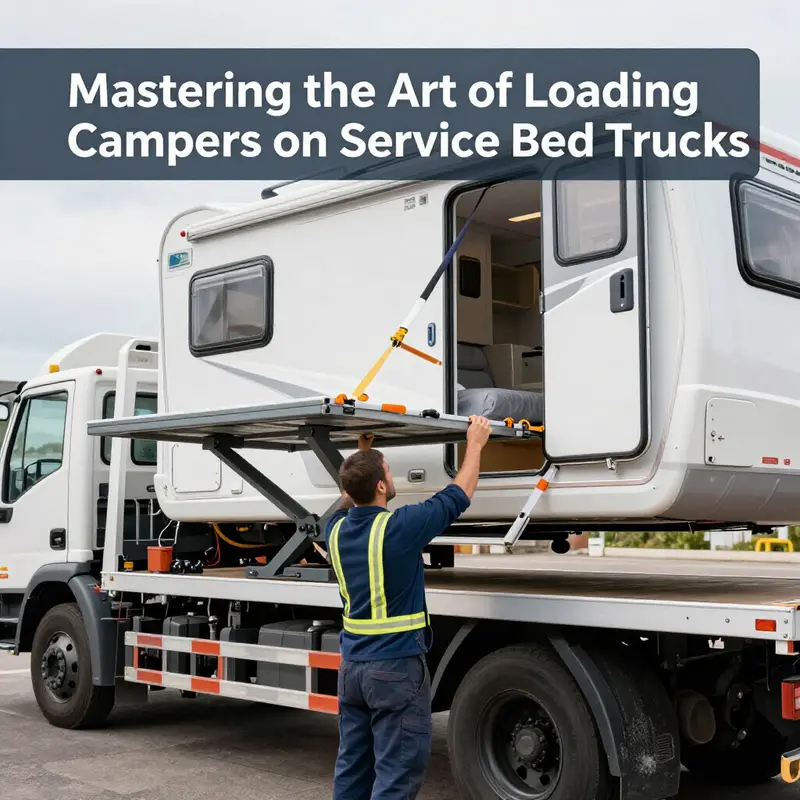
Loading a camper onto a service bed truck requires planning, patience, and attention to detail. This guide outlines a safe, repeatable sequence to bring the unit from ground to secured transport while protecting people and equipment. Start with a level work area, clear of bystanders, and with warning signals in place. Inspect the service bed for damage and verify payload capacity matches the camper’s weight, including fuel, water, gear, and the hitch or tongue weight. Confirm bed width and length accommodate the camper footprint and allow clearance from cab, tailgate, and overhang. If width is near the limit, use a spotter to help with alignment and prevent side contact. Equipment selection matters: ramps wide enough for tires, a winch or lift system with a safe working load well above the camper weight, sturdy tie-downs, chocks, and anti-slip mats. Use multiple attachment points to distribute load and test movement before lifting.
With equipment in place, perform a controlled lift. If using a winch, keep the line taut and move slowly, guiding the camper toward the bed edge. If a hydraulic lift gate is available, position the camper so that the lift line travels unobstructed and the center of gravity remains aligned with the vehicle. Keep hands and clothing clear of pinch points and never rush the lift. Once the camper rests on the bed, secure it with rated straps or chains anchored to designated bed points. Tighten gradually, checking that load remains centered and that the straps do not contact sharp edges. Place wheel chocks and anti-slip mats as needed to prevent any movement during securing. Perform a first drive test at low speed to verify there is no shifting, rubbing, or contact with the cab, bed sides, or tailgate.
Finally, complete a checklist: verify strap condition and anchor integrity, inspect tires and lights on the camper if applicable, and confirm no clearance problems at the tailgate or rear overhang. Recheck tension after a short drive, and adjust as necessary. Adopt a standard protocol for every load to ensure consistency and safety across crews and vehicles. For fleets embracing mechanization, lift gates and power-assisted ramps can reduce physical strain and improve repeatability, provided maintenance keeps the equipment reliable. Industry guidelines from the RV Industry Association offer further references for securing methods and load distribution that complement these steps. This structured approach helps ensure the load remains stable from the moment the camper leaves the ground until it is safely en route to its destination.
Loaded Right and Traveled Safe: Mastering Secure Mounting, Weight Balance, and Driving with a Camper on a Service Bed Truck

When a camper sits atop a service bed truck, the act of moving it from shop floor to road is as much about engineering and psychology as it is about brute strength. The service body, with its built-in cargo area and anchor points, changes the dynamics of a standard pickup bed. The low center of gravity inside a traditional truck bed can be a help, but a camper introduces height, wind loading, and a new distribution of mass that demands deliberate planning. The goal is not merely to get the camper into the bed, but to secure it so it behaves like a single, well-balanced vehicle on any highway, highway shoulder, or backcountry grade you might encounter. This chapter threads safety, mounting philosophy, weight management, and driving discipline into one cohesive practice. It is a continuity of the load-first mindset that proves its value long after the strap is cinched tight and the engine is fired up. The steps echo the same discipline common to moving heavy loads on any specialized truck configuration, yet they are tailored to the nuances of a camper sitting on a service bed. A careful sequence from mounting to driving ensures the work truck serves you as a stable platform rather than an unpredictable liability on the road. Before the journey begins, the most important decision is to treat weight and balance as a system problem, not as a string of independent tasks. The aim is to align the camper’s weight with the truck’s payload capacity and to keep the center of gravity as low and centered as possible. This is not just about following a rule; it is about preserving steering feel, braking response, and the confident handling you expect from a truck that already carries heavy equipment. The principles are straightforward, but their execution requires attention to detail and a calm, methodical pace that refuses to rush even when schedules tighten. Every trip becomes a test of how well the system is engineered and how well you anticipate changes to the load as fuel, water, and gear shift during the journey. In practice, that means choosing mounting methods that match both the camper’s geometry and the truck bed’s contours, securing every tie-down point with redundancy, and verifying that the final configuration respects the vehicle’s GVWR and payload rating. A practical starting assumption is to treat the installation as if you were adding weight to the front axle only, or to the rear, depending on the camper’s placement, and then to adjust with ballast or load distribution measures. To do this well, you need a clear sense of the camper’s weight and how it interacts with the truck’s inherent weight. The camper’s weight is not the only figure to consider. Fuel, fresh water, propane, tools, spare parts, and even passengers all contribute to the total mass the vehicle must handle. The more accurate your estimate, the better you can plan for safe acceleration, stable braking, and predictable cornering. The mount itself is a heartbeat of the system. It must be robust, corrosion-free, and specifically designed for service bed trucks. You may encounter several mounting configurations: bracket-based systems that bolt directly into the bed or hitch-based assemblies that offer adjustability and easier removal. Sliding rails can be especially valuable for overhead campers, which ride over the cab and change the truck’s weight distribution differently than a traditional bed camper. The recommendations are not vague. They emphasize compatibility, structural integrity, and secure, manufacturer-recommended mounting hardware. Your inspection should confirm that the bed is not cracked or warped, that all mounting points are unobstructed, and that installation hardware is clean, properly torqued, and free of corrosion. When overhead campers are involved, the stakes rise because the roof structure of a truck is not typically reinforced for additional vertical loads. In this situation, a professional assessment of the roof’s ability to support the extra weight, or a reinforcement plan, may be required. This is not optional; it is a safety-critical decision. The same careful approach extends to pop-up or slide-in campers, where the install must be precise enough to prevent any shifting during transit. Once the mounting base is in place and you’ve verified the truck’s payload capacity is comfortable for the planned load, the next layer of certainty comes from secure tie-down points. The camper should have purpose-built tie-down anchors or rails that align with the truck bed’s anchor grid. Ratchet straps or heavy-duty chains with proper tensioning devices should be used, and there must be redundancy—more than one good path for restraint, so a single failed strap does not release the load. Using anti-slip mats or rubber pads under the camper helps prevent sliding on a steel bed, which could otherwise translate micro-movements into a large shift during a corner or bump in the road. The more you can do to keep the camper stationary relative to the bed, the less work the vehicle’s suspension and tires must do to compensate for movement. The weight distribution dimension cannot be overstated. A well-balanced setup features the weight as close to the bed’s center as possible and, ideally, slightly lower than typical payload mass to avoid a high center of gravity. The goal is steady steering, consistent braking, and a predictable response to steering input. Weight distribution tools such as weight-distributing hitches or stabilization systems can help maintain a calm ride, particularly on rough roads or sweeping curves. The more you know about how the camper shifts mass with fuel consumption and water use, the better you can plan for the trip. In this light, a practical habit emerges: perform a post-loading check that mirrors a pre-trip inspection. Re-check every strap, anchor, and connection, and pay attention to any changes in the camper’s position after driving a short distance or negotiating a speed bump. When road conditions change, so can the load’s behavior. The driver must become a steward of weight integrity, not only someone who signs off on the initial setup. Driving dynamics shift in unsettling but manageable ways when a camper is mounted on a service bed. The truck becomes longer, higher, and noisier in terms of wind. Aerodynamic drag increases, contributing to fuel consumption and altering stability at speed. The extra length can complicate lane changes, and the height of an overhead camper can reduce clearance in bridges and gas stations with low canopies. The added vertical load can also affect the truck’s roll stiffness and suspension travel. In practice, this translates to a deliberate, restrained driving style. Plan your overtakes and lane changes with extra room. Maintain longer following distances so your braking margins accommodate the heavier, taller rig. Hills and curves require even more careful throttle control and speed management to avoid unsettling sway, particularly on uneven pavement or during gusty conditions. The vehicle’s braking system is now tasked with a greater demand. Practically, that means inspecting brakes more frequently, ensuring the wheels and tires wear evenly, and confirming the hitch or mounting system remains under uniform tension. A preventive mindset—checking bolts, latches, and seals before every trip—becomes part of routine rather than a special effort reserved for long-haul or off-road scenarios. The camper, by design, stores water, fuel, and gear, all of which contribute to mass and, in turn, to momentum. When planning a trip, you should factor these variables into your shift points. Sudden maneuvers or aggressive throttle input can produce load shifts that challenge the driver’s control. The responsible approach is to favor smoothness: slow, progressive acceleration, gentle deceleration, and careful, predictable cornering. A calm driving style, married to a well-engineered mounting system, translates into a safer ride and reduced risk of damage to the truck bed, camper, or road furniture. Beyond the mechanics of loading and driving, the ongoing duty of care remains central. Vehicles left in transit require occasional checks. If you must stop for a rest or for fuel, re-tension straps when you resume travel, and perform a quick visual inspection of every anchor point. If possible, make a habit of a mid-trip check when you’re traveling through rough terrain or encountering strong winds. The goal is to maintain a predictable, stable platform so that the camper becomes an integrated part of the truck rather than a separate load that tells you when it’s time to slow down. The discipline surrounding this practice is not merely about following a set of rules; it’s about building confidence. Confidence comes from knowing your mounting system can handle the worst a road can throw at it, from understanding how the weight distributes through the chassis, and from experiencing how the vehicle responds to careful, patient driving. There is value in learning from broader industry practices, particularly in the private fleets space where maintenance and load management are continuous competencies. For context, consider the ongoing discussions around maintenance trends in trucking, which illuminate how seasoned operators approach load security, inspection routines, and system redundancies on a daily basis. Private Fleets Trends in Trucking Maintenance. While the realities of a service bed truck differ from those of a straight box or a dedicated trailer, the underlying principle holds: design, test, verify, and rehearse. In other words, treat the camper as a mature, integrated element of the vehicle system rather than a separate burden you must keep from moving. The most effective practice you can adopt is a formal, repeatable loading and driving protocol. It begins with a precise inventory of weight, dimensions, and mounting compatibility. It proceeds with a physically secure mounting method that aligns with the camper’s geometry, and then continues with an explicit plan for weight distribution, tie-down tensioning, and road-handling checks during the journey. The protocol ends with a disciplined return to the shop or yard, where the load is decommissioned, reinspected, and archived for the next deployment. In sum, the art of loading and driving a camper on a service bed truck is a careful balance of engineering and stewardship. You respect the weight, you verify the strength of the mounting, you plan for how the mass moves through space, and you drive with the awareness that safety is a moving target—adjusted by weather, road quality, and the ever-changing load in your bed. When done right, the camper becomes a stable, predictable extension of the truck. The road becomes a platform for confidence rather than a test of nerve. The work is never one-and-done; it is a sequence of deliberate actions that, over time, becomes second nature. For readers who want to explore broader industry practices as they plan their own mounting and transport protocols, the public-facing guidelines from national safety authorities offer a solid reference point and a reminder to stay aligned with established standards. External safety standards and guidelines provide a broader frame for the operational decisions described here. For detailed diagrams, safety standards, and manufacturer guidelines on loading campers onto trucks, refer to: https://www.nhtsa.gov. This official source offers load distribution guidance and best practices for transporting recreational vehicles, including campers on service trucks and other utility platforms.
Final thoughts
Successfully loading a camper onto a service bed truck hinges on meticulous preparation, correct usage of loading equipment, and ensuring each load is secured comprehensively. By following the guidelines outlined in this article, businesses can streamline their logistics operations while enhancing safety during transportation. A thorough understanding of these processes not only mitigates risks but also boosts operational efficiency, making a significant difference in logistics and distribution.