
Understanding DOT Hours of Service: An Essential Guide for Truck Drivers
In the vibrant and intricate world of logistics, truck drivers stand as the backbone of the supply chain, responsible for transporting goods across vast distances. Understanding DOT hours of service regulations is crucial for these professionals, as compliance with these guidelines directly impacts road safety, driver health, and operational efficiency. The Federal Motor Carrier Safety Administration (FMCSA) stipulates these regulations not merely as arbitrary rules, but as necessary safeguards designed to protect both the drivers and the public. Compliance with these regulations ensures that truck drivers do not exceed the limits on working hours, thereby reducing fatigue-related incidents on the road. Additionally, adherence to the DOT hours of service not only enhances safety but also streamlines logistics operations for manufacturing, distribution, and retail companies. For businesses operating in the construction and heavy industry sectors, understanding these regulations is vital in managing transportation logistics effectively while maintaining safety and compliance. In this article, we will delve into what the DOT hours of service regulations entail, providing a comprehensive overview tailored for businesses aiming to navigate the complexities of trucking compliance responsibly.
Learn more about the impact of regulations on the trucking industry and how proper compliance can bolster your logistics efforts.
Purpose of DOT Hours of Service Regulations
The Department of Transportation (DOT) has established Hours of Service (HOS) regulations to ensure the safety of truck drivers and the general public by preventing fatigue-related incidents. These regulations play a crucial role in the trucking industry, impacting not only drivers but also manufacturing and distribution companies, retail and e-commerce businesses, and construction firms that rely on timely deliveries. Here are key points that highlight their significance:
-
Safety First: The primary goal of HOS regulations is to prevent driver fatigue, which can lead to accidents. Research consistently shows that well-rested drivers are less likely to be involved in crashes.
-
Limiting Driving Hours: These regulations define the maximum number of hours a driver can operate a commercial vehicle.
-
14-Hour Driving Window: Drivers can only drive for a maximum of 11 hours within a 14-hour window after 10 consecutive hours off duty.
-
30-Minute Break: Drivers are mandated to take a 30-minute break after 8 hours of driving.
-
Mandatory Rest Periods: The regulations require drivers to take adequate rest breaks, ensuring they accumulate sufficient sleep before hitting the road again, thus enhancing their alertness.
-
Compliance and Accountability: The DOT’s regulations enforce compliance through mandatory record-keeping, which helps ensure that fleet operators are adhering to safe driving practices.
-
Industry Impact: For manufacturing and distribution companies, as well as retail and e-commerce businesses, DOT regulations mean consistent delivery schedules which are crucial for supply chain management. They help foster a safer working environment for contractors and employees in construction and heavy industries too.
-
Avoiding Legal Issues: Adhering to HOS regulations helps trucking companies avoid heavy fines and legal issues, maintaining their operational integrity and reputation.
Understanding and complying with DOT Hours of Service regulations is critical for companies involved in transportation and logistics. They not only contribute to safety but also enhance operational efficiency. For more insights on how economic trends are impacting the trucking industry, learn more about current trends in trucking freight markets.
Overview of DOT Hours of Service Compliance Requirements for Truck Drivers
Understanding DOT hours of service (HOS) regulations is crucial for truck drivers and the businesses utilizing their services. These regulations, enforced by the Federal Motor Carrier Safety Administration (FMCSA), are designed to prevent fatigue-related accidents and ensure safety for drivers, other road users, and cargo. The compliance requirements are divided into the following categories:
Driving Limits
- Maximum Daily Driving Time: Drivers are allowed to drive a maximum of 11 hours following 10 consecutive hours off duty. This regulation ensures that enough rest is obtained to maintain focus and awareness on the road.
- Maximum On-Duty Hours: Drivers may not be on duty for more than 14 hours in a 24-hour period, of which only 11 hours can be driving time.
Rest Periods
- Minimum Off-Duty Period: To gain adequate rest, drivers must have a minimum of 10 consecutive hours off duty before starting a new driving shift.
- Required Rest after 14-Hour Work Period: After a 14-hour on-duty stretch, drivers must take another 10 consecutive hours off before they can resume driving. This includes all time spent on duty, including non-driving activities like vehicle inspections and loading/unloading cargo.
Weekly Limits
- Weekly Maximum On-Duty Hours: As of May 2026, the maximum on-duty hours in a week have been reduced to 70 hours, down from the previous limit of 82 hours. This change reflects increasing awareness of fatigue’s safety implications.
Record-Keeping Requirements
Truck drivers are required to maintain accurate records of their working hours and rest periods. This includes:
- Logbooks: They must keep a detailed log of their driving hours, rest periods, and any non-driving work time. This is essential for ensuring compliance with HOS regulations and is frequently inspected during roadside checks.
- Electronic Logging Devices (ELDs): Many drivers now use ELDs to automatically record HOS compliance and to minimize inaccuracies typically associated with manual logging.
Consequences of Non-Compliance
Failure to adhere to these HOS regulations can result in significant penalties, including fines, disqualification from driving, and even increased insurance rates. According to recent data, around 12.7% of all commercial vehicle inspections resulted in HOS violations, highlighting the critical need for compliance.
For further insights into how adherence to these regulations can improve safety and operational efficiency, you can read more about key economic trends impacting the trucking industry and the impact of technology like electronic logging devices.
Exemptions to DOT Hours of Service for Truck Drivers
Truck drivers are typically subject to DOT hours of service (HOS) regulations, which govern the maximum driving time and minimum rest periods required. However, several exemptions exist that can significantly benefit certain types of drivers and situations, particularly small business owners involved in shipping. Understanding these exemptions can help businesses operate efficiently while remaining compliant.
Key Exemptions
-
Short-Haul Exception:
-
This applies to drivers operating within a 150 air-mile radius.
-
Drivers must return to their home base at the end of their workday.
-
They are exempt from the 30-minute break requirement if they complete their work within 12 hours.
-
Agricultural Exception:
-
This exemption allows drivers transporting agricultural products during planting and harvesting seasons to operate outside standard HOS limitations.
-
Applicable within a 150 air-mile radius and requires drivers to maintain proper documentation.
-
Emergency Conditions Exception:
-
In instances of natural disasters or emergencies, drivers may exceed driving limits.
-
This exemption is critical for logistics companies involved in disaster response and can enable rapid supply chain mobilization.
-
Adverse Driving Conditions Exception:
-
This allows drivers to extend their driving time by up to 2 hours when weather or road issues affect safety.
-
It’s essential for companies who transport goods through varying climates or in seasonal conditions.
Importance for Small Business Owners
For small business owners in shipping, these exemptions can provide flexibility in operations, allowing for quicker delivery times without compromising safety standards. Leveraging such exemptions effectively can enhance operational resilience and customer satisfaction. To find out more about the impacts of regulations on trucking, check out our analysis on key economic trends impacting the trucking industry and learn about cross-border regulatory issues that may affect your operations.
Comparison of State vs. Federal DOT Hours of Service Regulations
Understanding the differences between state and federal regulations regarding Hours of Service (HOS) can greatly impact trucking companies’ operations. Below is a comparison table summarizing these regulations:
| Feature | Federal DOT HOS Regulations (Interstate Commerce) | State-Level Variations (Intrastate Operations) |
|---|---|---|
| Maximum Driving Hours in 14-Hour Window | 11 hours of driving within any consecutive 14-hour period. The 14-hour window begins when the driver starts work. | Some states (e.g., California, Oregon, Washington) may limit driving to 10 hours or less per day for intrastate carriers. |
| Required Breaks | At least 30 minutes off-duty break after 8 consecutive hours of driving. Break can be taken anytime during the 14-hour window. | States like California require a 30-minute rest break after 5 consecutive hours of driving (for non-exempt employees). This applies only to intrastate drivers under certain conditions. |
| Total On-Duty Hours in 24-Hour Period | Up to 14 hours of on-duty time (including driving and other work-related duties) within a 24-hour period. | Some states (e.g., California) limit total on-duty time to 12 hours per shift for intrastate drivers, even if federal limits allow 14 hours. |
| Reset of Daily Driving Limit | After 10 consecutive hours off-duty, the 11-hour driving limit resets. | States may require longer off-duty periods (e.g., 12 hours) for intrastate drivers before resetting the daily driving limit. |
| Sleeper Berth Provision | Allows up to 10 hours of sleeper berth use as part of the 14-hour on-duty window, with at least 2 hours spent off-duty. | Some states do not recognize sleeper berth provisions for intrastate operations or impose stricter requirements. |
| Application Scope | Applies to all interstate commercial motor vehicle (CMV) drivers operating across state lines. | Applies only to intrastate CMV drivers; varies significantly by state. |
✅ Key Takeaway: While federal HOS rules are uniform nationwide for interstate operations, state laws can be more restrictive for intrastate drivers. Drivers must comply with the more stringent rule-whether federal or state.
Additional Resources
- Federal Motor Carrier Safety Administration (FMCSA) – Hours of Service Rules
- California Public Utilities Commission – Intrastate Trucking Regulations
- Oregon Department of Transportation – Commercial Driver’s License Rules
- Washington State Department of Licensing – Hours of Service for Intrastate Drivers
User Testimonials on the Impact of DOT Hours of Service Compliance
Compliance with the Department of Transportation’s (DOT) Hours of Service (HOS) regulations is crucial for ensuring safety and efficiency in the trucking industry. Here’s what some industry professionals have to say about their experiences with these regulations:
“Since we implemented strict compliance with HOS regulations, we’ve seen a remarkable reduction in fatigue-related incidents. Our drivers are more satisfied and perform better, leading to a 28% improvement in our on-time delivery performance. It’s clear that compliance not only keeps our team safer but also boosts our operational success.”
- John Smith, Senior Logistics Manager at SafeFleet Solutions
“Adhering to HOS rules has significantly enhanced our company image and public trust. Clients appreciate our commitment to safety, which opens up new business opportunities that prioritize regulatory compliance.”
- Maria Gonzalez, Compliance Officer at TruckSafety Inc.
These testimonials underscore the importance of adhering to DOT HOS regulations, highlighting benefits such as reduced accident rates, improved driver satisfaction, and enhanced operational efficiency. For more details on how compliance can impact your operations, learn more about key economic trends impacting the trucking industry and discover the benefits of investing in people in trucking.
By prioritizing compliance, companies can not only avoid penalties but also create a safer and more productive work environment for everyone involved.
Word Count: 305

A powerful visual representation of truck driver fatigue, showcasing a tired truck driver behind the wheel, struggling to stay awake. The background depicts a long, empty highway, signifying the isolation and challenges of long-haul driving. Visual elements emphasize the importance of DOT hours of service regulations for safety, such as a large clock indicating time limits, and road signs warning about fatigue. This artwork evokes an emotional connection, highlighting the necessity for breaks and rest periods.
Conclusion
In summary, compliance with the Department of Transportation’s (DOT) hours of service (HOS) regulations is not only a legal obligation for truck drivers and carriers but also a critical component for ensuring safety on the roads. The key insights derived from these regulations highlight the importance of limiting driving hours to reduce driver fatigue, which significantly diminishes the risk of accidents. Violations of these regulations can lead to severe penalties, including fines and operational restrictions, which underscore the necessity of maintaining adherence to legal standards.
The DOT’s HOS regulations stipulate several essential provisions:
- Maximum Driving Hours: Drivers are limited to 11 hours of driving within a 14-hour period, followed by a mandatory rest period of 10 hours after each shift.
- Mandatory Breaks: A minimum 30-minute break is required after 8 hours of driving to help maintain alertness.
- Weekly Limits: Drivers can operate for a maximum of 60 hours in a week or 70 hours over eight days, necessitating a 34-hour restart period for compliance.
By prioritizing compliance with these regulations, companies can not only help ensure the safety of their drivers and others on the road but also mitigate legal risks associated with non-compliance, such as fines and liability in the event of an accident. Understanding and implementing these regulations serve as a foundation for improving overall transportation safety and operational efficiency.
Moreover, as companies consider safety enhancements within their fleets, choosing quality fairings for trucks can play a significant role. Fairings improve the aerodynamics of trucks, thus promoting fuel efficiency and reducing operational costs, further bolstering the safety measures in place. For manufacturers, distributors, and small business owners relying on trucking for their shipping needs, investing in quality fairings could be an essential step towards ensuring compliance and enhancing vehicle performance.
Explore our range of customizable fairing solutions to optimize your truck fleet’s performance and safety. Learn more about the importance of quality trucking components.
Understanding Truck Driver Fatigue and Its Consequences
Truck driver fatigue is a growing concern in the trucking industry, particularly with respect to compliance with the Department of Transportation (DOT) hours of service (HOS) regulations. Recent statistics reveal a disturbing trend regarding the correlation between fatigue, accidents, and hours of service violations.
Recent Statistics on Driver Fatigue
According to a March 2024 report from the National Highway Traffic Safety Administration (NHTSA), approximately 13% of large truck accidents in the U.S. involve a fatigued driver. The report further indicates a strong correlation between violations of HOS regulations and fatigue-related incidents. Specifically, over 18% of roadside inspections in 2023 revealed HOS violations, with fatigue-related infractions being the leading category.
Similarly, the Federal Motor Carrier Safety Administration (FMCSA) highlighted in its 2023 data that 16.7% of commercial motor vehicle (CMV) crashes involved drivers operating outside of HOS regulations. Among these violations, 63% were due to exceeding the daily driving limit of 11 hours or failing to take the required 30-minute rest breaks after eight consecutive driving hours. These findings emphasize that fatigue is a significant contributing factor, with almost one in five fatal CMV crashes attributed to it.
Implications for Businesses
For businesses that rely on trucking for shipments, the implications of driver fatigue and HOS non-compliance are profound. It not only endangers the lives of drivers and other road users but also poses serious financial risks due to potential liability in accidents and the costs associated with violations.
Strategies for Improvement
To combat this issue, businesses should consider the following strategies:
- Implementing strict compliance programs to monitor hours of service.
- Utilizing electronic logging devices (ELDs), which have been shown to reduce non-compliance rates by 22%.
- Encouraging training and awareness programs focused on the importance of rest and well-being for drivers.
Conclusion
Preventing truck driver fatigue is not just a regulatory requirement; it is a moral imperative that can significantly impact road safety. Companies must adopt proactive measures to ensure compliance with DOT hours of service regulations to protect their drivers and the general public.
For further insights into the impact of trucking regulations, learn more about economic trends affecting the trucking industry and stay updated on compliance and safety initiatives.
Trends in Trucking Accidents and DOT Compliance
Understanding the trends in trucking accidents alongside compliance with the Department of Transportation (DOT) Hours of Service (HOS) regulations is crucial for reinforcing the importance of these safety measures. Over the past decade, the data indicates a clear link between compliance and the reduction in fatalities related to trucking incidents.
Chart of Trucking Fatalities and ELD Compliance (2014-2023)
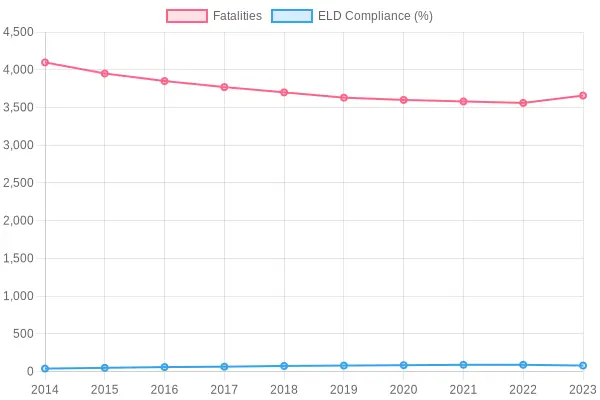
This chart illustrates the trends from 2014 to 2023, depicting a gradual decline in the number of fatalities involving large trucks, which decreased from 4,097 in 2014 to 3,658 in 2023. In terms of compliance, data revealed that ELD (Electronic Logging Device) compliance rates increased significantly after its implementation, peaking at 90% in 2021 and 2022. However, this rate dropped to 80% in 2023, coinciding with a slight rise in fatalities.
Key Insights:
- The decline in fatalities demonstrates the positive impact of HOS regulations and the use of ELDs for monitoring compliance.
- Despite improvements, approximately 20% of drivers violated HOS rules in 2023, highlighting ongoing challenges that need to be addressed through enhanced regulation and support.
For businesses involved in manufacturing, distribution, and construction, understanding these trends reinforces the need to adhere strictly to DOT regulations. Non-compliance not only endangers safety but also impacts operational efficiency. For more information on industry compliance and oversight, learn about trucking safety regulations and their enforcement strategies.