

Navigating the complexities of employee notice periods is crucial for companies reliant on trucking and logistics. For truck drivers, notice periods can vary significantly based on individual contracts, union agreements, and state regulations. Understanding the standard notice requirements, the influence of collective bargaining agreements, and state-specific laws is essential for manufacturing and distribution companies, retail and e-commerce businesses, construction firms, and small business owners with shipping needs. This article delves into these areas, providing a structured overview that informs employers and helps ensure compliance within the industry.
The Turnover Timeline: Unpacking Notice Days for Truck Drivers and Departing Employees

On the open road, timing matters as much as machinery and freight. When a driver decides to leave a job, or when a carrier must adjust its roster, the question of how many days of notice to require before a driver’s last day becomes a practical signal of planning, responsibility, and respect. The answer isn’t a single federal statute etched in stone. There is no universal federal mandate that prescribes a fixed number of days of notice for truck drivers who resign or who are terminated. The reality is shaped by a patchwork of factors: the contract that governs the worker, any collective bargaining agreement in place, and the laws of the state where the driver works. In the United States, at-will employment preserves the general default that an employer or employee can end the relationship at any time, with or without cause, subject to contract and law. Yet within the trucking industry, the norm has settled into a predictable window: roughly thirty to sixty days of notice before an employee’s last day. This window reflects the needs of large fleets and small carriers alike, and the unique cadence of logistics where a single departure can ripple through routes, equipment, and customer commitments. A driver exits not only a seat behind the wheel but also a complex web of shifting schedules, handoffs, and regional time commitments that track across days and weeks. The industry understands that notice serves the need for a clean handover. It buys time for knowledge transfer, reveals the exact moment a shift needs to be reallocated, and allows the administrative apparatus to unwind the payroll, benefits, and equipment assignments with accuracy. When a driver hands in notice, the clock begins for both sides to coordinate a smoother transition, and that coordination, in turn, becomes a measure of professional respect that travels beyond the last miles driven. Within this framework, the chapter on notice periods cannot be a mere recitation of numbers; it must illuminate how those numbers arise from lived practice and from the economic and operational realities of trucking. The 30-to-60-day band is not a universal decree but a corridor that many managers and drivers have learned to navigate. It factors in the time needed to locate a replacement who can operate the same routes, to train that replacement in the specifics of a given fleet’s standards, and to ensure that all required administrative steps—title and ownership transfers for vehicles, access to secure yards, and the proper deactivation of logins and routing systems—can be completed without interrupting service. It is also a reflection of risk management. A longer notice window reduces the risk of a mid-week disruption that cascades into missed deliveries, missed appointments, and penalties. It also helps protect the employer’s ability to honor existing service commitments to clients and to maintain a predictable payroll and maintenance schedule. Yet, unlike a formal schedule for shifts or for overtime, the notice period is a human and contractual instrument. It sits at the intersection where legal obligations meet workforce culture. For union workers, the notice clock often runs on the tempo set by a collective bargaining agreement. In many Teamsters contracts, for example, advance notice is spelled out in terms of termination or unwinding operations tied to major changes, and those agreements can require more specific procedural steps than a standard at-will arrangement would contemplate. In those contexts, the notice may be explicit not simply as a number of days but as a sequence of steps, such as how to communicate a resignation, who approves a transition plan, and what constitutes a proper handover of routes, equipment, and customer accounts. When a driver is covered by a CBA, the notice period might be in the range of two to four weeks, or sometimes up to a month, depending on the contract’s language and the operational needs defined within the agreement. Even where a CBA governs, many carriers adopt a broader internal policy that mirrors the CBA’s spirit while allowing for practical flexibility in day-to-day operations. A carrier may require thirty days of notice for voluntary resignations because that timeframe aligns with the typical recruitment cycle in trucking: posting the vacancy, screening applicants, and arranging a practical overlap where the new driver can ride along or shadow the outgoing one. Some complexes of operations—such as multi-state fleets with cross-border routes, or fleets handling highly specialized equipment—benefit from longer notice periods, say forty-five or sixty days, to ensure that the receivable routes and the most sensitive handoffs are covered with precision. On the flip side, some scenarios encourage tighter timelines. A driver might depart on short notice due to family emergencies, health concerns, or abrupt shifts in personal circumstances. In those cases, employers should still strive for a professional handover, but they often cannot require more than a reasonable notice while honoring legal rights and humane practice. If the company cannot absorb the departure without significant disruption, it may explore options such as expedited training plans, temporary reassignments, or the use of relief drivers to bridge gaps. This is where the operational heartbeat of trucking—its dependence on continuity and reliable schedules—meets the legal framework that governs employment. In parallel with federal labor laws, state law plays a role—though not by dictating a universal notice period, it can shape ancillary requirements around resignation or termination notices, or around the timing of shift changes and layoff notices in specific contexts. California, for instance, imposes a suite of protections around scheduling and notice for certain employment events, but it does not compel a fixed number of days of notice for every termination or resignation. Instead, it emphasizes notice-like protections where relevant to shifts and to other job actions. The broader lesson here is not to chase a precise number as an absolute rule, but to recognize the interplay of contract, union, and jurisdiction. A fleet that operates across state lines will often standardize on a default—say, thirty days for voluntary resignations and thirty to sixty days for organizational changes that affect a significant portion of the driver pool—while also accommodating the particular terms of CBAs and the statutes of any state where they operate. The practical implications of these notice expectations extend into the way a company plans its resources. A well-structured notice period is a governance instrument. It enables fleet managers to schedule truck replacements, align maintenance cycles, and ensure that new drivers are qualified with the necessary endorsements, medical certificates, and logbook compliance training. It allows human resources to prepare final-pay calculations, verify eligibility for benefits continuation or conversion, and finalize equipment transfers. It also creates a predictable flow for customer service teams who must communicate schedule changes to clients and adjust timelines without sacrificing reliability. The psychological and cultural dimensions should not be underestimated. Notice is, in part, a courtesy that reflects an employer’s appreciation for the contribution a driver has made over time. It is also a signal of professional discipline and mutual respect. For the driver, a clear notice window provides room to pursue a legitimate new opportunity with dignity, rather than facing an abrupt end that may complicate future employment and references. For the hiring company, it signals a commitment to continuity and a careful transfer of knowledge. The balance is delicate. If notice is expected but not provided, a company may need to implement interim procedures that safeguard operations, such as designation of a coverage plan, reallocation of loads, or the temporary assignment of a senior driver to supervise a handover with a new hire. If a driver’s departure is precipitated by a layoff or a restructuring, a broader set of notices, such as the federal or state guidelines for mass layoffs and plant closures, may apply. In those contexts, notice requirements can become more formal and legally consequential, emphasizing the need for documentation, timely communication, and compliance with applicable WARN-like provisions. Even within a system of notice windows, the human dimension remains central. Employers should articulate expectations clearly in employee handbooks and in employment contracts where applicable, including any references to notice procedures and the consequences of inadequate notice. For drivers who may be asked to provide longer notice as a best practice, this is not just about risk mitigation; it is also about sustaining a culture of professionalism that keeps teams intact and keeps customers confident in service continuity. Interestingly, the responsibility for managing this terrain often falls to human resources in collaboration with dispatch and operations leadership. HR can help translate the legal and contractual requirements into practical guidelines, while dispatch ensures that the realistic needs of routes and equipment are reflected in the timing and process. A thoughtful approach might include a standard notice period for voluntary resignations combined with a flexible, case-by-case lens for extraordinary circumstances. In other words, the question of how many days prior to departure a truck driver should give notice becomes less about a specific numeric target and more about a framework that binds contracts, unions, and operations into a coherent practice. In the spirit of continuous improvement, some organizations extend the dialogue beyond compliance. They incorporate the principle of investing in people in trucking, a concept that frames retention and transition as ongoing commitments rather than one-off requirements. This approach recognizes that labor market dynamics, driver shortages, and the volatility of demand in freight mean that a well-planned transition benefits everyone. The idea is not merely to enforce a notice period but to align it with mentoring, cross-training, and phased handovers that allow a departing driver to impart crucial route knowledge and safety practices before stepping away. It also means building robust onboarding and training programs so new drivers can assume responsibility with confidence, reducing the operational shock that can accompany departures. It is a forward-looking stance, one that helps carriers maintain reliability even as turnover ebbs and flows. For readers seeking a practical takeaway, consider how your organization’s policies reflect this blend of legal compliance and operational wisdom. Keep the default in mind: 30 to 60 days is a common corridor in trucking, especially for voluntary resignations in larger operations or when there is significant operational change on the horizon. But treat that corridor as a starting point rather than a rigid mandate. The presence of a CBA or state-specific laws can adjust the clock, sometimes shortening it to two weeks and at other times extending it to forty-five or sixty days to accommodate complex handovers. The most important outcome is a documented, transparent process that respects drivers’ contributions while preserving the integrity of service. As you reflect on your own organization’s practices, remember the words of the broader labor-relations landscape: even in a sector driven by tight schedules and heavy logistical constraints, fairness and predictability in departure processes matter. They reduce disruption, support safety obligations, and preserve the trust that clients place in a carrier. For those who want to anchor these principles in credible research, the U.S. Department of Labor provides official guidance on labor relations topics that influence how notice periods and terminations are understood in the legal framework: U.S. Department of Labor – Wage and Hour Division. In addition to this external resource, it is useful to see how industry stakeholders think about people, policy, and performance. The broader field of trucking and employment has converged on the idea that people are the most valuable assets in the supply chain, a sentiment that translates into practices designed to minimize disruption and maximize continuity. If you want a deeper look at how leadership in trucking views investing in people, you can explore industry conversations and case studies that emphasize workforce development, retention strategies, and succession planning. One such reference emphasizes the importance of nurturing talent and building resilient teams so that the organization can weather the inevitable changes that come with turnover. That framing helps explain why many carriers settle on a notice window that is practical, enforceable, and aligned with long-term organizational health. It is not enough to know what to do when a driver hands in notice; it is also essential to anticipate the ripple effects of departures and to design systems that can absorb those effects with minimal impact on safety, compliance, and customer satisfaction. In this sense, the notice period becomes a strategic instrument rather than a bureaucratic formality. It is a testament to a culture that values responsibility, clear communication, and thoughtful planning. For readers seeking further perspective on the human side of trucking—and the policies that support a sustainable, ethical approach to workforce transitions—the discussion can extend to related topics such as cross-border regulatory issues, maintenance trends, and the evolving landscape of private fleets. These elements shape, and are shaped by, how a company manages its people through times of change. The practical takeaway remains consistent: establish clear expectations, document them in contracts or handbooks, honor union or state requirements, and implement handover processes that protect safety and service continuity. In doing so, a fleet demonstrates that notice is more than a countdown; it is a cornerstone of professional stewardship that guards the road, the customer relationship, and the people who drive the industry forward. For readers who want to explore related themes beyond notice periods, consider the broader context of how fleets invest in their workforce and adapt to economic trends that influence driver demand, wage structures, and retention strategies. This integrated view helps explain why many carriers lean toward a 30-to-60-day practice and why, in some circumstances, adjustments are made to accommodate specialized equipment, routes, or bargaining agreements. The chapter on notice periods thus comes full circle: it is an artifact of law, a reflection of contract, and a practical tool for operational resilience. If you seek a concrete anchor for your next steps, review your current policies, compare them against your union agreements and state statutes, and think about how your notice practices can be part of a broader commitment to investing in people and maintaining reliable service on the road. The balance you strike will shape how smoothly your fleet can transition when a driver leaves and how readily you can welcome a successor into the rhythm of the road. And as you plan, keep in mind the broader audience—drivers who value clarity and fairness, managers who seek stability, and customers who count on dependable deliveries. The timeline you adopt should support all these stakeholders, creating a continuity of care that keeps freight moving and teams intact, mile after mile.
Counting the Days That Matter: How Collective Bargaining Shapes Days of Prior Service for Truck Drivers Reentering the Workforce

In the trucking world, the rhythm of a driver’s career is not measured only by miles logged or deliveries completed. A quieter, more consequential cadence runs through the way employers and unions count time when a driver leaves and later returns. The days of prior service—how those days are counted, credited, or foregone—can determine how a driver is positioned for reinstatement, pay progression, route selection, and eligibility for certain benefits. This is not a universal rule book handed to all drivers at hiring; it is a living framework, often written into collective bargaining agreements (CBAs) that reflect the priorities of both sides after years of bargaining. The interplay between CBAs and the concept of days prior service is not merely theoretical. It shapes real-world outcomes for drivers who have been laid off during downturns, who leave for personal reasons, or who seek to return after a spell away from the road. In situations like these, the timing of a driver’s departure and the manner in which service is counted on return can substantially influence career continuity and economic security.
To understand why CBAs matter so deeply for days prior service, it helps to first sketch the landscape of how these agreements operate in the trucking sector. CBAs are negotiated between labor unions—most notably, though not exclusively, organizations like the Teamsters in various regions—and employers. They set conditions that go beyond bare legal minimums, addressing issues such as seniority, job security, recall rights, wage scales, route assignments, and the rules around reinstatement after layoffs. In many ways, a CBA serves as a social contract about how a workforce will weather fluctuations in demand for labor, how it will manage the regrouping of crews after downsizing, and how fairness will be maintained when workers return to work after a period away. The concept of days prior service sits squarely at the intersection of seniority and recall, two levers that CBAs frequently manipulate to balance the interests of workers seeking stability with the employer’s need to resume operations efficiently.
Within this framework, “days prior service” can be defined and applied in several ways, each with practical consequences. Some CBAs credit drivers who return to work for the same employer after a layoff, recognizing the time they spent in the industry even if it was with different employers within the same sector. In other agreements, credit for prior service may be limited to periods when a driver was laid off due to economic reasons or restructuring, rather than when a driver voluntarily resigns. The decision rules here are not random; they are designed to preserve continuity for workers who faced involuntary termination, ensuring that their experience and loyalty are acknowledged when they seek re-employment. By contrast, voluntary departures can reset some measures of seniority, which can slow access to preferred lanes, higher-paying assignments, or priority in recall. These thresholds are not merely matters of procedure; they translate into tangible differences in shift patterns, overtime eligibility, and even the likelihood of obtaining certain endorsements that unlock access to more desirable routes.
The criteria for credit in CBAs frequently rest on a few core principles aimed at fairness and predictability. First, there is often a presumption in favor of credit if the driver’s separation was not the result of voluntary termination. If a layoff was caused by market conditions, equipment shortages, or a corporate restructuring that reduced headcount, many CBAs provide a mechanism that preserves some or all prior service. The logic is straightforward: a worker who has already demonstrated reliability and skill should not be penalized for circumstances beyond their control. This approach tends to facilitate smoother reintegration for the driver and reduces churn, which is costly to both the carrier and the workforce. Second, the length of time away and the relevance of the prior service to the current job are sometimes considered. A return after a long hiatus may still earn some credit for prior continuous service if the driver can demonstrate that the industry has not entirely eroded their skill set, and if the gap is bridged by training or requalification measures deemed acceptable under the CBA. In practice, this means that the door to better routes and more favorable working conditions remains open longer for drivers who have walked away and then come back with proven competencies.
The reinstatement and hiring procedures codified in CBAs are equally important. Many agreements outline a recall process that prioritizes displaced workers, sometimes granting preferential treatment to those with substantial prior service. This continuity can translate into a quicker path back to work, reduced time spent on unemployment, and an earlier chance to re-enter the company’s most preferred job pools. For drivers who return after layoffs, this structure can be a lifeline, especially in regions with high demand volatility. In practice, a driver returning under a CBA might find that their prior service counts toward a higher seniority placement than a new hire with less experience. The practical effect is a smoother transition: a familiar dispatch pattern, earlier access to the routes they previously excelled on, and the ability to leverage the institutional knowledge built up during earlier stints with the same employer or within the same carrier network.
The impact on career advancement flows directly from how days prior service are counted. Seniority, a cornerstone of many CBAs, often governs pay progression, the availability of high-paying lanes, and eligibility for certain benefits or training opportunities that can lead to better job security in downsizing scenarios. When prior service is recognized, a driver who returns can expect a fewer learning curve obstacles, quicker requalification for endorsements, and earlier access to roles that align with their street-tested expertise. Conversely, if the prior service is not credited or if the conditions applied are more restrictive, the returning driver risks being relegated to lower-priority recall or to operations that do not fully utilize their capabilities. In a competitive landscape where turnover rates are persistently high, preserving the value of prior service through CBAs is a strategic choice aimed at workforce stability. Employers gain by retaining institutional knowledge, maintaining safety and efficiency standards, and reducing the time and cost associated with training new hires. Drivers gain through steady career progression, clearer pathways back to the roles they know best, and a sense of continuity that can sustain morale during periods of market stress.
In this context, the broader industry realities cannot be ignored. The trucking sector has long faced high turnover, episodic demand shocks, and a labor market that does not always align perfectly with equipment cycles. CBAs that thoughtfully address days prior service respond to these dynamics by providing a framework that accommodates fluctuations while protecting workers’ accrued benefits and seniority. The consequences extend beyond individual careers. When recall and seniority rules are designed to recognize prior service, carriers can plan more reliably for capacity, staffing levels, and route coverage. This, in turn, influences service reliability for customers, cost structures for fleets, and the strategic allocation of resources during economic downturns. The net effect is a more predictable ecosystem where workers and employers can navigate volatility with a shared sense of fairness and purpose.
From the driver’s perspective, understanding the terms of a CBA and the specific language about days prior service is essential. New entrants to a unionized environment may be unfamiliar with how these provisions operate, and even experienced drivers can overlook nuances that affect recall rights or the recognition of prior service. In some agreements, the crediting rules hinge on whether the driver maintained certain qualifications, continued to meet safety standards, or completed retraining requirements upon return. These conditions reflect a balancing act: the union seeks to protect workers’ long-term interests by ensuring that years of service are not erased by layoffs, while the employer looks for assurances that returning drivers meet current operational demands and compliance standards. The dialogue between these aims is what gives CBAs their practical teeth. It means that when a driver who has left the company comes back, both sides refer to a shared document that explicitly governs how many days of prior service will be counted, under what terms, and with what consequences for salary bands and recall timelines.
An important, often underappreciated aspect of days prior service within CBAs is how this metric intersects with fairness and equal opportunity. The structure of credit rules can serve as a safeguard against discrimination or arbitrary treatment. By codifying criteria for credit, recall, and advancement, CBAs help ensure that a returning driver does not face an arbitrary penalty for taking a layoff or a voluntary period away from the industry. Instead, the rules provide a transparent pathway that recognizes the value of experience accumulated in the industry. The emphasis on industry-specific experience is particularly salient in trucking, where routes, equipment knowledge, safety culture, and customer relationships are built over many years and across multiple employers within the same sector. These are not trivial assets; they contribute to on-road safety, efficient dispatch, and predictable service levels for clients. When CBAs preserve these competencies by crediting prior service, the sector benefits from a stabilizing force that can dampen the adverse effects of cyclical demand and reduce the costs associated with training and ramp-up for returning workers.
In contemplating the practical implications for individual drivers, one can imagine a veteran who was laid off during a downturn and is now seeking re-employment with the same carrier. Depending on the CBA, that driver might be recalled more quickly than a new hire and could enter at a higher seniority tier due to recognized prior service. This could translate into priority in selecting shifts with less monotonous routes, better safety metrics, or routes that align with the driver’s proven track record. It could also influence eligibility for incentive programs, sign-on or retention bonuses that are not purely about tenure but about continued value to the company as evidenced by past performance and the continuity of service. Conversely, for a driver who leaves voluntarily for personal reasons and then returns, the CBA might impose a stricter approach to crediting prior service. The rationale is not punitive; it is a matter of aligning incentives with the worker’s demonstrated commitment to the company and to the safety and efficiency standards that the fleet depends upon.
For anyone who is charting a career path in a unionized trucking environment, it is worth noting how these provisions interact with the broader legal framework. In the United States, there is no federal law mandating a fixed number of days of notice for at-will employment, including truck drivers. However, CBAs and state-specific laws can shape expectations around recall, seniority, and the treatment of prior service. The absence of a universal federal mandate does not render these considerations arbitrary. Instead, CBAs fill the corridor where collective rights and practical workforce management converge. They create a blueprint for how days prior service are counted, under what circumstances, and with what impact on a driver’s future within the company. In jurisdictions with more expansive employment protection schemes, or in states where the law guarantees certain forms of notice or severance, CBAs may complement or enhance statutory requirements, providing an added layer of security for drivers returning to work and ensuring that the company’s operational realities are respected.
The practical takeaway for fleet management and human resources professionals is to approach days prior service as a governance issue as much as a payroll or scheduling concern. The chapter of the CBA that governs recall and seniority should be treated as a living document that needs careful interpretation by managers, especially as market conditions, workforce demographics, and training needs evolve. When the CBA anticipates changes in equipment fleets, route structures, or safety standards, it often provides mechanisms for updating how prior service is counted or for extending recognition to drivers who rejoin after a period away with new qualifications. In this sense, the handling of prior service becomes a strategic lever: it can support a smoother reintegration, protect the integrity of the company’s workforce planning, and maintain a sense of fairness among drivers who have already proven their value under the current system.
As readers reflect on the larger arc of this topic, it is useful to connect these points to concrete questions that often arise for drivers and managers alike. How is prior service defined when a driver has worked for multiple employers within the same carrier network versus across different operators? Are there caps on the amount of time that can be credited, and do these caps change with tenure or with the creation of new job families within the company? What happens when a driver is recalled from layoff into a role that is materially different from the one they held before the layoff, perhaps requiring retraining or a shift to a different equipment type or route profile? These questions do not have universal answers; they are answered through the terms of the relevant CBA, through negotiations that reflect current market conditions, and through ongoing conversations between unions and employers about how to balance loyalty with operational flexibility. In this sense, days prior service is not merely a numerical figure; it is a narrative about how a workforce values its experience and how a company anchors its future staffing in the past commitments of its drivers.
For readers who want to see the broader, non-CBA context of labor standards that underpin these agreements, one can consult authoritative resources from the U.S. Department of Labor. While CBAs operate within the realm of collective bargaining, they still exist within a framework of worker rights and labor relations that are grounded in federal standards. This linkage helps explain why the rules around prior service are not arbitrary but are embedded in a recognized system of protections and procedures designed to ensure fairness and predictability for workers who navigate layoffs, recalls, and re-employment across the industry. In the end, the value of days prior service in a CBA is measured not just by the number of days credited but by the stability, continuity, and opportunity it preserves for drivers who continue to contribute to the efficiency and reliability of the nation’s freight network.
To read more about the legal backbone that supports collective bargaining and worker rights in this context, see the U.S. Department of Labor’s discussion of labor standards and collective bargaining at the Fair Labor Standards Act site. For readers seeking further practical perspectives and industry reflections, there is a broad literature on how CBAs shape workforce planning in trucking, including discussions on seniority, recall procedures, and career pathways. This body of work helps illuminate why days prior service matter so much to the people who drive the supply chains that power economies. And for those who want a closer, practical example of how these ideas play out in real corporate cultures, consider the perspective of industry peers and practitioners who are continually negotiating to align workforce commitments with business realities. Within this landscape, one consistent thread emerges: fair recognition of prior service is a shared value that supports both the worker’s long-term livelihood and the carrier’s ability to deliver reliable service, even when the road ahead looks uncertain.
External resource: https://www.dol.gov/agencies/whd/fair-labor-standards-act
Internal link note: For perspective on how companies invest in people in trucking and align workforce development with long-term retention, see Investing in People in Trucking.
Departure on the Road: How State Rules Shape Days of Prior Service for Truck Drivers and Former Employees
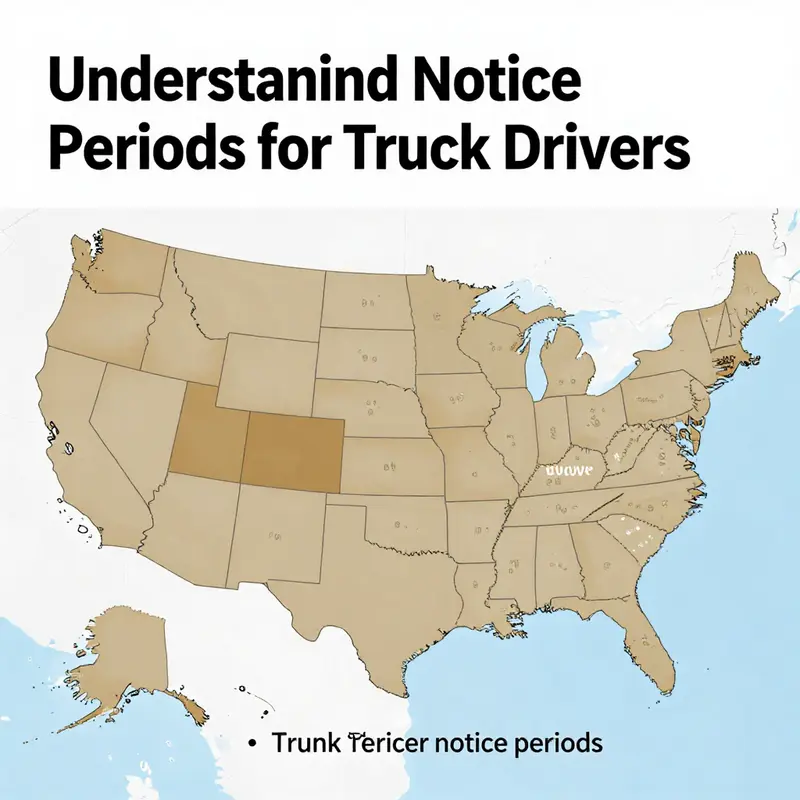
Across the trucking industry, the formal act of leaving a job is more than a personal career milestone. It is a carefully choreographed transition that must respect a patchwork of rules, from federal hours-of-service (HOS) standards to state-imposed restrictions, union agreements, and contractual notice obligations. The chapter you’re reading seeks to illuminate a nuanced truth: the number of days of prior service that count when a driver departs—or when a new employer counts that past service—depends not on a single law, but on the interplay of employment contracts, collective bargaining agreements, and the many state provisions that regulate how hours are logged, how rest is scheduled, and how departures are processed. In the United States, there is no universal federal mandate requiring a fixed number of days’ notice for at-will employment, and particularly in trucking, the default remains a flexible, contract-driven arrangement. Yet the industry standard—often cited as a window of 30 to 60 days—serves as a practical benchmark that reflects the time needed for a clean handover, the training of a replacement, and the administrative work that accompanies a change in drivers. The landscape becomes more intricate, however, once you zoom in on state rules and the realities of cross-border or cross-state work, which can tilt the balance in a subtle but important way when it comes to how much prior service is creditable, how quickly a new hire can be deployed, and how compliance is demonstrated in ongoing operations.
At the core of this discussion is safety. The Federal Motor Carrier Safety Administration (FMCSA) sets nationwide hours-of-service rules that create a baseline for daily work patterns. But states are free to add layers—sometimes more restrictive, sometimes more clarifying—that affect when a driver can operate, how much time must be allocated to rest, and how logbooks must record the last period of activity. California, for instance, is widely recognized for its stringent approach to HOS. The state enforces a 10-hour driving limit within a 14-hour workday and obligates a 30-minute break after eight consecutive hours of driving. That 30-minute break is not a federal requirement, but it is a California imperative intended to safeguard driver alertness and road safety. The practical knock-on effect for days prior service is not about a calendar line in the sand, but about the time available to fulfill operational handovers without compromising safety rules. If a departing driver has a trailing record that must be reconciled with HOS logs, the state’s strict oversight can extend the administrative window during which prior service is verified and credited for the purposes of payroll, benefits, or rehire eligibility.
Other states reinforce the complexity with their own idiosyncrasies. Oregon, for example, adheres to a 70-hour workweek limit stretched over eight consecutive days, a standard that reinforces safe fatigue management while requiring meticulous recordkeeping to ensure compliance across multiple jurisdictions. The difference may seem granular, but it translates into measurable consequences for how long a driver can be counted as actively onboarded on a particular schedule, and how the employer documents the transition when a driver exits. When drivers cross state lines—carrying loads that traverse bi-state corridors or longer national routes—the need to harmonize federal baselines with state requirements becomes even more pressing. A misalignment can trigger not just administrative headaches, but potential penalties during roadside inspections or enforcement actions by state authorities that are charged with enforcing HOS compliance. In the broader discussion of prior service, this means that a driver’s history in one state might be fully acknowledged for certain benefits, while the same history could be scrutinized more closely in another state’s regulatory framework to ensure that no fatigue-related risk has been carried forward in a new assignment.
The situation is even more intricate in the northeastern corridor and in coastal states that have chosen to add constraints at the boundary of the federal baseline. New York and Washington are known for implementing regulations that, in some cases, cap on-duty time at earlier thresholds relative to federal allowances. For workers who log hours across multiple states, these cap rules can limit the extent to which prior on-duty time is transferable to a new employer’s scheduling plan. If a driver’s employment history under a different state program included long stretches of on-duty time, the current employer may need to document that history precisely to determine whether the prior service credits affect the start date of a new schedule, the eligibility for certain benefits, or the calculation of transition pay or severance that might hinge on the exact timing of departure. The practical implications are not merely administrative; they shape the driver’s transition experience and influence the employer’s ability to deploy the driver on time without compromising safety or regulatory compliance.
Beyond the technicalities of HOS and the formal notice window, the concept of days prior service also intertwines with the realities of contracts and labor relations. In the United States, casual or at-will employment arrangements dominate, yet many trucks operate within contexts that involve collective bargaining agreements or specific employment contracts. For unionized drivers, CBAs often spell out explicit resignation and termination procedures, including minimum notice periods and defined handover processes. In some Teamsters negotiations, for instance, the notice period and the procedural steps for disengagement from a position are laid out in granular terms to protect both the driver and the employer from disruption in service and to maintain a safe, orderly transition. When the CBA governs the terms of departure, days prior service become not just a calculable metric, but a binding compliance point that must be observed to avoid grievance procedures or disputes that can delay a replacement’s onboarding. The practical upshot is that for departing employees under a CBA, the notice period can be as much a regulatory safeguard as a courtesy: it preserves service continuity, ensures proper training of successors, and aligns payroll and benefits changes with the company’s fiscal cycles.
In states with strong safety cultures, the interplay between notice requirements and safety compliance becomes a central narrative. California’s approach to HOS and rest breaks can influence when a trainee can be integrated into a new route, how much time a departing driver has to provide direct handover, and how soon a replacement can be fully routable on the schedule without triggering fatigue-related violations. A driver who has logged a significant block of prior on-duty time in a state with aggressive HOS enforcement must be careful about how their departure is sequenced with the onboarding of a new driver and the transfer of logs to the new rider on the route. The corrective housekeeping needed to maintain continuous compliance can stretch the if-then boundaries of a typical 30- to 60-day notice window. In practice, fleets that rely on careful, cross-state scheduling tend to build in additional time for transitions when the driver’s past hours and the state’s HOS constraints intersect with the business need to avoid service interruptions. They recognize that the number of days counted as “prior service” is not merely a tally on a ledger but a live variable that affects scheduling, payroll, security clearances for routes, and even the clock for safety audits.
From the driver’s perspective, the realities of state-specific regulation demand proactive planning. When a driver contemplates departure, the questions are layered: Is there a union agreement that dictates a fixed notice period? What do state-specific HOS rules imply about the timing of the handover and the training of a replacement? How will prior employment be treated for purposes of payroll adjustments, retirement benefits, or rehire eligibility? In states with more restrictive rules, a departing driver might need to coordinate an extended notice period to ensure that their logbooks align with the new employer’s expectations and that any required training or certification transfers can be completed before the last day on the current roster. The driver’s own recordkeeping becomes critical here. Maintaining accurate, verifiable logs that show the last period of on-duty activity, rest periods, and the precise timing of any breaks is essential for smooth transition, for avoiding disputes over hours, and for ensuring that the driver does not accidentally breach a state-imposed cap during the transition window.
To navigate this landscape successfully, many fleets place a premium on clear, timely communication and robust human resources practices. A thoughtful HR approach recognizes that when a driver is leaving, the organization is not simply winding down a contract; it is ensuring that operations remain safe, compliant, and efficient. The best practice is to align the notice period with a concrete transition plan that includes hands-on training for the replacement, a documented handover of routes and customer responsibilities, and a thorough audit of logs and safety records before the driver’s final day. Within this framework, days prior service become a living element of the transition rather than a formula on a payroll sheet. The transition plan may also incorporate an engagement with ongoing professional development, especially if the driver has been working toward certain certifications or endorsements that could transfer to the new employer. This is where the culture of investing in people—an approach highlighted by industry leaders who prioritize people-centric HR strategies—plays a critical role. The idea is not only to retain safety and compliance but to ensure that the driver exits with dignity and with a clean slate that supports continuing careers in trucking. For readers who want to explore the human capital side of trucking more deeply, a useful reference is found in the piece on investing in people in trucking, which discusses how workforce development and succession planning can make transitions less disruptive and more predictable. Investing in People in Trucking.
As the field moves forward, the practical implications of state-specific days-prior-service rules become a matter of prudent policy, not just legal compliance. Fleets that aim to minimize risk and maximize continuity will favor proactive transition planning that accommodates the most restrictive state rules in any given route. They will standardize notice periods where possible, but build in flexible buffers to accommodate the unique demands of state laws, CBAs, and the operational realities of cross-border work. They will also ensure that drivers are informed early about how their past service will be treated on the way out and into the next role, including whether their previous hours will impact payroll, benefits, or eligibility for any severance or rehire programs. In this sense, days prior service becomes a bridging concept—a way of translating past work into a safe, compliant, and efficient future. The emphasis is not only on the legality of the departure but on preserving the integrity of the road network that depends on well-trained, rested, and properly transitioned drivers.
To bring this discussion back to the practical, consider how drivers and fleets can approach departure more strategically. Start with a clear understanding of any contractual requirements around notice. If you are unionized, review the CBA for minimum notice periods and the sequence of steps to ensure a smooth transition. If you are non-union, seek a documented agreement on a reasonable notice window that allows for a thorough handover and training of a successor, while also respecting any state-imposed HOS requirements that could affect scheduling during the transition. When evaluating prior service, request a comprehensive, auditable record of hours and rest periods to determine whether the past work can be credited toward future schedules or benefits. For the employer, build a transition blueprint that assigns a designated follow-up period during which the departing driver can assist with the handover while ensuring compliance with state HOS laws. This blueprint should incorporate the logistics of training, the transfer of route assignments, and the finalization of payroll and benefits in a way that protects the company’s safety record and keeps customer commitments intact. In a world where fatigue and safety are non-negotiable, the careful alignment of notice periods with state-specific rules is a core component of responsible fleet management.
The overall takeaway is that state-specific regulations deeply influence how many days of prior service can be counted for departing truck drivers and for departing employees seeking to enter a new role. The ordering principle is simple in theory and complex in practice: comply with the federal baseline, respect every applicable state rule, honor contractual obligations, and structure transitions in a way that preserves safety, reliability, and fairness. Drivers and employers alike benefit from leading with safety and clarity, rather than letting the confusion around hours, rest, and notice become a source of risk. For readers who want to broaden their understanding of the state-by-state nuances and the broader regulatory landscape, the California Hours of Service Regulations page provides a detailed starting point for state-specific requirements, which, alongside federal guidance, shapes how transitions are managed across the country.
External reference: California Department of Motor Vehicles – Hours of Service Regulations: https://www.dmv.ca.gov/portal/dmv/detail/vr/hos
Final thoughts
Understanding the intricacies of notice requirements for truck drivers is vital for effective workforce management in your business. By grasping the standard practices, the implications of collective bargaining agreements, and state-specific regulations, companies in manufacturing, retail, construction, and small business sectors can navigate potential challenges and foster a compliant, efficient working environment. This holistic approach not only aids in workforce stability but also enhances operational efficiency across the board.