
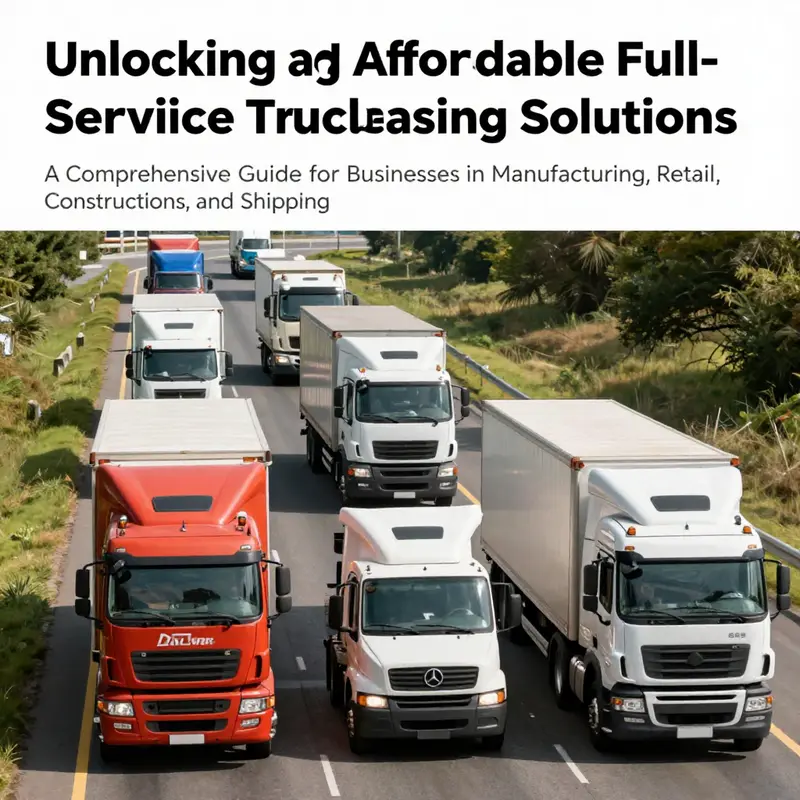
Finding the right full-service truck leasing company can be daunting, especially for manufacturing, retail, construction, and small shipping enterprises. These businesses require vehicles that are not only cost-effective but also reliable and suited to their specific needs. In this guide, we will explore how to identify your requirements, leverage online resources, research established providers, and understand the costs involved. Each chapter will equip you with actionable insights to confidently navigate the leasing landscape and ensure your operations run smoothly and efficiently.
Charting Your Fleet Map: How Clear Needs Drive Affordable Full-Service Truck Leases
Identifying what you truly need from a full-service truck leasing partner is not a casual starting point. It is the compass that keeps every pricing discussion honest, every maintenance promise verifiable, and every uptime target within reach. A well-mapped set of needs does more than narrow options; it reframes the entire conversation with providers from one of guesswork to one of precision. When you begin with clarity, the path to affordability emerges not from squeezing every penny from a lease, but from aligning your operational realities with a service package that genuinely supports your work. That alignment starts with a careful articulation of five core questions that shape your leasin g strategy: what you haul, where you run, how often you run, how many vehicles you need, and what you can responsibly invest. These questions form the backbone of a practical, enforceable set of criteria that keep you from drifting into expensive, mismatched commitments. In practice, this means your procurement conversations become less about lowest sticker price and more about total cost of ownership, service breadth, and the reliability of the truck–provider ecosystem that will carry your business forward.
The first lens through which you must view any full-service offer is the type of cargo your operation handles. Cargo type dictates not only the vehicle configuration but also the maintenance demands and the regulatory considerations that come with those demands. Dry freight is comparatively forgiving, but it still benefits from a robust maintenance plan and a predictable service schedule to keep wheels turning and temperatures stable where needed. Refrigerated transport introduces additional layers of complexity. It requires equipment that maintains precise temperature control, power source reliability, and a more stringent maintenance cadence to prevent spoilage, product loss, and downtime. Hazardous materials add further dimensions—specialized containment, leak prevention, and enhanced safety training all become non-negotiable components of your leasing package. When you define cargo with specificity, you also clarify the service envelope that must accompany the equipment: how quickly a technician can reach a site, what kinds of parts are stocked on-site, and what the liability framework looks like if a spoilage event occurs or a compliance issue surfaces. In short, cargo type is not a mere descriptor; it is a guidepost that shapes the entire contract.
Beyond the cargo itself, geographic reach matters as much as the cargo. Where you operate determines which regulatory regimes apply, which dealer and maintenance networks you should expect, and how a lease should handle regional taxes, insurance premiums, and warranty coverage. If your routes are concentrated in a single region, you might negotiate tighter service-level commitments and faster response times from a provider with a dense local network. If you move across state or provincial borders, a partner with a broad service footprint and cross-jurisdictional experience can avert costly delays and ensure registration, inspections, and compliance are managed with minimal friction. The chapter on cross-border regulatory issues in your broader resource pool becomes particularly relevant here, guiding how to validate a provider’s capability to operate seamlessly across jurisdictions. cross-border regulatory issues
Frequency of trips is another critical dimension that affects both the choice of equipment and the economics of the lease. A fleet that runs nonstop on long-haul cycles benefits from higher-mileage guarantees, better scheduling of preventive maintenance, and amortized fixed costs that improve per-mile economics. On the other hand, seasonal operations or sporadic demand patterns may favor shorter-term terms, tiered maintenance plans, or even alternative fuel management arrangements that align with fluctuating utilization. When you map your calendar, you are effectively creating a forecast of wear patterns, downtime expectations, and the probability of unexpected incidents. A provider who can translate your usage profile into a maintenance plan that minimizes downtime will typically offer a more favorable total-cost-of-ownership picture, even if the base rental rate appears higher at first glance. This is why a robust data-driven approach to utilization is not a luxury but a necessity.
The scale of your fleet—the number of trucks you require—also shapes affordability in meaningful ways. A single truck with a full-service package might deliver just enough capacity to cover a peak period, but such a setup can leave you exposed to downtime if that truck is in the shop. Conversely, a fleet that spans multiple units offers redundancy and better scheduling, but it also requires more sophisticated management, maintenance planning, and negotiated terms that reflect higher volume. The right balance depends on your business model, warranty expectations, and the operational risk you’re willing to bear. When you articulate whether you need one truck or a fleet, you should also specify anticipated mileage bands, retirement timelines for units, and preferred maintenance intervals. This level of specificity helps you avoid lease structures that charge you for features you do not need while simultaneously shielding you from the hidden costs that creep in when a plan is too generic for real-world use.
Budget constraints sit at the heart of every decision about affordable full-service leasing. You may have a hard cap on monthly payments or a more flexible ceiling that considers total cost of ownership over the contract term. Either way, you should translate your budget into concrete expectations about what the lease will cover without surprises. A transparent pricing model can be a strong signal of a provider’s commitment to long-term reliability. Think in terms of predictable monthly fees that bundle routine maintenance, tire replacement, and repairs where possible, rather than fragmented charges that appear only after a breakdown. This approach reduces downtime and stabilizes cash flow, which is particularly valuable in industries where downtime translates to lost contracts or missed service windows. It is also wise to evaluate what level of insurance is included or negotiable, and how deductibles, liability limits, and cargo coverage align with the risk profile of your operation. In a market where fuel costs, tire wear, and parts prices can swing, a lease that offers caps or predictable surcharges becomes a vital anchor for budgeting.
A crucial, often overlooked, dimension of affordability is the quality and transparency of the provider’s service network. A lease is only as good as the support that comes with it. Before committing, you should demand a clear, written breakdown of what “full service” includes in your contract. This is where the total cost of ownership concept proves its value. You want to know not only the base rental, but also how maintenance and repairs are priced, whether there are caps on maintenance and parts, how fuel surcharges are handled, and whether administrative or processing fees are nested in the monthly rate or charged separately. When in doubt, request a sample maintenance schedule aligned with your cargo type and mileage plan. Ask about roadside assistance response times and the geographic range of their service centers. A network that can reach you quickly helps you avoid expensive delays and reduces the chance that a minor issue becomes a major setback. In this sense, the practical health of a leasing partnership rests on the reliability of the service ecosystem rather than the allure of a low introductory rate.
The condition and age of the vehicles in a leasing program can subtly shift the economics of affordability as well. Newer trucks typically deliver better fuel efficiency and lower breakdown rates, translating into fewer unexpected maintenance costs and less downtime. While a newer fleet may carry a higher monthly price, the improved reliability and reduced risk of catastrophic failures can lead to a lower total cost over the contract period. If you operate in regions with stringent emissions standards or where newer engines enjoy preferential maintenance terms, the age of the fleet becomes not just a preference but a strategic lever. This is another reason to negotiate with data: collect your own usage statistics, maintenance records, and downtime history, then compare those with the projected maintenance schedule offered by the provider. A provider who can demonstrate a clear service track record and a plan for keeping equipment within compliance parameters will be more likely to offer sustainable, long-term affordability.
An additional layer worth considering is the value of “support beyond equipment.” Leaders in the leasing space increasingly position themselves as strategic partners rather than mere vendors. They offer regulatory guidance, driver training resources, and technology integrations that enable real-time tracking, telematics-enabled performance monitoring, and proactive maintenance alerts. If your operation spans multiple regions or complex routes, a partner who helps you navigate regulatory changes, optimize driver performance, and leverage data can offer measurable efficiency gains and cost savings. The goal is not to replace your team but to extend your capabilities in a way that reduces risk and accelerates responsiveness to changing conditions in the market.
To translate these ideas into a practical, doable plan, begin with a structured needs assessment. Create a simple, shared document that captures cargo types, geographic coverage, trip frequency, fleet size, and budget expectations. Then translate each item into a set of criteria for the leasing provider. For cargo type, specify the required vehicle configuration and any special equipment needs. For geography, list the regions or corridors you serve and any regulatory considerations that must be addressed by the provider. For trip frequency, include your anticipated annual mileage and peak periods. For fleet size, outline the number of units and the projected turnover rate. For budget, set clear caps on monthly payments and define which service components must be included. When you discuss pricing with providers, you will have a robust baseline that helps you spot hidden costs, assess the real value of bundled services, and compare apples to apples rather than chasing the lowest initial quote.
The process benefits from a disciplined benchmarking approach. Gather quotes from at least three providers and require the same level of detail from each. Ensure every quote includes base rental, insurance premiums, maintenance and repair costs or caps, fuel surcharges or mileage fees, and any administrative or processing fees. Don’t settle for vague terms such as “subject to change” or generic service level expectations. Ask pointed questions about the size and proximity of the service network, the average response time for roadside assistance, and the process for replacing end-of-life equipment. If you discover there is a mismatch between what a provider claims and what your needs require, use it as a negotiation lever. A credible provider will be able to adjust terms to align with your risk tolerance and budget constraints, rather than forcing you into a one-size-fits-all package.
In the end, identifying your needs in as precise a manner as possible does more than simplify the procurement process. It protects your business from downtime, budget shocks, and misaligned incentives. It clarifies what you will insist upon and what you are willing to trade off for reliability and service breadth. It also signals to potential partners that you approach leasing as a strategic investment, not a temporary fix. When a provider understands that your operation depends on predictable performance and transparent costing, they are more likely to propose thoughtful, value-driven options rather than aggressive, unsustainable discounts. And as you explore your options, remember that the objective is not to squeeze the cheapest monthly rate but to secure a comprehensive package that minimizes risk, maximizes uptime, and aligns with your long-term growth trajectory. The routes you will travel—geographic, regulatory, and operational—will be better navigated with a partner who understands your map and is prepared to help you stay on course.
For those who want a broader framework to refine their evaluation, consider consulting established industry resources that compare cost structures, service inclusions, and reliability metrics across providers. One external resource that offers a grounded overview of cost considerations, service inclusions, and reliability assessment tips can provide a useful companion to your internal analysis: Truck Leasing Companies: How to Choose the Right One. This guide helps illuminate common pitfalls and best practices as you build your shortlist and conduct deeper due diligence. https://www.tractor-trailer.com/truck-leasing-companies-how-to-choose-the-right-one/
null
null
Economies in Motion: Choosing Established Full-Service Truck Leasing Providers That Align Cost Predictability with Reliable Capacity
Selecting an affordable full-service truck leasing partner starts with a clear recognition: true affordability comes not from the lowest sticker price, but from a predictable total cost of ownership achieved through reliability, service breadth, and wise scale. The landscape favors established providers because they bring balance to cost, uptime, and risk. They operate fleets large enough to negotiate favorable insurance terms, maintenance discounts, and rapid access to parts with a nationwide service network. At the same time, seasoned operators know that affordability is a function of uptime as much as price. A truck that sits idle costs more than one that runs on a tight, well-managed schedule. For fleet operators, the best path to affordability is not a bargain rate alone but a holistic package that covers the vehicle, the care for it, and the operational scaffolding that keeps it productive. In this light, the focus shifts from chasing the lowest daily rental to evaluating whether a provider’s full-service model genuinely reduces downtime, lowers risk, and delivers predictable monthly expenditures that scale with the business, not against it.
Established providers—by virtue of their longevity, breadth of service, and developed networks—offer a compelling case for affordability when cost is measured as total value rather than as a momentary price tag. They tend to offer diversified fleets, from rigid trucks that excel in urban delivery to heavy-duty tractors designed for regional and long-haul work. The breadth of their fleet matters because it decreases the risk of mismatches between vehicle capability and job requirements. A misaligned truck can drain profitability through higher fuel consumption, incompatible payload capacity, or increased maintenance events caused by atypical usage. When an operator can source the right mix from a single provider, the administrative burden shrinks, and so does the potential for scheduling gaps that ripple into missed deliveries and unhappy customers.
Full-service leasing, as typically defined by established players, is more than a vehicle loan with a maintenance bill tacked on. It is a package that often includes preventive maintenance programs, 24/7 roadside assistance, insurance management, driver support services, regulatory compliance help, fuel management tools, and sometimes telematics integration. The objective is straightforward: minimize friction so that the fleet can focus on core operations rather than juggling maintenance calendars, insurance certificates, or road callouts. This is where the value proposition of reputed providers shows up in measurable ways. Consider maintenance scheduling. A well-staffed network can perform preventive work before it becomes a costly repair event. With a robust maintenance program, trucks spend less time in the shop and more time on the road. For operators, that translates into fewer missed deadlines, steadier service levels, and better utilization of assets. The same logic applies to roadside assistance. A nationwide network with a rapid response capability minimizes downtime when a breakdown occurs and helps preserve the reliability that customers expect.
The decision to work with an established provider also brings a certain degree of financial clarity. Transparent pricing becomes a competitive differentiator because it reduces the risk of surprise invoices that blow up the monthly lease cost. Responsible providers present a detailed, written quote that disaggregates each cost layer: the base rental fee, insurance premiums (liability, collision, comprehensive), maintenance and repair costs (and whether they are capped), fuel surcharges or mileage fees, and any administrative or processing fees. When this level of detail is available, operators can compare apples to apples across different bids and, crucially, across different lease terms. The discipline of requesting multiple quotes is not simply a price exercise; it is a way to stress-test each provider’s commitment to transparency and to verify whether there are built-in cost protections that reduce long-run exposure to capricious charges.
The evaluation process should go beyond the visible price and into the quality of the service network. A major strength of established providers is a dense service footprint. The value here is not just convenience but risk management. A reliable provider can dispatch a technician to a breakdown site quickly, arrange a loaner or replacement vehicle when necessary, and coordinate with insurers to minimize downtime and administrative complexity. The speed of response—the average time to dispatch and repair, the availability of service centers across regions, and the ease of scheduling routine maintenance—directly affects uptime and, thus, the bottom line. Operators should ask for specifics: how many service centers comprise the network, what is the typical response time for roadside assistance, and how is the maintenance work prioritized during peak periods? These questions reveal how well a provider can translate geographic reach into operational reliability.
Another critical dimension is vehicle age and condition. Fleet health is a leading indicator of total cost efficiency. Newer vehicles typically offer better fuel efficiency, improved reliability, and lower breakdown rates. An established provider’s vehicle refresh cycle often aligns with maintenance performance metrics that reduce unexpected repair costs and downtime. However, newer does not always mean cheaper. The key is a carefully negotiated balance between depreciation, maintenance reserves, and lifetime fuel economy. A savvy operator will prefer a fleet where the vehicle age aligns with maintenance and warranty coverage terms, ensuring predictable maintenance expenses and steady availability. In practice, this requires transparent reporting from the provider on vehicle age distribution, service history, and anticipated lifecycle replacements. The more you understand about the fleet’s health, the more confidently you can project total costs over the lease period.
A crucial, sometimes overlooked, element of affordability is the provider’s approach to operational efficiency beyond maintenance. Integrated fleet management tools and telematics can yield meaningful savings by optimizing routing, driver behavior, and load planning. When a full-service leasing partner brings a technology platform that interfaces with insurance, maintenance, and fuel cards, the result is a cohesive system that reduces waste, improves accountability, and enhances decision-making. Operators should explore what the provider offers in terms of digital dashboards, real-time tracking, and data-sharing capabilities. A platform that consolidates maintenance alerts, insurance documentation, and roadside events into a single view can substantially shorten the cycle from issue identification to resolution, thereby expanding uptime and reducing administrative frictions.
The pricing architecture that accompanies these capabilities deserves careful scrutiny. A common misstep is accepting a quotation that looks attractive upfront but blossoms into a monthly expense that grows with repair costs, administrative fees, or unexpected surcharges. To avoid this trap, demand a comprehensive cost model. Confirm whether maintenance costs are capped and, if so, at what level. Understand whether fuel surcharges are fixed or variable, and how mileage fees scale with usage. Probe any potential processing fees and the timing of payments. The goal is not to minimize the sticker price but to illuminate the total cost of ownership under realistic operating conditions. It is also wise to clarify exit costs and termination terms. If business needs shift, you want a clean path out of a lease without punitive charges that could undermine cost advantages gained during the term.
Incorporating the broader macro environment into the assessment refreshes the decision with realism. The trucking market is influenced by demand cycles, fuel prices, regulatory developments, and the pace of technology adoption. These forces shape price dynamics, service expectations, and risk profiles. For operators aiming to stay ahead, connecting the provider selection to these larger trends matters. The discussion of key economic trends impacting the trucking industry highlights how scale, coverage, and technology integration become not only differentiators but protective mechanisms against volatility. Recognizing that the provider ecosystem is part of a larger system helps fleet managers weigh risk, resilience, and long-term value when evaluating options. Key economic trends impacting the trucking industry offers a framework for anticipating how supply chain shifts, labor markets, and regulatory changes may tighten or loosen operating margins. This linkage is not a mere sidebar; it underpins practical choices about fleet composition, maintenance strategy, and vendor partnerships.
Of course, the practical experience of working with established providers bears repeating. A mature company can deliver a one-stop solution that reduces the number of vendors a fleet has to manage, which in turn lowers administrative overhead and the risk of miscommunication. The interplay between the vehicle, the maintenance ecosystem, the insurance structure, and the driving force behind the wheel is where true value emerges. A robust program often includes driver support and training, which not only improves safety and compliance but also enhances fuel efficiency and asset longevity. In a full-service model, the driver becomes a partner in cost control rather than a passive element. The provider’s responsibility for driver onboarding, safety training, and ongoing coaching translates into measurable reductions in incidents and insurance costs over time. This is a nuanced form of affordability—one that rewards steady adherence to best practices and continuous improvement rather than episodic cost-cutting.
While it is tempting to focus on a single metric such as weekly cost or monthly payment, seasoned operators know to look at how a provider structures the renewal cycle. A prudent approach favors contracts that offer predictable renewal terms, with options to adjust the vehicle mix, service level, or term length as business needs evolve. The value here is flexibility and foresight: you can scale up during peak seasons or down when demand softens, without paying excessive penalties. The right established provider should be able to accommodate growth without forcing a whole new procurement project each time. In practice, this means a well-defined process for upgrading equipment, rebalancing the fleet, and onboarding new drivers with the same standard of care and efficiency.
The human element should not be overlooked. Long-standing providers typically invest in customer service infrastructure that can handle complex inquiries across legal, safety, and regulatory domains. When you are negotiating a lease, you are negotiating access to a knowledge base as well as a fleet. A responsive account team can translate shifting regulations into actionable steps, help with certificates of insurance, and bridge the gap between fleet operations and administrative compliance. The upshot is less bureaucracy and more time to devote to core business activities. For operators prioritizing stability, this combination of reliable service, scalable capacity, and transparent pricing constitutes a compelling argument for partnering with an established full-service leasing provider.
In sum, affordability in full-service truck leasing from established providers rests on a triad: the reliability and breadth of the service network, the clarity and predictability of pricing, and the capacity to scale with business needs while maintaining uptime. When evaluating potential partners, operators should seek a clean alignment of truck type with job requirements, transparency about every cost component, and a strategic orientation toward uptime rather than short-term price wins. The ecosystem benefits from the presence of mature players who can integrate maintenance, insurance, and fuel management into a single, coherent service. The result is a lease arrangement that not only lowers immediate expenses but also reduces risk and administrative overhead, enabling smoother operations and steadier cash flow over time.
Finally, the choice of an established provider should be viewed as a strategic commitment, not merely a procurement decision. It requires due diligence, a clear understanding of end-to-end costs, and a forward-looking view of how the fleet will evolve with the business. When these elements align, a fleet operator can realize true affordability: lower nuisance costs, higher uptime, and more predictable financial planning. The path to that outcome is paved by asking the right questions, demanding thorough documentation, and recognizing that value in trucking often comes from the partnership surrounding the vehicle as much as from the vehicle itself. For readers seeking a reference point on the scale and scope of what robust leasing programs can deliver, industry literature and provider profiles underscore the advantages of partnering with established full-service operators who deliver on reliability, transparency, and service breadth.
External resource: https://www.ryder.com/leasing
Seeing Through the Rate Card: Costs, Clarity, and Confidence in Affordable Full-Service Truck Leases
When fleets look for an affordable path to operation, leasing full service trucks is often framed by a single monthly number. The promise of an all in price is attractive, but only if the utility behind the price is clear. A transparent rate card should reveal what is included, what is excluded, and what drives changes over time. Without that clarity, the monthly payment becomes a shadow on outlays that can surprise a finance team and disrupt plans.
The core concept of full service leasing is simple: the provider bundles vehicle, maintenance, roadside support, insurance, and sometimes even driver services into one predictable payment. The value is not just convenience; it is risk management. When downtime costs are bundled, the fleet gains a stabilizing force for budgeting and for delivering service levels.
A rigorous cost assessment starts with the scope of services. The base rental is only the anchor. The contract should spell out liability and collision coverage, maintenance caps, tire and brake allowances, and any limits on parts or labor. It should make clear whether routine wear and tear is covered and whether there are caps on fuelrelated costs, surcharges, or mileage penalties. A low headline price can vanish once fuel surcharges and overage fees are added, so the price must be inclusive and transparent.
Quotes matter. The best quotes present the total cost of ownership over the lease term and break it into components: base rate, insurance premiums, maintenance and repairs, parts, tires, and any administration charges. They should also show how fees evolve with miles, time, or seasonality. To avoid misinterpretation, fleets should request quotes from at least three providers and compare apples to apples, ensuring that each quote reflects the same service scope and same maintenance levels.
Service capability and credibility are non negotiable. A credible partner has licenses, an established service network, defined response times, and a plan to minimize downtime when a breakdown occurs. They should be able to dispatch technicians, arrange a replacement vehicle, or provide on site service within a guaranteed window. The supplier’s network and performance history directly affect uptime, not just the sticker price.
Transparency extends to governance. The contract should document the boundaries clearly: what is fixed in the monthly payment, what can fluctuate, and what events trigger extra charges. It should include a process for dispute resolution and a path to reprice if market conditions shift. When a company negotiates such an agreement, it is purchasing not just trucks but a framework for operational control and financial predictability.
Macroeconomic context matters. Insurance markets, parts availability, and fuel volatility shape pricing and risk. A robust full service model absorbs some of those shifts by spreading costs over a stable base, but buyers should still probe how the provider models volatility and what protections exist in minutes of downtime or service delays. A pricing mechanism that can adapt without eroding predictability is the most valuable in the long run.
Practical steps for buyers include requesting written quotes from multiple providers, insisting on a line by line cost breakdown, and asking for the math behind fuel or mileage assumptions. Compare the same service level, confirm the limits on maintenance, check the terms on wear items, and verify any caps or caps on replacement equipment. Keep a checklist of inclusions and exclusions and use it as a governance tool in ongoing negotiations.
Bottom line: the value of transparent pricing is not a single price tag but a disciplined approach to business. A well constructed rate card aligns incentives, reduces surprises, and supports reliable delivery performance. When teams understand the economics of the lease, they can plan capacity, routes, and growth with confidence, knowing that the price reflects reality rather than promises.
Final thoughts
Selecting an affordable full-service truck leasing company is a critical decision for businesses across various sectors. By effectively identifying your needs, utilizing available online resources, researching established providers, and closely examining cost structures, you can make informed decisions that support operational efficiency and financial management. Empowering your shipping and logistics with the right vehicle leasing partner can lead to improved service delivery and business growth.