
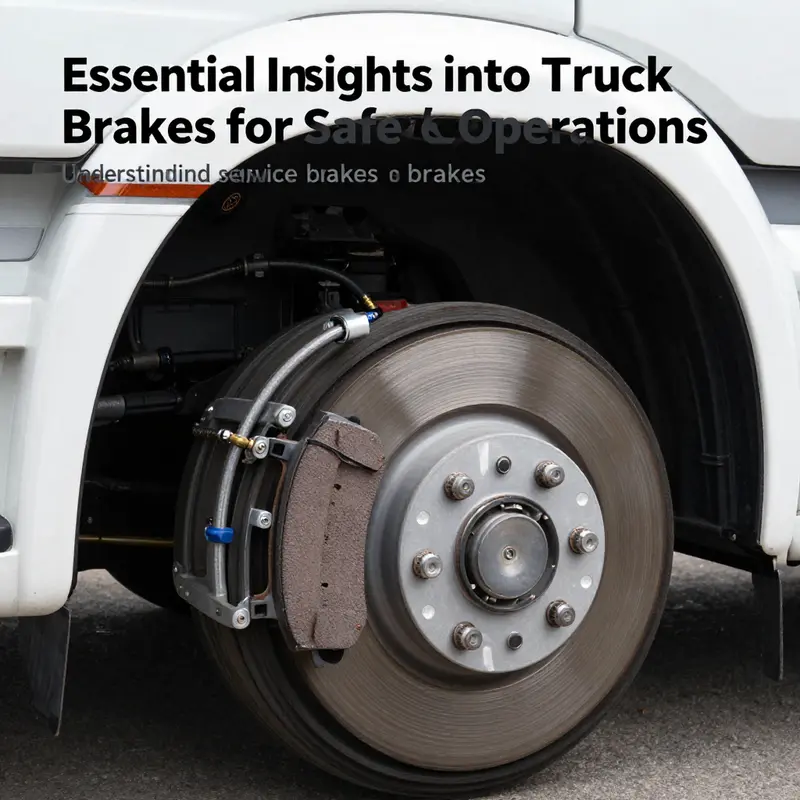
A truck’s service brake is a critical component for ensuring safe operations, crucial for Manufacturing & Distribution Companies, Retail & E-Commerce Businesses, Construction & Heavy Industry Firms, and Small Business Owners with Shipping Needs. Understanding the service brake’s functionality, its differentiation from parking brakes, the significance of auxiliary brakes, and the latest technological advancements ensures optimal performance and safety on the road. This comprehensive exploration serves as a guide to help stakeholders make informed decisions about their trucking operations, emphasizing the importance of proactive maintenance and technology integration for enhanced operational reliability.
null
null
Between Control and Hold: Understanding the Service Brake’s Core Role and Its Distinct Life from the Parking Brake on a Truck
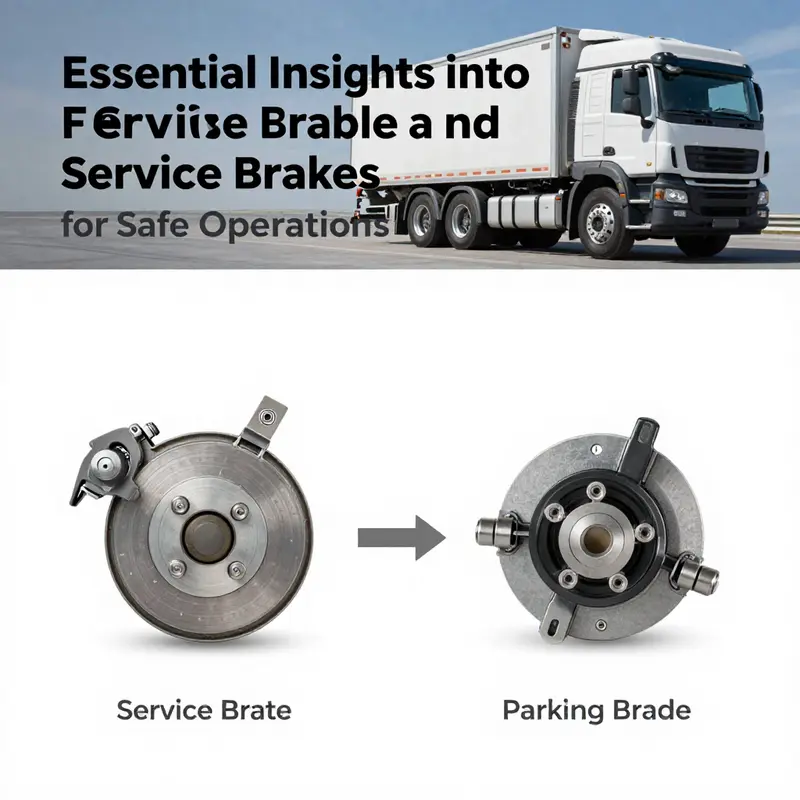
A truck’s braking story centers on the service brake as the workhorse of daily operation. It is the primary braking system used to slow, maneuver, and stop under normal driving conditions. In heavy trucks, the service brake is typically an air brake system that converts compressed air into the stopping force. When the driver presses the brake pedal, air pressure is routed to the brake chambers, which apply braking force to the wheels.
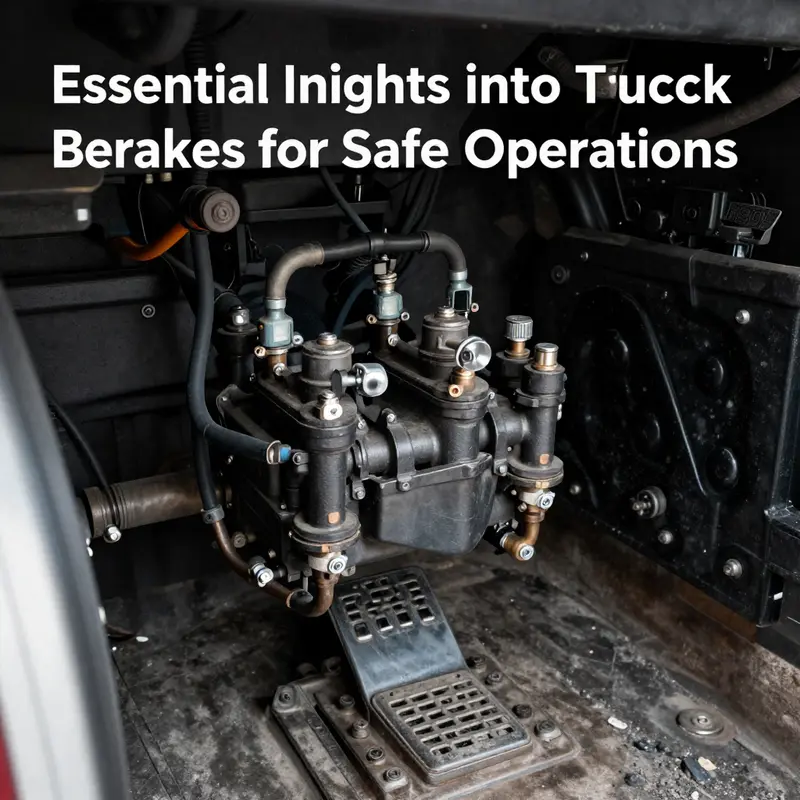
The service brake does not operate in isolation. It works with safety systems such as ABS and EBS to modulate brake force, prevent wheel lock, and optimize stopping performance in challenging conditions. ABS uses wheel-speed sensors and a controller to prevent skidding, while EBS coordinates brake application with greater precision across the system. These technologies rely on the service brake hardware—the chambers, hoses, friction materials, and linkages that translate air pressure into wheel force. In heavy trucks, brake chambers are designed for consistent performance across temperature and duty cycles, and reliability depends on clean air lines, fittings, and diaphragms and on wear of pads or shoes.
The regulatory landscape reinforces the service brake’s central role. Vehicles with GVWR above 4500 kilograms rely on robust service braking and a brake system designed to maintain control under load. Routine checks—air pressure, leakage, and friction-material wear—are essential to minimize brake fade, preserve stopping distances, and maintain steering control during hard or prolonged braking. A well-maintained service brake is the daily guardian of speed control and predictable response to the driver’s input.
If the service brake is the engine of dynamic deceleration, the parking brake is the anchor of safety when the vehicle is stationary. The parking brake, sometimes called the emergency or hand brake, is designed to hold the truck in place on grades and during emergencies. It is often spring-applied and released via a lever, pedal, or release mechanism connected to the air system, but it remains functionally independent of the main air supply. This independence provides a fail-safe that remains effective even if the service brake system loses pressure, giving fleets a critical redundancy in the safety framework.
From a maintenance perspective, the service brake emphasizes air-system integrity and friction material wear, while the parking brake emphasizes the mechanical and spring components that hold or release the vehicle. Servicing the service brake focuses on air lines, leaks, chamber health, slack adjusters and camshafts, and pad or shoe wear. Parking brake maintenance centers on ensuring sufficient spring force, reliable release, and freedom from binding in the linkage. Taken together, both subsystems require regular inspection to ensure reliability under both normal operation and fault conditions.
In driving scenarios, the two systems work as partners rather than competitors. On a descent, the service brake delivers most of the deceleration, with ABS helping maintain steerability. The parking brake may be engaged later to secure the vehicle after a controlled stop on a grade or to provide a hold in emergency scenarios when service braking alone is insufficient. The two systems, with their complementary roles, form a layered safety strategy that helps fleets manage risk in a range of conditions.
For practitioners, recognizing where each mechanism shines informs maintenance priorities and operational decisions. The evolving braking landscape—integrated controls, electronic controllers, and smarter sensors—further ties service brake reliability to system performance. By focusing on air-quality, leak prevention, and wear management for the service brake, and on the reliability of the release geometry for the parking brake, fleets can sustain safer, more predictable braking across the life of the vehicle.
Balancing the Braking Equation: How Auxiliary Brakes Augment the Service Brake on Heavy Trucks
The braking system of a heavy truck is rarely a single, solitary device working in isolation. It is a carefully choreographed ensemble, built to slow and stop a vehicle that can weigh many tons when fully loaded. At the center of this ensemble sits the service brake, the primary means by which a driver decelerates in normal driving. Yet, in the high-demand world of long-haul transportation, the service brake does not act alone. Auxiliary brakes operate as a crucial partner, modulating speed, easing the burden on the service brakes, and enhancing safety and efficiency across challenging road conditions. This collaboration, subtle in ordinary traffic but vital on steep descents and heavy loads, is the quiet work that keeps brakes from overheating and minimizes the risk of brake fade when it matters most.
To understand this partnership, it helps to picture the braking system as a layered defense against speed. The service brake applies friction directly to the wheels, using air pressure or hydraulic force to push pads against rotors or drums. It is designed for routine stopping, predictable stops, and the repetitive demands of city traffic and highway cruising. But as grade after grade stretches ahead on a long journey, the driver faces scenarios that demand more than friction alone can reliably provide. This is where auxiliary brakes come in. They are not substitutes for the service brake but complementary tools that reduce the heat and wear associated with heavy braking, preserve brake life, and give the driver more control over the vehicle’s speed in difficult terrain.
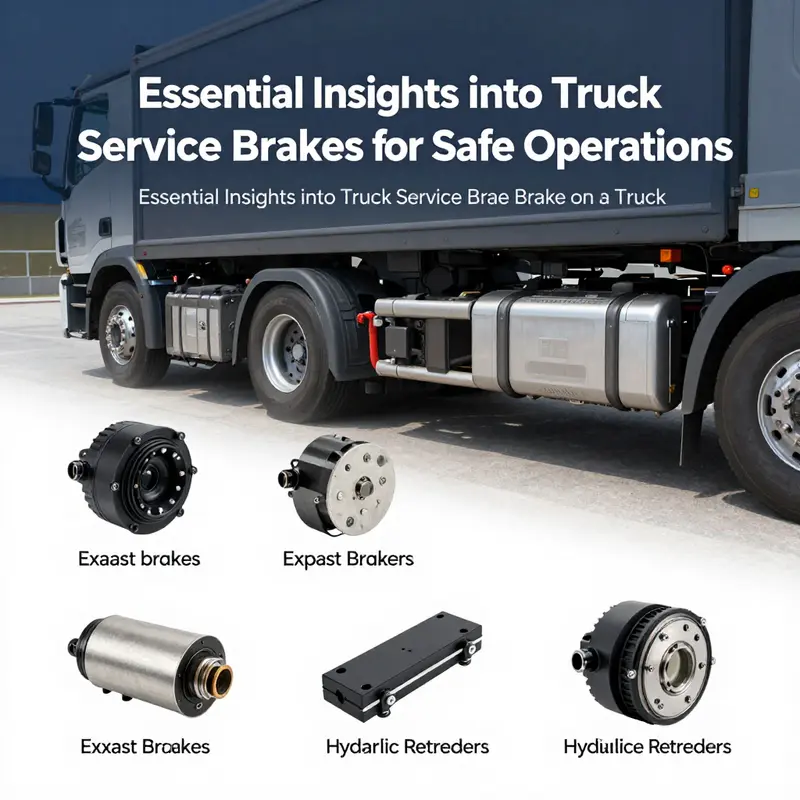
Among the most common auxiliary options are engine brakes, exhaust brakes, and transmission retarders. Each uses a different mechanism to convert the truck’s motion into a form of resistance that slows the vehicle without relying solely on the friction of brake linings. An engine brake, often colloquially referred to in the industry as a Jake brake, leverages the engine’s compression to absorb energy. When activated, it alters the engine’s valvetrain behavior so that the piston compression on each cylinder resists rotation, producing a braking effect without the driver needing to press the service brake harder. The exhaust brake, by contrast, narrows or partially blocks the exhaust flow, increasing backpressure in the exhaust path. That backpressure slows the engine’s rotation and, in turn, helps decelerate the vehicle. A transmission retarder, found in some heavy transmissions, absorbs energy through the driveline or uses hydraulic or other mechanisms to create drag, smoothing deceleration across multiple gears.
Importantly, these auxiliary brakes are not designed to bring the truck to a complete standstill on their own. Their strength lies in reducing the workload on the service brakes during long descents, heavy-duty deceleration, and during frequent speed changes with heavy loads. By engaging auxiliary braking, drivers can maintain a controlled, safe speed with less reliance on the friction-based service brake. The result is a reduction in heat buildup within the brake drums or discs, less brake fade on prolonged descents, and an extended service brake life that translates into lower maintenance costs and reduced downtime.
Modern trucks often couple these auxiliary systems with sophisticated electronic braking control. Anti-lock braking systems (ABS) and Electronic Braking Systems (EBS) coordinate the distribution of braking force across axles, monitor wheel speed, and modulate brake pressure to prevent wheel lockup. When auxiliary brakes are in play, the electronics choreograph their use with the service brake in a way that produces smoother deceleration, more consistent vehicle speed, and improved overall stability. This integration matters because, on a steep grade or when navigating a heavy load, abrupt, uneven braking can unsettle a vehicle and raise the risk of loss of control. The electronics help ensure that the engine brake or exhaust brake comes on progressively, in time with the driver’s demand, and in harmony with the brake pressure delivered to the wheel brakes.
The practical benefits of this arrangement extend beyond mere safety. For drivers, auxiliary braking can transform difficult descents into predictable, manageable processes. Instead of riding the service brakes to maintain control, a skilled operator uses engine braking to trim the vehicle’s speed first, then lets the service brakes handle the final stop or fine-tuning of speed as needed. In the process, brake linings and drums or discs wear less aggressively, and the thermal load on the braking system remains within acceptable limits. When a truck descends a long hill, the combination of engine and exhaust braking, guided by the ABS/EBS logic, preserves tire grip and steering feel while reducing the likelihood of brake overheating.
From a maintenance and reliability perspective, the synergy between auxiliary brakes and the service brake means that technicians monitor the entire braking system as a single, integrated system. Regular checks aren’t limited to pad or shoe wear, although those remain essential. Technicians must also verify the health of the engine brake activation circuits, the integrity of exhaust backpressure control, and the responsiveness of transmission retarders where present. Leaks in air lines, degraded valve seals, or worn actuating linkage can undermine the effectiveness of both service and auxiliary braking. A well-maintained system keeps the vehicle safer and ensures that the driver can rely on the braking performance under a wide range of conditions. The maintenance philosophy tends to be holistic: check air pressure with the engine idling and with the brakes applied, inspect for leaks in the air system, and validate that the electronic control units correctly demote or enhance brake force based on speed, load, and terrain.
The human factors involved in using auxiliary brakes alongside the service brake hinge on disciplined driving and a clear understanding of each system’s role. Unlike the service brake, which is directly linked to the pedal in the floor, auxiliary brakes are often engaged through a combination of throttle position, brake control switches, and transmission or engine management. The driver’s awareness of when and how to deploy these systems is critical. In practice, trained drivers think about deceleration in stages: first reduce speed with engine braking to a level where the service brakes can finish the job without overheating, then use the service brakes for precise stopping or when traffic requires a rapid reduction in speed. This staged approach minimizes abrupt transitions and helps maintain vehicle stability, especially when the road surface is slick or when curves demand careful handling.
There is a notable interdependence between driver behavior and the vehicle’s braking architecture. Proper use of auxiliary brakes can yield smoother deceleration profiles, which in turn reduces the likelihood of wheel lock or tire skidding under braking. Smooth, progressive engagement of the engine brake and controlled backpressure via the exhaust brake can prevent sudden velocity changes that upset the truck’s weight distribution. When paired with modern ABS/EBS, the system can modulate braking force across axles, preventing rear axle lockup on slippery descents or uneven road surfaces. This coordinated action contributes to safer cornering, better control in emergency situations, and a more predictable response from the vehicle under heavy loads.
To see how these concepts translate into practice, consider the maintenance implications for a fleet that prioritizes reliability and uptime. A typical approach emphasizes proactive checks of auxiliary braking components as part of routine maintenance, recognizing that the health of the engine brake activation circuits, exhaust backpressure valves, and transmission retarder systems directly affects overall stopping performance. Fleet managers often incorporate targeted inspections alongside standard brake pad and shoe wear checks. They track operation hours and descending routes to anticipate when auxiliary brake components may require calibration or service, ensuring that performance remains consistent across varying terrains and climates. When maintenance schedules are aligned with actual usage—such as frequent mountain routes or long-haul operations with heavy payloads—the braking system’s health and effectiveness stay aligned with safety standards.
For readers interested in how this discipline plays out in real-world fleets, one ongoing area of focus is how private fleets manage braking system maintenance and diagnostics. Trends in maintenance practices, technician training, and the integration of diagnostic tools influence everything from routine pad replacement to the timing of auxiliary brake inspections. To explore these industry-wide perspectives, you can follow resources that discuss private fleets trends in trucking maintenance. private fleets trends in trucking maintenance.
In addition to the practical considerations of use and maintenance, there is a broader conversation about how auxiliary brakes contribute to sustainable trucking. While the primary function remains safety and control, the extended life of friction components and the reduced need for aggressive emergency braking help lower maintenance costs and downtime. When a fleet operates with fewer brake replacements and less heat-related wear, energy and resources are conserved across the braking system’s lifecycle. The environmental dimension—reduction in brake dust, lower fuel and oil consumption indirectly associated with more consistent deceleration, and a quieter, steadier descent profile—also factors into long-term planning for heavy-duty operations.
The chapter on auxiliary brakes would be remiss without acknowledging the role of external, technical references that illuminate how these systems work in principle and in practice. An external resource that provides a detailed technical overview of auxiliary braking is available through industry literature and manufacturer documentation. It offers insights into the physics of braking, the operation of engine and exhaust brakes, and the ways electronic controllers coordinate braking actions to optimize safety and performance. External resource: https://www.boschautomotive.com/en/trucks/braking-systems/auxiliary-brakes/
As this discussion shows, the service brake remains the central participant in the vehicle’s stopping process, but auxiliary brakes play a decisive supporting role that makes the overall braking strategy more robust, especially for heavy trucks facing demanding routes. The best outcomes arise when drivers, technicians, and fleet operators adopt a holistic view—treating the braking system as an integrated whole rather than a set of isolated parts. Training, maintenance, and technology converge to deliver smoother deceleration, reduced wear, and a safer, more efficient operation for long-haul trucking. This cooperative braking approach is not just a technical detail; it is a practical necessity for modern fleets that must balance safety, reliability, and cost in a world where road conditions, vehicle weights, and travel demands can vary as quickly as the weather.
From Pneumatic Baselines to Digital Brakes: The Evolution of the Truck Service Brake and Its Safety Shield
The service brake sits at the core of a truck’s safety architecture, a reliable partner that translates driver intent into controlled deceleration and, when required, a decisive stop. In the traditional sense, this system is inseparable from the air brake, the pneumatic workhorse of commercial trucking. When a driver presses the brake pedal, a precisely orchestrated release of compressed air travels through a network of hoses and valves, translating into mechanical force at the wheel end. The message is simple in principle: air pressure drives brake actuators that apply friction between linings and drums or rotors, converting kinetic energy into heat and gradually lowering speed. Yet this straightforward premise masks a sophistication that has grown over decades, as engineers, fleets, and regulators have sharpened the braking equation for the realities of heavy loads, variable terrain, and extended highway accelerations and descents. The service brake is the everyday brake—the one drivers rely on most to manage speed during routine deceleration, approach to intersections, and contingency stops. It must be consistently responsive, predictable, and repeatable, because the difference between a smooth stop and an abrupt, risky deceleration can hinge on a fraction of a second and a few pounds of pressure.
Historically, the service brake’s strength is also its vulnerability. The air brake system depends on a constant supply of clean, dry air and an intact network of lines without leaks. Any drop in pressure weakens all four corners of the rig simultaneously, potentially compromising stability during heavy braking or emergency maneuvers. The driver’s ability to modulate force through the pedal rests on a cascade of components—brake chambers, slack adjusters, camshafts for drum brakes, or calipers and pads for disc brakes—and, above all, on the air that feeds them. This reliance on pneumatic force means maintenance is not merely a matter of pad wear or rotor thickness but also a matter of air quality, volume, and the integrity of lines and valves. In that sense, the service brake embodies a broader truism of trucking: a system built for resilience under demanding conditions must be able to anticipate and absorb minor faults before they escalate into critical failures. The discipline of maintenance becomes a daily practice, from checking air pressure to listening for air leaks, from confirming proper brake shoe alignment to ensuring that the power supply to the braking system remains unimpeded.
What shifts the narrative in recent years are the technologies that integrate the service brake more deeply with electronics, sensors, and intelligent control. The move toward dry brake-by-wire configurations marks a significant departure from the older hydraulic-fluid-based links between pedal and piston. In these envisioned systems, the hydraulic conduit is replaced by an electronic pathway that translates pedal movement into brake actuation with minimal delay and no fluid to bleed or leak. The immediate benefits are clear: reduced maintenance tasks, because there is no hydraulic fluid to monitor for contamination or leakage; faster responses in emergencies because there is no hydraulic compression lag; and a cleaner, more predictable brake feel that can be finely tuned by software rather than solely by mechanical adjustments. The shift toward dry brake-by-wire technology is not an isolated trend; it is part of a broader industry push toward electronic control and integration with advanced driver-assistance systems ADAS, where braking actions must harmonize with features like automatic emergency braking, adaptive cruise control, and lane-keeping technologies. In such a landscape, the service brake becomes not just a friction-based decelerator but a strategic actuator in a network of safety systems designed to reduce stopping distances and improve vehicle control in diverse situations.
Even as the industry experiments with dry brake-by-wire concepts, the established air-brake framework continues to evolve in meaningful ways. Enhanced air brake systems now commonly feature Electronic Braking Systems EBS that monitor pressure, temperature, and wear in real time. These electronic control modules empower fleets to move from reactive maintenance to predictive maintenance, where data-driven alerts flag components nearing end of life before a failure occurs. The practical upshot is a reduction in unscheduled downtime and a strengthening of safety margins on the road. In parallel, the core safety features—Anti-lock Braking Systems ABS and Electronic Stability Control ESC—have become standard, not optional, in modern heavy-duty configurations. ABS prevents wheel lockups that can convert a cornering panic into a skid, while ESC helps maintain directional stability when the truck encounters moments of adverse grip or abrupt steering input during braking. Trailer safety systems, too, extend the reach of the service brake’s protective envelope, ensuring that braking forces are appropriately distributed between the tractor and the trailer, even under mixed load conditions or uneven road surfaces. The net effect is a more integrated braking experience, where the service brake acts in concert with a suite of safety technologies rather than as a standalone friction device.
The evolution does not stop with electronics alone. The industry’s continuing interest in propulsion and braking synergy is shaping future configurations. Hydraulic master cylinder systems linger in lighter segments and specialized applications, but as speeds rise and loads become more demanding, the trend clearly favors electronically controlled architectures. The promise of more precise brake modulation and faster actuation can translate into shorter stopping distances, improved control on steep grades, and better handling in wet or icy conditions. This is especially valuable for long-haul and regional fleets that routinely confront challenging terrains and extended descents, where fatigue, road grade, and weather test the limits of human reaction time. The modernization of the braking ecosystem also has a human component. Drivers benefit from clearer brake feedback, better predictability, and the assurance that the vehicle’s safety net is being consistently reinforced by technology that can anticipate and mitigate hazards before they fully reveal themselves. For fleets, the advantages extend to operational reliability, as advanced diagnostics help prioritize maintenance tasks, allocate resources more efficiently, and keep drivers on the road longer with fewer interruptions due to brake-related failures.
Looking ahead, the most transformative developments revolve around intelligent braking algorithms and vehicle-to-everything V2X communication. Artificial intelligence-driven braking logic aims to optimize how braking force is distributed across axles and during complex driving conditions, such as when a heavy load interacts with road crown, wind, or slipping surfaces. By analyzing sensor arrays and real-time feedback from the road, AI can tailor brake force in a way that preserves stability and minimizes stopping distances, even in edge cases that challenge human perception. V2X communication promises to extend braking awareness beyond the single vehicle. If a truck can receive timely information about a suddenly slowing vehicle ahead or a change in traffic conditions from connected infrastructure or nearby vehicles, it can preemptively adjust braking plans, reduce the need for harsh deceleration, and maintain smoother traffic flow. While these advancements require rigorous testing and careful regulatory oversight, their potential to reduce crashes and injuries is substantial. The National Highway Traffic Safety Administration NHTSA has highlighted that advanced braking technologies contribute to safer operations and fewer severe incidents in commercial fleets, underscoring the role of robust braking systems as central to modern highway safety. This ongoing research and testing map a trajectory where the service brake remains the anchor of safety, but it becomes increasingly augmented by digital intelligence and networked awareness.
For the fleet operator and the driver, the practical implications are most visible in maintenance philosophy and daily safety routines. Regular checks of air pressure, the absence of leaks, and the health of brake pads or shoes remain foundational. In a dry-brake-by-wire world, technicians emphasize the integrity of electronic channels, sensor calibrations, and software updates, alongside traditional mechanical wear checks. The best practices now include continuous monitoring dashboards that present brake temperatures, pressure curves, and pad wear in real time, turning braking performance into a visible metric rather than a latent concern. Such visibility lets fleets schedule proactive interventions during planned downtime, reducing the probability of unscheduled repairs that disrupt service commitments. In parallel, driver training evolves to emphasize the nuances of electronically coordinated braking, such as how to interpret brake feel in mixed-technology systems, how to respond to predictive maintenance alerts, and how to leverage ADAS features to complement human judgment rather than competing with it. The aim is not to replace driver skill with automation but to harmonize human reflexes with algorithmic precision, crafting a braking experience that is safer, more predictable, and resilient under the variable pressures of real-world operation.
This broader view of the service brake as both a friction device and a node in a safety network helps explain why modern conversations about trucking safety increasingly center on integration. The service brake is not a solitary mechanism but part of a living ecosystem that includes sensors, actuators, software, and communication protocols. When equipment failures or wear threaten any part of that system, the entire braking response can be degraded. The industry’s response is to emphasize redundancy, fault detection, and quick diagnostic feedback so that a driver and a fleet manager can act decisively. In practice, this means cleaner interfaces for fault codes, more intuitive dashboards for brake health, and a culture that treats preventive maintenance as a core competitive asset rather than a cost center. The result is a trucking sector that can sustain higher speeds and heavier payloads with new levels of confidence, knowing that the service brake will perform consistently when every second counts.
Ultimately, the service brake’s story is one of continuity and adaptation. Its core function—slowing and stopping the vehicle during normal operations—remains unchanged. Yet the means by which that function is delivered are increasingly sophisticated, integrating dry brake-by-wire concepts with proven pneumatic systems, advancing control electronics, and forward-looking safety technologies. The consequence is a braking system that is simultaneously more reliable, more informative, and more capable of supporting safe, efficient travel across a complex transportation network. The road ahead holds promise in the form of smarter algorithms, better vehicle-to-vehicle and vehicle-to-infrastructure communication, and a deeper collaboration between human drivers and automated safety features. As this evolution continues, the service brake will continue to be the most familiar, most trusted, and most essential instrument in the trucker’s toolbox, a constant in a world of rapid technological change. For readers who want to explore the broader context of how these shifts align with enduring trucking dynamics, the discussion around key economic trends impacting the industry offers a useful lens into how technology adoption interacts with market realities. Key Economic Trends Impacting the Trucking Industry. For readers seeking authoritative regulatory and safety testing perspectives on advanced braking systems, authoritative information is compiled by national safety authorities and can be found here: https://www.nhtsa.gov/technology/advanced-braking-systems.
Final thoughts
The service brake remains the backbone of a truck’s braking system, directly influencing safety and operational efficiency. As various industries rely on efficient transport solutions, understanding the intricacies of service brakes, along with their comparison to parking brakes and the role of auxiliary systems, becomes crucial. Embracing modern advancements in brake technology further enhances the reliability and performance of trucking operations. Stakeholders in manufacturing, distribution, retail, and construction sectors must prioritize maintenance and continual investment in their braking systems to ensure a safe and efficient operational environment.