

In the modern business landscape, understanding asset classification is crucial for effective financial reporting and operational strategy, especially for sectors heavily reliant on service trucks, such as manufacturing, retail, construction, and distribution. This article delves into the classification of service trucks as either current or fixed assets. The first chapter outlines essential definitions and interpretations surrounding current and non-current assets. The second chapter analyzes the financial implications of categorizing service trucks as current assets, providing insights into how this decision impacts financial statements and business strategy. The final chapter offers strategic considerations for businesses in deciding the asset classification of service trucks within their operational frameworks.
Service Trucks as Current Assets? Navigating Asset Classification
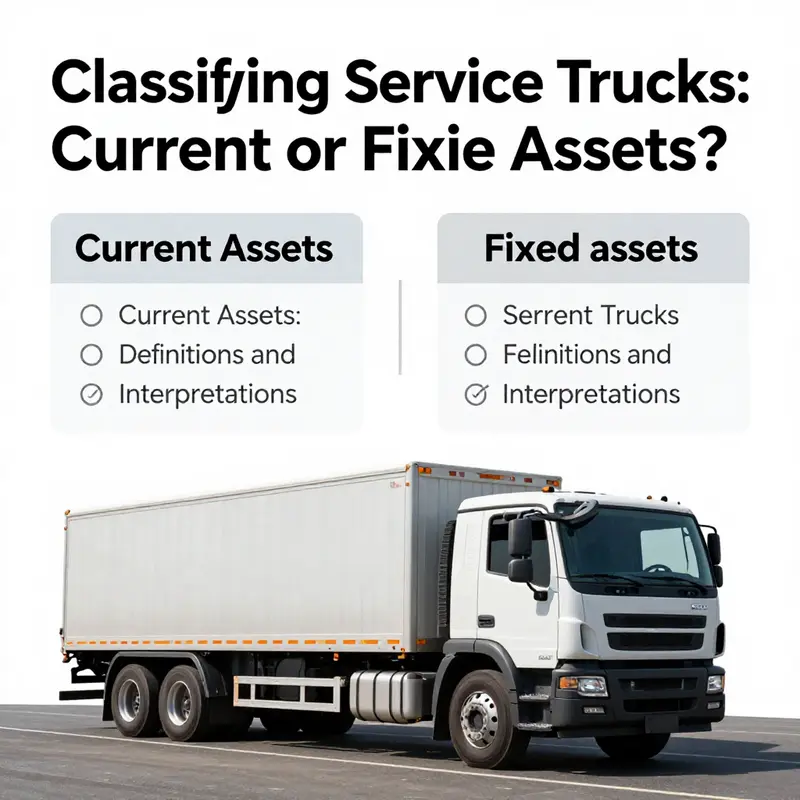
Analyzing whether service trucks should be treated as current assets requires tying accounting labels to operational reality. The core criterion is the operating cycle and the expected timing of cash realization or consumption. Service trucks are durable, multi-year assets that are typically depreciated over several years and are commonly classified as PPE. In most firms, the long-lived nature of the fleet aligns with the traditional PPE treatment, reflecting their role in sustaining operations over multiple periods.
There are scenarios, however, where the line can blur. If a company operates a fleet with rapid turnover and disposes of vehicles within a year as part of a deliberate strategy, management might consider a current asset designation—but only with clear policy, documented support, and alignment with the operating cycle. Such a reclassification would be unusual and would require disclosure and justification under GAAP or IFRS.
Practical governance matters: classification should mirror reality, be consistent with the company’s operating cycle, and be supported by explicit policies. In practice, most service fleets stay in PPE, with held-for-sale or similar categories reserved for dispositions that are highly probable within the year. When a current asset designation is contemplated, the disposition timing and centrality to near-term operations are the essential tests.
In sum, the default is PPE for service trucks, reflecting their long useful lives and revenue-generating role. A current asset label is possible in narrowly defined circumstances, but it must be anchored in documented practice and communicated to investors and auditors through appropriate disclosures. For readers seeking deeper grounding, consult the applicable GAAP and IFRS guidance on asset classification and impairment.
The Timing Puzzle: When Service Trucks Qualify as Current Assets and Why It Matters

In fleet-intensive operations, a service truck is more than a mode of transport; it is a workhorse that underpins service delivery, response times, and revenue generation. The question of whether these assets should sit on the balance sheet as current assets or as long-term fixed assets is not a purely technical concern. It shapes the way leadership portrays liquidity, sets expectations for creditors and investors, and colors how management tracks the health and pace of the business. The answer, in practice, is nuanced. Service trucks are typically treated as long-term tangible assets—fixed assets—precisely because they have extended useful lives and are not intended for sale in the ordinary course of business. Yet there are conditions under which a company could, in theory, reclassify them as current assets, and those conditions carry implications that ripple through financial reporting, performance metrics, and even day-to-day strategic decisions. Understanding this requires not only a firm grasp of accounting definitions but also a sober look at how classifications influence the numbers stakeholders rely on to judge operational strength and enduring value.
First, grounding the discussion in definitional clarity helps. A current asset is an asset expected to be realized in cash or consumed within one year or within the operating cycle of the business, whichever is longer. Under this broad lens, many everyday items—cash, accounts receivable, inventory, and sometimes marketable securities—fit comfortably into the current asset category. Service trucks, by contrast, typically have far longer lives. They are used to provide service over several years, often with a useful life ranging from five to ten years, and they are not acquired with the intention of resale as part of normal operations. This is the core reason why they are almost universally classified as non-current assets, specifically as fixed assets or property, plant, and equipment. This traditional treatment aligns with how the asset is used to generate revenue: steady, ongoing capability rather than a short-term cash conversion event.
Yet the accounting landscape allows for edge cases that hinge on how an asset is intended to be disposed of and how a company’s operating strategy unfolds. If a firm were actively planning to sell a service truck within the next 12 months as part of a strategic fleet renewal or a broader liquidation plan, there would be a stronger argument for reclassifying that asset as current—potentially as inventory or under assets held for sale—so long as the relevant criteria are clearly met and properly disclosed. The idea behind such a reclassification is that the asset is expected to be realized in cash or consumed within the near term, which is precisely the test that current-asset classification uses. However, in the context of service trucks that underpin ongoing service delivery and are not merely sitting in a showroom or being parked in a yard for a quick sale, this scenario is uncommon. The reclassification would be a signal that the company expects to realize value from the truck soon, and that expectation would need to be supported by explicit plans, market conditions, and credible sale channels that are actively being pursued.
If a company does pursue such a reclassification, the implications cascade through several layers of financial reporting and analysis. On the surface, shifting service trucks into the current-asset bucket inflates current assets relative to current liabilities. This change can push the current ratio higher, potentially suggesting stronger short-term liquidity. In practice, the current ratio is calculated as current assets divided by current liabilities. A higher numerator, all else equal, improves the ratio, which may convey a healthier liquidity posture to creditors and investors. In many analyses, a higher current ratio is perceived as a sign of cushion against short-term obligations, reinforcing the impression that the company can meet near-term demands without resorting to financing or asset sales. The quick ratio, which excludes inventory from current assets, could be affected differently depending on how the current classification is framed. If the truck is placed under the broader current-asset umbrella without reclassifying it explicitly as inventory or an asset held for sale, the impact on the quick ratio can be less direct, and some analysts might discount the effect given the specialized nature of the asset. Nevertheless, the very act of reclassifying a durable, service-focused asset as a near-term liquidity builder sends a message—one that invites careful scrutiny from auditors, analysts, and regulators.
The more technical consequences circulate in the income statement and the notes to financial statements. A durable asset like a service truck is normally depreciated over its useful life, with depreciation recognized as a non-cash expense that allocates the asset’s cost to the periods benefiting from its use. If, hypothetically, the company moves the truck into a current-asset category under inventory or assets held for sale, the accounting options shift. Under typical accounting treatment, inventories are not depreciated. They are carried at cost and expensed as cost of goods sold when sold (or written down for obsolescence or impairment). If the asset is reclassified as current and treated as inventory, depreciation would no longer be the vehicle of expense recognition. This fundamental change means that the near-term income statement could show higher expenses through a different mechanism, or, more accurately, lower profits due to the shift from a depreciation expense to an inventory expense profile. The research results you provided articulate a related concern: that, under a current-asset classification, depreciation would be accelerated, leading to higher expenses in the near term. While this is a theoretical consequence of misclassification that some practitioners worry about, it highlights a broader truth: shifting classification alters the timing and nature of how costs are recognized, which can distort profitability metrics and trend analyses over multi-year periods.
Beyond the mechanics of depreciation and ratios, there is a broader governance question. GAAP and IFRS emphasize consistency and faithful representation. Reclassifying service trucks to current assets merely to improve a liquidity metric would be at odds with the fundamental definition of a current asset as a resource expected to be realized within one year. If authorities or auditors were to scrutinize such a move, the company would need a compelling justification and robust disclosures explaining the strategic rationale and the sale timelines, supported by explicit plans, purchase commitments, or market indicators. The risk is not merely a stumble in compliance; it is the erosion of trust in the financial statements. When readers encounter a number that looks suddenly more favorable, they will seek the narrative behind the pivot. If that narrative hinges on a temporary disposition plan rather than sustained operational use, the credibility of the entire set of statements could be called into question. The SEC’s guidance on asset classification underscores the expectation that companies present financial information transparently and consistently, with appropriate disclosures that illuminate the risks and assumptions behind any unusual classification.
From a fleet-management perspective, the practical drive to reclassify—if ever contemplated—would need to be balanced against the operational reality of the business. Service trucks are integral to responding to customer demands, performing preventive maintenance, and enabling field-based revenue generation. Even in a year of accelerated renewal, fleet strategy typically prioritizes stakeholder alignment, capital budgeting discipline, and asset depreciation schedules that reflect the enduring nature of the service capability. The cost of reinstating a consistent classification, the potential for misinterpretation by lenders, and the complexities of government and regulatory oversight must be weighed against the perceived short-term liquidity benefit. In most cases, the prudent path is to keep service trucks on the balance sheet as fixed assets. Depreciation continues over their useful life, and the asset’s operational utility is documented through maintenance records and service-level metrics rather than through a shift in classification.
Within the broader narrative of the trucking and service industry, the issue of asset classification intersects with ongoing shifts in technology, maintenance practices, and fleet composition. As fleets consider modernization—whether through electric powertrains, telematics-enabled maintenance schedules, or modular service units—the accounting ramifications of asset categorization become part of the strategic conversation. The idea of reclassifying a service truck would sit uneasily with investors who are watching the pace of modernization, the balance between long-term investments and working capital, and the firm’s overall capital structure. When governance teams communicate clearly about asset life cycles, renewal plans, and the expected timing of disposals, the financial statements gain in credibility. Readers gain confidence that the numbers reflect real economic decisions rather than a deliberate reshaping of metrics to achieve a desired impression.
To connect this discussion to the broader macro environment, many managers find it useful to stay informed about the forces shaping the trucking sector. For example, the external environment—ranging from macroeconomic trends to regulatory developments—provides context for fleet renewal strategies and asset-management choices. A useful lens for these conversations is to consider how evolving industry dynamics may influence the pace of fleet turnover and the expected outcomes of those changes. For readers seeking a concise synthesis of these market drivers, one resource delves into the key economic trends impacting the trucking industry, offering a grounded view that complements the asset-classification conversation. Key economic trends impacting the trucking industry
Ultimately, the core takeaway is straightforward. Service trucks belong on the balance sheet as non-current assets in ordinary circumstances because they provide lasting service capacity rather than a near-term cash conversion. Misclassifying them as current assets is a structural misalignment with both their functional role and the way most companies manage capital-intensive fleets. If a company truly faces imminent disposal of a service truck as part of a deliberate strategic pivot, it should document the rationale and ensure disclosures meet the standards of GAAP or IFRS, including the timing of planned sales and the expected proceeds. The goal is not to game liquidity metrics but to present a truthful, decision-useful view of the enterprise’s asset base and the durability of its operating capacity. In the chapters that follow, readers will see how this theme of asset classification threads through related topics—from inventory management and capital budgeting to debt covenants and investor communications—and how, when done correctly, it enhances rather than undermines the clarity of financial reporting.
For readers who want to explore the regulatory and standards-based angle further, the U.S. Securities and Exchange Commission offers official guidance on asset classification and reporting expectations. This guidance reinforces the principle that consistency, transparency, and disclosure are essential to credible financial reporting. The practical upshot for managers is clear: preserve the integrity of asset categories, resist the urge to manipulate metrics with classification shifts, and rely on robust disclosures to explain any exceptional circumstances that truly justify a deviation from the norm. By anchoring decisions in the actual role of the asset, the longevity of the fleet, and the strategic plans for renewal, companies can avoid the missteps that sometimes accompany aggressive attempts to massage liquidity figures. In doing so, they preserve the usefulness of the balance sheet as a faithful instrument of the company’s real economic position and prospects.
External resource:
https://www.sec.gov/
Internal resource for wider industry context:
Key economic trends impacting the trucking industry
Rethinking the Ledger: How Service Trucks Fit into Current Asset discourse Without Disrupting Liquidity

To ask whether service trucks are current assets is to examine how a business translates its daily mobility into the language of the balance sheet. Service trucks are the machinery behind a service team’s reach, the mobile workshop that carries tools, spare parts, and the technicians who convert plans into revenue. They are the blunt instrument of daily operations, and their presence on the asset side of the ledger signals a commitment to long-term capacity. Yet the precise categorization hinges on a core accounting question: how long is the asset expected to serve, and how quickly will it be converted into cash or consumed in the ordinary course of business? In most setups, service trucks fall into non-current assets, specifically under property, plant, and equipment. They are purchased to be used for more than one year, depreciated over their useful life, and not acquired with the intent of sale as part of normal operations. This is the framework that guides most financial statements, the same framework that underpins depreciation schedules, asset impairment testing, and the separation of operating costs from capital investments. The natural tendency is straightforward: fix your fleet, depreciate it over time, and classify the trucks where your policy and standards dictate. Tricky questions arise, however, when the operational reality blurs into the horizon of liquidity and short-term planning. If the company intends to dispose of a truck within the next year, or if a fleet renewal is being executed with a deliberate shift toward a new model or lease arrangement, there is room, under certain standards, for reclassification or for presenting the asset held for sale in the current portion of assets. It is not common, but it is possible, and the implications ripple through liquidity ratios and working capital management. In practice, companies usually reserve such reclassifications for vehicles and fleets that are imminently being decommissioned or cannibalized for parts, or for vehicles that have been restructured as part of a deliberate and temporary inventory-like strategy. The day-to-day reality, however, reinforces that service trucks are induced to behave as long-term capital—tools that support the business for multiple reporting periods and that are subject to systematic depreciation rather than immediate expense. The practical takeaway is that the trucks themselves are almost always non-current, while related expenditures can straddle current and non-current categories depending on their nature and timing. Consider the broader definition of current assets. A current asset is one expected to be converted into cash or consumed within one year or the operating cycle, whichever is longer. This broad framework includes cash equivalents, receivables, inventories, and prepaid expenses. The trucks themselves are not cash or a closely held cash equivalent; they are not typically converted into cash through ordinary operations within a year. They are, instead, a mechanism for generating service revenue across multiple years. Yet the ecosystem around trucks—maintenance plans, insurance paid in advance, and spare parts stocked for immediate use—can sit comfortably within current assets. Prepaid expenses, such as insurance coverage for the upcoming year, or prepaid maintenance contracts, are recognized as current assets because their economic value will be consumed in the near term. The careful distinction between the asset itself and the surrounding costs matters for liquidity forecasting and for presenting a faithful picture of how much cash is available to fund day-to-day obligations. When a company analyzes liquidity, it will typically examine the current ratio, quick ratio, and working capital. The trucks’ depreciation does not directly alter these metrics, but the cash outlays for insurance, maintenance, and unexpected repairs do. If a fleet undergoes a renewal, management might reallocate from capital expenditure to operating expenditures in a manner that affects the timing of cash outflows. In that sense, the operational urgency of keeping a fleet on the road can influence how prepaid expenses and repair reserves are sized and reported. It is here that one sees a practical governance implication: the need to clearly separate asset capitalization decisions from liquidity planning. The capitalization policy governs how and when a truck is recorded as a fixed asset and depreciated. The liquidity policy governs how cash commitments for maintenance, insurance, and parts are tracked and forecasted. A misalignment between these policies can distort both profitability and liquidity assessments, making it harder to evaluate the true cost of service provision and the real health of the balance sheet. The nuanced picture also invites consideration of leases and alternative ownership structures. In many fleets, operators evaluate the desirability of owning versus leasing, or of turning to rental arrangements for peak periods or for more specialized vehicles. Leasing can shift portions of the economic life of the truck toward current expense or off-balance-sheet treatment in some jurisdictions, depending on the terms and the accounting standards applied. The decision to lease or own influences how the asset appears in financial statements and how cash flows are presented. If a company leans toward lease arrangements, the trucks may still be non-current assets from an ownership perspective, but lease liabilities can appear on the balance sheet and affect leverage measurements. These strategic choices ripple into working capital management and liquidity planning, because the timing and structure of payments alter the firm’s cash runway. The overarching narrative remains consistent: the trucks themselves are largely non-current assets, but the ecosystem around them—insurance, maintenance, spare parts, and related contracts—lives across current periods and interacts with the day-to-day liquidity of the business. In this light, the prudent manager pays close attention to the structure of prepaid expenses and to the timing of cash outlays. A well-managed practice is to review prepaid insurance and maintenance on a quarterly basis, aligning them to the anticipated service horizon and renewal cycles. This disciplined approach helps prevent sudden cash shortages that could strain service delivery. It also reinforces the distinction between long-term asset stewardship and short-term liquidity management. The maintenance of trailers and service trucks is often a substantial line item in operating budgets. Even though the asset itself is depreciated over several years, the costs required to keep it in service—routine servicing, tire replacements, oil changes, and unexpected repairs—are ongoing and time-sensitive. When these costs are prepaid, they contribute to current assets, but they must be assessed against anticipated use. If maintenance obligations are deferred, the risk to service quality rises and future cash outlays may spike unexpectedly. The parallel here is with inventory management. While the trucks are not inventories in a traditional sense, the concept of “inventory for service readiness” echoes the idea that current assets reflect the resources available to meet near-term operating needs. In some businesses, this concept takes a more literal form through the management of spare parts inventories and the provisioning of fuel and consumables. These elements improve response times and service reliability, and they sit squarely in the current asset bucket. The practical implications extend into the realm of financial planning and compliance. Companies must ensure that their asset classifications align with both internal policies and external reporting standards. Misclassifying a long-lived truck as a current asset can distort turnover ratios, depreciation calculations, and tax treatment. Conversely, treating short-term prepaid arrangements as long-term assets could obscure liquidity concerns and misstate obligations. The governance challenge is to maintain a transparent, auditable delineation between the asset’s capital life and the near-term cash commitments that keep the fleet in motion. It is this clarity that lends credibility to financial statements and supports sound decision-making about investments in equipment, maintenance programs, and fleet renewal strategies. The conversation about whether service trucks are current assets is not a sterile algebra of accounts; it is a reflection of how a business prioritizes reliability, cash flow, and strategic flexibility. When viewed through this lens, the chart of accounts becomes a living map of how the company converts assets into service capacity, and how it translates long-term investments into near-term liquidity. To anchor this idea in practical terms, consider how fleet managers and CFOs align their policies with the realities of daily operations. They establish a capitalization threshold that determines when a truck is recorded as property, plant, and equipment, and they set depreciation schedules that reflect the asset’s expected life and usage. They also implement maintenance and upgrade plans that forecast cash requirements across multiple periods. In doing so, they recognize that while the trucks themselves are not current assets, the company’s current assets are inseparably linked to the health and availability of the fleet. For readers who want to explore related topics within the broader ecosystem, one can look to industry discussions about private fleets and maintenance trends. See further insights on private fleets trends in trucking maintenance here. This linkage helps illuminate how maintenance discipline and asset renewal cycles influence both operating performance and liquidity planning. The governance challenge is not merely technical accounting; it is a strategic one. A fleet that runs reliably becomes a more predictable engine of revenue, which, in turn, supports steadier cash flows and more accurate working capital projections. Conversely, a fleet in constant repair or under constant renewal pressure can generate unpredictable outlays that stress liquidity ratios and complicate forecasting. That is why the separation between non-current asset management and current asset planning matters. It ensures that the true cost and benefit of owning a fleet are captured over the asset’s life while keeping a robust view of the near-term financial obligations that must be met to sustain operations. In a broader sense, the discussion touches on how businesses adapt to evolving conditions in the transportation sector. Trends in fleet age, maintenance practices, and capital replacement cycles influence both the asset mix and the liquidity profile. For instance, if market dynamics push toward longer service lives or higher maintenance intervals, the financial statements reflect a heavier accumulation of depreciation and longer-term financial commitments, even as the near-term cash requirements remain manageable through ahead-of-time budgeting and reserves. If the company chooses to modernize its fleet—perhaps by shifting to a more fuel-efficient mix or by adopting telematics-enabled maintenance programs—these decisions can alter the cost structure without necessarily changing the fundamental non-current nature of the trucks themselves. In other words, modernization affects cost behavior and asset utilization, not the classification of the trucks as fixed assets. The ongoing task for financial leadership is to translate these operational shifts into a coherent accounting and liquidity framework. That involves aligning policy documents, management reporting, and external disclosures so that stakeholders understand what the trucks are, how they are used, and how they affect both longevity and liquidity. The final take-away is that service trucks are best understood as non-current assets in the vast majority of scenarios, with a supporting cast of current assets that includes prepaid expenses, spare parts inventories, and other near-term commitments. The balance sheet tells a story of capacity and cash readiness: capacity in the form of durable assets that enable service delivery, and cash readiness in the form of prepaid commitments and working capital. For managers who must balance reliability with liquidity, the message is practical and clear. Keep the trucks on a disciplined depreciation and maintenance schedule, monitor prepaid and insurance commitments closely, and be prepared to reclassify only when there is a genuine near-term disposition plan that meets the criteria of current asset reporting. In the end, the classification serves not as a label alone but as a tool for better decision-making about investment, risk, and resilience in service delivery. As the industry continues to evolve with changing utilization patterns and increasingly complex maintenance ecosystems, the logic remains consistent: the trucks drive the business, while the classifications drive the clarity with which the business communicates its health and its priorities to lenders, investors, and regulators. For readers seeking broader context about current assets in accounting, a foundational overview is available at Investopedia’s Understanding Current Assets. External resource: https://www.investopedia.com/terms/c/currentasset.asp
Final thoughts
Effective asset classification is critical for businesses utilizing service trucks, impacting both financial reporting and operational decisions. Service trucks predominantly serve as fixed assets, reflecting their role in generating revenue over time. However, understanding when these assets might transition to current assets is vital, especially in the context of strategic business shifts or fleet management. Companies must carefully evaluate their operations and future plans to make informed decisions regarding the classification of service trucks. This approach ensures accurate financial reporting and compliance while maximizing operational efficiency.