
Stealing a postal service truck is a significant federal crime in the United States, with various legal implications that encompass multiple statutes. Understanding the laws that govern such actions is crucial for those in sectors like manufacturing, retail, construction, and shipping. This article delves into the specifics of various charges one might face, from theft of government property to possession of a stolen vehicle. By examining the ramifications under federal law, potential penalties, and real-world examples of such incidents, businesses can better navigate the legal landscape surrounding postal service theft and avoid costly repercussions.
Stealing a USPS Truck: How a Postal Vehicle Triggers a Federal Case
The idea of commandeering a postal service truck might play out like a scene from a high stakes thriller, but in the real world it would land you squarely in federal crosshairs. A postal truck is not just a fancy van with a different paint job; it is a government asset tasked with delivering the nation’s mail and carrying out official duties. When someone takes that vehicle without authorization, the crime transcends ordinary car theft. The government treats it as theft of government property, a violation that sits at the core of federal criminal law and carries consequences that can reach into a decade of imprisonment and substantial fines. Understanding why requires looking closely at the relevant statutes, how they interact, and the practical realities of federal prosecution. What begins as a theft of a vehicle quickly expands into questions about property belonging to the United States, the transportation of mail, and the integrity of interstate commerce. In short, stealing a postal truck is not a run-of-the-mill offense; it is a federal offense with a web of potential charges that prosecutors can braid together to pursue a severe penalty.
At the center of this scenario sits 18 U.S.C. § 641, the fundamental statute governing theft of government property. The law makes it a felony to steal, convert, or embezzle any property that belongs to the United States government. A USPS truck is government property and, because it is used in the performance of official duties—delivering mail, supporting route operations, and enabling postal workers to reach their destinations—the act of taking it falls within § 641’s ambit. The essential elements are straightforward: the defendant knowingly took or converted property owned by the government, and the property value or the government’s interests were harmed as a result. The penalties reflect the gravity of the offense, with potential imprisonment up to ten years and the possibility of fines. The federal frame is deliberately broad, ensuring that a broad array of government assets—from office equipment to vehicles and beyond—can be protected against misappropriation. This choice of framework emphasizes that the United States treats government property theft as a serious breach of the public trust, not merely a private crime against private property.
But the federal liability does not hinge on the vehicle’s price alone. The government can press multiple charges depending on the circumstances of the act. If the stolen truck was involved in conveying mail or performing a postal function, additional offenses may come into play under other statutes that govern mail and mail-related operations. For example, there is the possibility of an offense described as Interference with Interstate Commerce, codified at 18 U.S.C. § 1705 in some contexts. This provision covers the theft or destruction of mail or vehicles used in the delivery of mail when the conduct disrupts the flow of interstate commerce. The parallel here is clear: postal operations are a national enterprise, and interfering with those operations can trigger federal liability with penalties akin to those for the underlying property theft. The practical effect is that prosecutors can seek to prove not just the theft of equipment, but the disruption of a nationwide system that relies on timely mail delivery. The range of consequences reflects the federal system’s emphasis on protecting critical national services and the people who rely on them.
A separate federal path can arise under 18 U.S.C. § 2314, which covers transportation of stolen property across state lines. If the thief moves the stolen USPS truck from one state to another—even briefly—the transport element becomes a distinct offense. The act of crossing state lines with government property amplifies the government’s interest, and the penalties mirror that increased seriousness. The literal interstate movement of government-owned machinery used in public service undermines not only the property itself but the broader interstate framework that enables a consistent, nationwide postal operation. Prosecutors may coordinate § 641 and § 2314 charges, leveraging the different statutory angles to create a more robust case with compounded penalties. In practice, the jury or judge will consider the totality of the conduct, including whether mail was involved, whether interstate routes were affected, and how thoroughly the act endangered the postal system’s capacity to operate smoothly.
State law can also come into play, especially if the theft occurs on a particular piece of property that a state has jurisdiction over, or if a defendant is tried in state court for related conduct. Vehicle theft statutes at the state level can carry their own penalties, often including significant imprisonment and fines. The overlap between federal and state avenues means that a case involving a stolen USPS truck can quickly acquire layers of severity, with federal charges dominating the venue if the properties of the mail system or interstate aspects are implicated. This layered approach underscores the careful calibration of federal and state authorities to ensure that thefts involving national infrastructure receive appropriate attention and punishment. The gravity of offenses that imperil government operations and the public’s daily life is precisely why the statutes function in tandem rather than in isolation.
Real-world examples underscore the seriousness of these offenses. In 2022, a California case highlighted the federal machinery that responds when a USPS vehicle is taken. A man was arrested and charged with federal theft of government property and transporting stolen property across state lines after allegedly taking a USPS delivery van. The case illustrates that even a single act of taking a government vehicle can unleash a chain of charges and a long potential prison term. It also demonstrates how the government sometimes pursues multiple routes to ensure accountability, recognizing that the theft implicates not just the immediate asset but the system that relies on timely mail delivery. While the details of every case vary, the core message remains stable: the federal government treats the theft of a postal truck as a serious breach with long-term consequences. The Department of Justice’s own materials on § 641 reinforce this emphasis, providing the full legal framework and context for the primary charge investors should understand when examining how these cases unfold in court.
The seriousness is not solely about the physical theft; it is about the disruption to a national service that touches everyone. When a truck vanishes from a route, it can cause delays, misrouting, and a ripple effect that slows mail across entire regions. The government’s response—the combination of § 641, § 1705, and § 2314—reflects an intent to deter not only the theft itself but the broader risk of undermining public operations. The penalties are designed to reflect that broader harm and to deter would-be offenders who might otherwise assume that a stolen vehicle could simply be used as a private asset. The landscape of potential charges also acts as a formal warning: federal authorities pursue government-property theft vigorously, especially when the act intersects with the mail system or interstate commerce. In a field where even a momentary lapse can disrupt millions of daily tasks, the federal framework prioritizes accountability and public safety over any personal calculus about the value of a single asset.
For readers who want to explore related regulatory considerations in trucking, there is a broader context that can help illuminate how these federal protections fit into the larger framework of transportation and logistics. For example, a resource such as Cross-Border Regulatory Issues offers insights into how trucking operations must navigate interstate and international rules when assets move across boundaries. Cross-Border Regulatory Issues provides a window into the regulatory environment that makes any vehicle’s movement across state lines a matter of national concern. This is not a detour; it is a reminder that the postal service operates within a highly interwoven system where the theft of a single vehicle can trigger a cascade of federal concerns that reach beyond a mere private crime.
Even with this broad network of charges, the central takeaway remains straightforward: stealing a postal service truck is a federal crime with consequences that can number in the tens of years in prison and substantial fines. The government treats it as theft of government property under § 641, and it can be augmented by offenses that address mail service disruption and cross-border movement of stolen property. Prosecutions in these cases are often complex, reflecting the multiple legal angles the government can pursue to secure accountability. Those who study or report on these offenses should understand that the issue extends beyond the act of taking a vehicle. It implicates public trust, the efficiency of essential services, and the integrity of the nationwide infrastructure on which millions depend every day. And while the chapter has focused on the law and its implications, the human dimension remains clear: the consequences impact not only the offender but postal workers, customers awaiting mail, and communities that rely on timely delivery.
External resource: https://www.justice.gov/criminal-fraud/section-641-theft-of-government-property
Stealing a Postal Truck and the Price of Interstate Disruption: The Federal Reach of 18 U.S.C. § 1705
A theft of a postal service truck is not simply a crime catalog entry. It sits at the intersection of property crime and the system that keeps mail moving across state lines. When the question shifts from “Is this legal theft?” to “What broader impact does this have on interstate commerce?” a federal statute named 18 U.S.C. § 1705 often sits at the center of the discussion. This provision targets intimidation, coercion, or threats designed to interfere with or obstruct interstate commerce. It is aimed at guarding the seamless movement of goods, services, and people as they traverse state borders. The core notion is simple and stark: if someone uses fear, force, or coercion to disrupt what travels between states, that person can be charged with a serious federal crime, even if the act appears merely as a vehicle theft.
At first glance, one can separate the act of stealing a vehicle from the disruption of commerce as if they lived on two parallel tracks. The theft of a postal truck triggers several interconnected offenses that reflect the role of mail service in the national economy. Under 18 U.S.C. § 641, theft of government property is a felony with potentially long prison time and substantial fines. If the stolen vehicle is used to move mail across state lines or to delay the delivery of mail, prosecutors may invoke § 1705 to address the coercive or intimidating tactics that cause the disruption. The combination of these statutes reflects a legal architecture that treats government property theft not just as a property crime but as a threat to the orderly operation of interstate commerce. The threat is not simply to an object or a route; it is to the predictable, regulated flow of mail and goods that citizens and businesses rely on every day.
The essence of § 1705 lies in the malicious use of intimidation or coercion to obstruct the movement of goods, property, or people in interstate commerce. The statutory language targets those who threaten or bully others to influence business operations through fear. For a postal truck scenario, this means more than driving away with a vehicle. It could involve intimidation directed at postal workers, threats against transportation personnel, or tactics that force mail routes to halt or reroute. In practice, this is the kind of conduct that elevates a crime from a straightforward theft to a federal felony with broad consequences. The statute acknowledges that disrupting the postal system, even indirectly, can ripple across supply chains that rely on predictable, timely delivery across state borders.
This dynamic is why the context matters. Society’s dependence on a smooth, scalable postal network makes the prompt movement of mail a matter of national interest. When a stolen vehicle is used in a way that intimidates the people who keep those routes open or to disrupt the infrastructure that supports cross-border shipments, § 1705 can come into play. It is not necessary that violence be involved. The key element is intimidation or coercion intended to obstruct interstate commerce. The law recognizes that disruptions can be achieved through fear as effectively as through force. That is why the statute has earned a place in prosecutions beyond labor disputes or overt extortion; it speaks to the heart of operational reliability—the capacity of the country to move essential items from one state to another without impediment.
To see the practical texture of how § 1705 operates, consider how a theft involving a USPS vehicle might unfold in the real world. If a thief steals a delivery truck and threatens a driver or other employees to deter them from continuing a route, or if the theft is accompanied by actions that block, slow, or threaten to slow a delivery schedule, prosecutors can look to § 1705 for the coercive element. The law targets the use of intimidation to influence business decisions or to create delays in interstate movement. It sits alongside § 641, which addresses the underlying act of taking government property, and alongside potential charges under § 2314 for transporting stolen property across state lines. The convergence of these charges signals the seriousness with which federal authorities treat acts that undermine mail service and cross-border commerce.
The 1705 landscape is also colored by the broader historical usage of the statute. While it is frequently invoked in labor disputes where unions or employers engage in intimidation to influence transportation and delivery, the reach of the law extends to other efforts that disrupt interstate commerce through fear-based tactics. In that sense, § 1705 helps prosecutors address the psychology of disruption, not merely the physical act of theft. The federal interest is in preserving the confidence of businesses, workers, and the public that mail and goods will move through the system with a minimum of fear and a minimum of delay. This is particularly salient for mail carriers who operate complex networks and who must operate under a framework of safety, predictability, and timely communication with customers.
The penalties attached to § 1705 are substantial. When paired with additional offenses—such as the theft of government property under § 641 or the transportation of stolen property under § 2314—the consequences escalate. While § 1705 alone can carry a felony designation with a potential sentence of up to five years, banking on the possibility of multiple statutes running concurrently creates the possibility of longer terms in federal prison, especially in cases involving threats directed at personnel or disruptions that demonstrably affect interstate commerce. The legal regime is designed to deter not just the thief, but the broader pattern of acts that create uncertainty in cross-state operations. In other words, the consequences are not merely punitive for the act of theft; they are designed to protect the integrity of a nationwide logistical system.
The practical takeaway for readers seeking to understand the risk calculus is that a postal truck theft sits within a web of federal concerns aimed at maintaining the reliability of cross-state movement. The disruption of a single route can cascade into delays that affect businesses, consumers, and the functioning of government services. The law acknowledges that the postal network does more than move letters; it sustains supply chains, informs financial and commercial activity, and supports emergency communications. When someone interrupts that system through intimidation or coercion, § 1705 provides a mechanism for federal authorities to respond with seriousness and precision. For those studying how federal charges are layered in complex cases, this chapter underscores how a single act—like stealing a vehicle—can activate a multi-pronged response that combines property crime, interstate commerce concerns, and the protection of personnel and infrastructure.
For readers who want to explore the regulatory terrain beyond the specific statute, the topic connects to a broader set of cross-border regulatory issues that shape how trucking and mail delivery operate across jurisdictions. This context helps explain why prosecutors frame certain thefts in a way that emphasizes the potential to disrupt interstate commerce rather than treating them as isolated incidents. It also illustrates how the law aims to preserve a predictable environment for carriers, customers, and civil servants who rely on timely mail service. If you want a deeper dive into these regulatory dimensions, cross-border regulatory issues can provide a broader lens on how legal standards guide interstate operations and enforcement expectations, reinforcing why a postal truck theft would be treated as seriously as it is.
In sum, stealing a postal service truck triggers a calculus that extends far beyond the vehicle itself. The federal framework recognizes that such a theft can be a lever to disrupt interstate commerce, especially when intimidation or coercion is involved. The penalties reflect the gravity of creating fear, stalling routes, or undermining the flow of mail and goods between states. The interplay among § 641, § 1705, and § 2314 showcases a comprehensive approach to safeguarding a system that enables daily life and economic activity across the country. The bottom line remains clear: a postal truck theft is not a standalone property crime; it is a federal offense with the potential to disrupt the very channels that connect communities and markets across state borders. For the statute’s language and official interpretation, see the U.S. Code.
External resource: https://www.justice.gov/uscode/title-18/section-1705
Beyond Car Theft: Stealing a USPS Truck and the Federal Net Across State Lines (18 U.S.C. § 2314)
Stealing a United States Postal Service truck is not simply a misdeed against a single vehicle. It is a breach that reverberates through federal agency operations, public safety, and the nation’s mail system. In the United States, when a vehicle owned by the government is taken, the act triggers a spectrum of federal statutes tailored to deter theft, protect property, and safeguard the flow of mail that underpins commerce and personal communication. The essential point is straightforward: a postal truck is government property that also serves as a rolling link in interstate commerce. The moment it leaves its home yard, it steps into a jurisdiction where federal law, rather than state law alone, governs the consequences. This is not a hypothetical risk; it is a real boundary where criminal conduct moves from a local misstep to a national-security concern, with penalties calibrated to reflect the seriousness of interfering with government operations and mail delivery.
Among the relevant statutes, 18 U.S.C. § 2314, which criminalizes the transportation of stolen property across state lines, sits at the center of most prosecutions involving a stolen USPS truck. The law makes it a felony to transport, sell, or receive stolen property that has a value of five thousand dollars or more across state lines. A postal truck, by its very nature, is more than a simple motor vehicle. It is equipment used in the distribution of mail, a service that involves multiple jurisdictions and a web of regulations designed to ensure timely, secure delivery. Because the vehicle is used to move mail across state borders, the act of moving such a vehicle even briefly from one state into another can trigger the § 2314 provision. The consequences are serious: a maximum penalty that can reach ten years in federal prison, along with substantial fines. This is not a minor debt; it is a federal felony with far-reaching implications for sentencing, supervision, and future opportunities.
Yet the § 2314 charge does not exist in isolation. The government commonly charges a thief with additional offenses that reflect the dual nature of the crime: the theft itself and the subsequent transport across state lines. The theft of government property, codified at 18 U.S.C. § 641, is a parallel track that recognizes the harm done to the government and to the public who rely on the USPS’s operations. Like § 2314, a conviction under § 641 carries the potential for up to ten years in prison, and the penalties can be driven higher when the theft intersects with more than one federal statute. In many cases, prosecutors pursue both statutes to ensure prosecutors can address the full scope of the wrongdoing—the initial removal of property and the interstate movement that escalates the offense to a nationwide problem. In court, the alignment of these charges reflects the government’s policy choice to treat the act as a multi-layered crime rather than a single, isolated incident. The government’s theory is simple and persuasive: when a postal truck is stolen, the public’s trust in the mail system is compromised, national security considerations are implicated, and interstate commerce impacts must be accounted for in the same judicial calculus.
Intertwined with these two primary statutes is a third layer that can come into play when the stolen vehicle is used to carry out further crimes or when the theft disrupts intercity and interstate mail delivery. The provision sometimes labeled as Interference with Interstate Commerce, codified in various forms, becomes relevant when the stolen vehicle is integral to the mail stream or when the theft itself disrupts the orderly operation of mail distribution. The penalties under this umbrella can align with those under the other sections, reinforcing the federal stake in preventing any act that derails multi-state mail service and the broader economy that depends on predictable, secure delivery. The practical effect is a triad of potential federal charges, each with the capability to extend a sentence and augment the financial penalties. The result is a case that is not merely about a stolen vehicle but about a chain of consequences affecting the entire postal ecosystem and the public’s confidence in it.
To fully appreciate the gravity of stealing a USPS truck, it is helpful to consider the interstate dimension that lies at the core of § 2314. A USPS truck, by design, travels across state lines and through different regulatory environments. When the operator accelerates onto a highway with a stolen vehicle, the act triggers federal jurisdiction precisely because the vehicle’s mission is inherently national. The law’s logic is that transporting stolen government property across state lines undermines more than private rights; it disrupts a federally funded service that must remain available to citizens in every corner of the country. The cross-border element is not merely about travel from one state to another; it is about the transactional and regulatory fabric that binds many states into a single postal system. In this way, protecting a postal truck becomes part of safeguarding the integrity of nationwide mail service, the reliability of the supply chain, and the public’s access to essential communications.
The discussion of the relevant statutes would be incomplete without acknowledging a real-world instance that illustrates the seriousness of these charges. In 2022, a case in which a person stole a USPS delivery van underscores the message that federal prosecutors treat such acts with the utmost seriousness. He faced charges under the theft statute for taking government property and under the transport across state lines statute. The sentence, reflecting the penalties associated with these offenses, served as a stark reminder that federal authorities view theft of a postal vehicle not as a simple misdeed but as a calculated action with broader consequences, including the potential to impair mail delivery across multiple jurisdictions. This real-world example is not unique in substance to the doctrine described here, but it does demonstrate how prosecutors assemble a coherent federal theory that captures both the initial theft and the interstate dimension.
A reader may wonder how these offenses interact in court and what that means for someone facing such charges. First, the value threshold in § 2314 is five thousand dollars or more; a large postal truck easily surpasses this amount. Second, the government’s charging decisions often reflect the certainty with which a stolen asset can be moved across state lines. Third, the government may pursue multiple charges to secure a robust conviction and to address the multiple harms caused by the crime: theft of government property, transportation of stolen property across state lines, and any associated interference with mail delivery or interstate commerce. Fourth, the penalties, each capable of a decade in prison, create a compelling incentive for prosecutors to consider all applicable statutes to ensure the offense is framed as a comprehensive federal violation rather than a localized crime. In implementation, this means an offender could face a coordinated federal prosecution that aggregates several legal theories into one overarching case, with sentences that may be served consecutively or concurrently depending on the court’s rulings and the specific charge configuration.
In turning to the broader implications, it is important to recognize how statutes like § 2314 fit into the federal approach to property theft that intersects with public infrastructure and national services. The government’s ability to recover stolen property is reinforced by these laws, which seek not only to punish but also to deter such actions, given the potential ripple effects on mail delivery and national commerce. The cross-state element ensures that criminals cannot easily evade accountability by moving the vehicle within a single state; instead, the crime activates a nationwide framework designed to address the outsized impact of government property theft. The implications for future offenses are clear: the stakes rise as the property involved becomes more integral to public services, and the legal system maintains a consistent posture that federal charges will be pursued when interstate movement is involved.
For readers who want to explore the legal text directly, the statutory framework is accessible and explicit. The 2314 statute lays out the offense of transporting stolen property across state lines and codifies the substantial penalties that accompany such acts. The combination of § 2314 with § 641 creates a layered approach to the wrongdoing, ensuring that the theft and subsequent interstate transport are each accounted for within federal law. This dual approach is purposeful, reflecting a concern that the public must be protected from crimes that can disrupt the government’s operations and the services that millions rely on daily. The legal landscape is complex, but its architecture is designed to prevent the most disruptive forms of property crime from bypassing federal jurisdiction entirely.
In sum, stealing a USPS truck is not a simple violation of vehicle theft norms. It is a federal offense that can trigger multiple statutes, with § 2314 serving as the primary vehicle for addressing interstate transport of stolen government property. When coupled with § 641—covering theft of government property—and other related provisions, the act becomes a serious crossroads of federal criminal law. The penalties—potentially ten years for each primary offense—reflect the seriousness with which the judiciary treats threats to government operations, mail integrity, and interstate commerce. The practical outcome is a reminder that the postal system operates within a carefully regulated framework designed to preserve trust, efficiency, and safety across all borders and jurisdictions. As the legal narrative shows, the distance between a theft and a federal indictment can be nothing more than a handful of interstate miles—the kind of mile marker that transforms street crime into a matter of national consequence.
For readers curious to verify the statutory language and to see the official text, the law provides a clear, accessible framework. 18 U.S.C. § 2314, which governs the transportation of stolen property across state lines, is a cornerstone of the federal response to such offenses. The law explicitly contemplates the movement of property across state lines and the penalties that accompany such conduct, underscoring the gravity with which the government treats the theft of government property and the impact on interstate commerce. The combination of statutes ensures that prosecutors can address the full scope of the wrongdoing in a single, coherent federal theory, reflecting both immediate harm and broader systemic risks. For authoritative information on this law, see the official U.S. Code: https://www.law.cornell.edu/uscode/text/18/2314. Additionally, to gain a broader understanding of how cross-border regulatory issues shape motor carrier operations and enforcement beyond a single statute, you can explore more about cross-border regulatory issues here.
External reference: 18 U.S.C. § 2314 text and context are detailed in the Law Cornell resource: https://www.law.cornell.edu/uscode/text/18/2314
Not Just Federal: How State Vehicle-Theft Laws Can Arrest You for Possessing a Stolen Postal Truck
When people ask what they would be arrested for if they stole a postal service truck, the most immediate answer often points to federal statutes that criminalize stealing property owned by the government. Yet the legal picture is more layered. In many cases, the act of taking and especially the possession of a postal truck will trigger state-level charges as well. The central thread of this chapter is not simply that a postal truck is a big, government-owned vehicle, but that the law treats the possession of a stolen vehicle as a separate, serious offense under state criminal codes. These state offenses sit alongside federal theories, and they can be charged even when the property belongs to a federal agency. The result is a web of potential liability that spans both state and federal jurisdictions, depending on the facts of the act and the path the vehicle takes after the theft.
A useful way to think about the state side is to distinguish between the initial act of theft and the later possession or transportation of the stolen property. If a person physically takes a postal truck from its location, that is the act of taking itself. But even if the conduct stops short of a clean getaway and the vehicle ends up in someone else’s hands, the holder of the vehicle can still be charged under state law for possession of stolen property. In practical terms, possession means more than mere physical contact; it encompasses knowledge that the property is stolen and intent to deprive the owner of it permanently or for a long enough period to violate the law. In the context of a postal truck, this often translates into a chain of circumstances where the thief does not merely borrow the vehicle; they retain control over it, hide it, or attempt to use it in ways that would deprive the government of its property. Across many states, those circumstances can become the basis for a felony charge.
The essential concept here is “possession.” Courts typically examine whether the defendant knew the vehicle was stolen and whether they had the intent to deprive the owner of it. This can be proven through a combination of direct evidence—such as admissions or surveillance footage—and circumstantial evidence, like how and where the vehicle was found, the presence of stolen keys or related tools, or the defendant’s behavior after discovery that the vehicle is theft-related. In state systems, the crime often labeled as possession of stolen property or, in many places, a form of vehicle theft, can carry penalties that mirror or surpass a typical auto-theft charge. The penalties will hinge on the vehicle’s value, the defendant’s criminal history, and the precise statutory language the state uses to classify the offense. The common thread is that the government’s ownership of the vehicle does not immunize a person from state liability. The ownership difference matters for federal questions, but state law concerns are triggered by the act of unlawful possession itself.
To illustrate, consider how state law treats a stolen vehicle that happens to be a postal truck. A state crime of possession of stolen property often does not require the theft to be of a private property item; it targets the possession of property the owner did not authorize the possessor to have. Even when the owner is a federal agency, the state can still prosecute a person who knowingly possesses the stolen property. The practical effect is that someone caught in possession of a postal truck can face a felony in state court, potentially accompanied by other charges such as concealing or transporting stolen property, depending on the surrounding facts. In many states, a stolen vehicle—government-owned or not—can be treated as a serious offense with substantial penalties, including prison time and fines. The same analytic framework applies to the broader category of stolen motor vehicles: the state’s vehicle-theft statutes and the separate offense of receiving stolen property often capture the central elements of the crime.
The legal landscape becomes more complex when federal laws intersect with state charges. The federal government does regulate certain aspects of theft involving government property, especially when the theft affects mail delivery or mail processing. Vehicle theft itself can become a federal matter if the stolen vehicle is used to transport mail across state lines, as that activity touches interstate commerce and the delivery system itself. For example, 18 U.S.C. § 641 makes it a crime to steal government property, and penalties can be severe. If the stolen postal truck is moved across state lines, even briefly, a separate federal charge under 18 U.S.C. § 2314 for transporting stolen property across state lines may apply. A concurrent or subsequent federal charge might also arise under § 1705 for interference with interstate commerce, if the theft disrupts the delivery of mail on a broader scale. The practical upshot is that a single act—stealing and then possessing a postal truck—can ripple through both state and federal realms, each with its own elements and potential penalties. The real-world consequence is that a defendant may face a stacked set of charges, each with distinct discovery timelines, sentencing guidelines, and proof requirements.
A real-world example helps anchor this concept. In 2022, a California man was arrested for stealing a USPS delivery van. He faced charges for federal theft of government property and for transporting stolen property across state lines. The case underscored how seriously the federal government treats the theft of a postal vehicle, even as state authorities pursue parallel routes for possession and vehicle theft. The outcome highlighted that while the immediate event is the act of theft, the legal consequences extend far beyond the moment of taking, especially when the vehicle’s use or movement touches interstate channels. The severity of potential penalties, including long prison terms and significant fines, reflects the combined weight of federal statutes and state vehicle-theft laws. This case demonstrates how federal and state charges can align or diverge, depending on the facts, the vehicle’s movement, and the jurisdiction where the offense occurred.
From a legal pedagogy standpoint, the distinction between possession and theft matters because it shapes the prosecutorial strategy and the defense. A prosecutor pursuing a state charge of possession of stolen property will focus on evidence of knowing possession and intent to deprive, rather than proving every aspect of the initial theft. A defense attorney, in turn, might challenge the knowledge element by arguing lack of awareness that the vehicle was stolen, or they might dispute the extent of possession or the intent to deprive. In some cases, the defense may seek to argue that the vehicle was not genuinely possessed for a duration long enough to meet the statutory threshold. The value attached to the vehicle and the jurisdiction’s statutory framework will guide the calculus of how the case is charged, negotiated, or tried. In others, the focus shifts to whether the state can properly classify the character of the offense as possession of stolen property rather than theft, a distinction with implications for sentencing, especially where the law ties penalties to the value of the property and the offender’s prior record.
The cross-border dimension also deserves nods of attention, since the trucking industry operates in a geography where vehicles and shipments cross state lines with regularity. The route a stolen postal truck travels could push the matter into federal territory or complicate the state’s charge with federal implications. For readers who want to explore how these regulatory and jurisdictional issues interplay in practice, the topic of cross-border regulatory issues is a natural extension. See more in the discussion on cross-border regulatory issues. cross-border regulatory issues
In sum, when a postal service truck is stolen, the criminal picture does not reduce to a single statute or a single line of defense. State law often treats the act of possessing a stolen vehicle as a felony in its own right, separate from how the federal government might charge theft of government property or interstate transport of stolen property. The government’s ownership of the vehicle does not shield the offender from state-level liability. The criminal calculus includes the defendant’s knowledge, the nature of possession, and the context in which the vehicle was found or used. The legal penalties can be severe, and they may be layered with federal consequences depending on how the vehicle was moved or what interstate activity it enabled. The deterrent effect of these laws is mirrored in the policy aim—to protect both property and the integrity of critical public services such as mail delivery. The case law and statutory structure reflect a careful balance: hard lines against theft of government property, tempered by the realities of how property is used and moved within a sprawling, regulated transportation ecosystem.
For readers seeking further legal detail about how states define receiving stolen property and related offenses, the California Penal Code provides a representative framework. The statutory language and penalties illustrate how the possession of stolen vehicles can become a serious state crime, even when the stolen property belongs to a federal entity. See California Penal Code § 487 – Receiving Stolen Property for an authoritative overview of how receiving and possessing stolen property is treated in a state context. External resources expand on these themes and offer a comparative lens on how different jurisdictions approach similar conduct, including thresholds for value and the interplay with other theft-related statutes. External resource: https://leginfo.ca.gov/california/penalcode/pc487.html
A Federal Reckoning: The Real-World Consequences of Stealing a Postal Service Truck
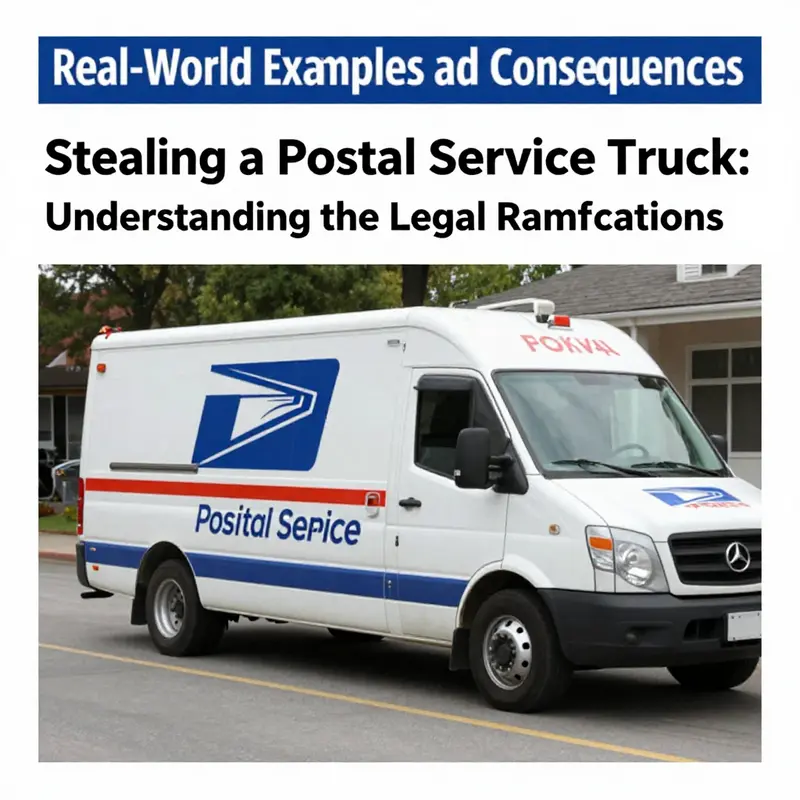
The image of a someone sliding behind the wheel of a postal service truck might feel like a scene from a thriller, but the legal footprint behind such an act is anything but cinematic. Stealing a USPS vehicle is not treated as ordinary car theft. In the United States, a postal truck is government property, and its unauthorized taking triggers federal law with potentially severe consequences. The core statute most directly implicated is 18 U.S.C. § 641, which criminalizes theft, conversion, or embezzlement of property that belongs to the United States government. When a truck that delivers mail is involved, the government’s interests become twofold: protecting property and preserving the essential service that keeps millions of Americans connected. The moment the key turns in a postal truck’s ignition without authorization, the clock starts on a federal exposure that can stack charges and magnify penalties in ways most people don’t anticipate. The law does not measure the seriousness of the offense by the size of the vehicle or the amount of cash on hand. It measures it by the fact that the property belongs to the government and, more importantly, by the risk the act creates for the mail system and the public. Citizens rely on dependable mail delivery for everything from paychecks to prescription medicines, and a truck that disappears from its route can disrupt that reliability in hours, not days. In that sense, the act of theft is not merely a property crime; it becomes a disruption of a national service and a risk to public safety that lawmakers insist on deterring with serious penalties. This is the frame through which prosecutors view any case involving a stolen postal vehicle, and it shapes what follows when the statute is invoked at trial or in plea negotiations. The impact on an individual accused of such a crime is not confined to a single incident. It reverberates through career prospects, personal freedom, and the perception of trust in public institutions. From the moment of arrest, a defendant may confront a cascade of federal charges that can animate a complex legal strategy, with each statute offering a different angle on the same core act. The practical question is not just whether someone took the truck, but how the act fit into the broader pattern of conduct and how prosecutors maneuver to bind it to the most serious available charges. The law makes room for accountability that goes beyond the mere loss of a vehicle. It recognizes that a truck used to deliver mail is a mobile node of a national infrastructure. When it disappears or is misused, mail delivery stops in some places, shipments are delayed, and postal workers are forced to scramble to maintain service. The consequences therefore become not only punitive but also corrective, aimed at restoring the public’s faith in a system that thousands of people rely on every day. The federal structure also means that the penalties, if imposed, will be shaped by processes that differ from state-level vehicle theft cases. In many jurisdictions, the government’s position is explicit: stealing a government vehicle is a serious offense that warrants meaningful punishment. The federal framework recognizes that a single act can hinge on questions that reach across state lines and into the realm of interstate commerce—precisely the type of concern Congress sought to address when it authored broad anti-theft provisions that protect government property and critical services. The decision tree a prosecutor follows when a postal truck is involved typically starts with 18 U.S.C. § 641. The statute, in plain terms, makes it a felony to steal or convert property that belongs to the United States. A postal truck qualifies because it is government property. The penalties—the possibility of years in prison alongside substantial fines—serve as the most conspicuous deterrent, but the story doesn’t stop there. If the theft or attempted theft involved mail or vehicles used in the delivery of mail, other federal provisions may come into play. One of the most relevant is 18 U.S.C. § 1705, which targets interference with interstate commerce by stealing or destroying mail or vehicles used to deliver mail. The presence of mail in transit and the likelihood of crossing state lines can convert a local misstep into a nationwide concern. In practical terms, this can translate to additional counts and, potentially, stiffer sentencing when the government argues that the defendant’s actions endangered a broader system. A separate but closely related provision is 18 U.S.C. § 2314, which criminalizes transportation of stolen property across state lines. The moment a stolen vehicle crosses state lines—even briefly—the defendant faces another federal layer of liability. The cross-border dimension is not merely a ceremonial label; it is a recognized aggravator in federal sentencing schemes that often results in harsher outcomes than a purely intrastate theft would. Confronting these charges collectively means the defendant’s exposure is not limited to a single statute but can expand to multiple, each with its own penalties and proof requirements. When a stolen truck is involved, state law can also apply, especially if the case is pursued at the state level for the act of vehicle theft within a particular jurisdiction. State charges can carry their own penalties, which may include fines, probation, or imprisonment. The interplay between federal and state charges can produce a complex procedural landscape, sometimes leading to plea bargains that strategically resolve multiple counts with a unified sentence or, in other cases, culminating in trial on several theories of liability. The practical consequences, however, are rarely confined to courtroom outcomes. A person facing federal charges related to a postal truck can expect howls of media attention, the stigma of a federal indictment, and the potential for long-standing collateral consequences that shape employment and personal life. Federal offenders may face mandatory or enhanced sentences under advisory guidelines, depending on the circumstances, such as the value of the property involved, the role of the accused in any conspiracy or attempt, or the presence of aggravating factors like violence or threats to public safety. Even when the theft was opportunistic and not intended to cause harm, prosecutors often emphasize the risk to mail service, which has real-world implications for people who rely on timely deliveries of critical items. The Essex County example from 2021—though involving mail theft rather than the truck itself—illustrates how federal prosecutors treat mail-related crimes as serious breaches. Court documents show that the employee faced multiple counts of mail theft, a felony that adds weight to the government’s case against any person who exploits USPS assets. This context matters because it demonstrates the degree to which authorities view any unauthorized use of postal resources as part of a broader ecosystem of offenses designed to protect the integrity of mail delivery. It is not merely about wrongdoing against a single property; it is about undermining a nationwide system that depends on predictable routines, security protocols, and a chain of custody that preserves the integrity of mail. The federal angle thus informs the severity of the response. The bottom line remains stark: stealing a postal service truck is a federal crime with the potential for up to ten years in prison, in addition to substantial fines. Prosecutors have the tools to pursue multiple charges that can stack and overlap, especially when the act intersects with interstate commerce, mail delivery, or transportation of stolen property across state lines. The possibility of conspiracy or accomplice liability adds another layer, turning a solitary act into a more expansive inquiry into how and with whom the crime was planned and executed. For people eyeing a hypothetical or actual theft, the legal landscape offers a crucial warning: the consequences extend far beyond the moment of taking the vehicle. The courts consider the disruption to a national service, the risk to public safety, and the potential for harm to the mail system and recipients. Even if the vehicle is recovered and no one is hurt, the mere fact that the government’s property was taken can result in a robust, punitive response. The broader moral of this discussion is not to sensationalize crime but to illuminate the stakes involved in any attempt to appropriate government assets. The postal system is a lifeline for millions, and the state and federal authorities have aligned to protect it with determined resolve. In the end, the risk is not simply legal; it is societal. The security of mail, the reliability of delivery, and the safety of postal workers are the public-facing metrics of success for this system. When a truck goes missing, those metrics falter, and the incentives to pursue accountability become markedly stronger. For readers seeking a deeper dive into the statutory text that underpins these charges, the Department of Justice provides an authoritative resource on Theft of Government Property. While the real-world cases may vary in specifics, the governing principle remains constant: the government’s property is protected by serious laws, and the consequences of violating them are correspondingly serious. The practical takeaway is clear for anyone who might one day face such a scenario: do not underestimate the breadth of liability that accompanies the theft of a postal vehicle, and recognize that the federal system has multiple levers to ensure accountability. External resources offer further clarity on the statutory framework, including the official text and interpretation of 18 U.S.C. § 641. For additional context on how federal and cross-border regulatory factors influence trucking and logistics in related scenarios, see the discussion on cross-border regulatory issues. cross-border regulatory issues. As always, understanding the law’s reach helps illuminate not only what could happen, but why these provisions exist in the first place. The bottom line remains a warning etched in statute: theft of a postal service vehicle is not a mere property crime; it is a federal offense that can trigger a constellation of charges, a long prison term, and lasting consequences on personal and professional life. For those who study the mechanics of how such offenses are treated, the takeaway is predictable and sobering: the system responds with gravity to protect public service and public safety. External reference: https://www.justice.gov/criminal-fraud/section-641-theft-of-government-property
Final thoughts
Stealing a postal service truck is not a trivial offense. It encompasses serious federal and state legal implications that can lead to significant penalties, including imprisonment and fines. As industries rely on postal services for logistics and delivery, understanding these legal frameworks becomes essential to safeguard against criminal liabilities. Stakeholders in manufacturing, retail, construction, and small businesses that utilize shipping must recognize the severity of such actions to promote compliance and avoid costly implications for operations.