
Understanding the taxation of trucking services is crucial for various sectors such as manufacturing, retail, construction, and small businesses with shipping needs. As transportation regulations and tax implications can significantly influence operational costs and compliance, it becomes essential for stakeholders in these industries to grasp how federal and state tax frameworks impact their trucking services. This article explores the multifaceted issue of taxation in trucking services, examining federal excise taxes, state-level tax considerations, and the necessary filing requirements and deadlines. By delving into these chapters, businesses can better navigate their responsibilities and optimize their financial strategies.
Taxing the Open Road: Unraveling When Trucking Services Trigger Federal and State Taxes
Taxing the open road is a complex dance between federal mandates and state levies, and trucking services sit right at the center of that balance. For carriers and the vendors who serve them, understanding when a trucking activity becomes taxable is essential to stay compliant and to price services accurately. The starting point is federal: the Heavy Highway Vehicle Use Tax, a federal excise levy that applies to owners of heavy highway vehicles used on public roads. In practical terms, this means that if a truck or tractor-trailer has a taxable gross weight of 55,000 pounds or more, and it operates on public highways, the weight that travels under the calendar year becomes taxable. The mechanism for reporting and paying this tax is Form 2290, and the clock starts ticking the moment the vehicle is first used on a public highway within the tax period. The deadline for filing is the last day of the month following that first use. If a truck is first used, say, on July 15, the Form 2290 must be filed by August 31. This interplay of weight, use, and timing means that trucking operations and their finance teams must track not only miles and loads but also the precise moment when a vehicle first graces the public highway in a calendar year. The federal emphasis on the first-use event helps the Internal Revenue Service monitor vehicle activity across fleets and ensures tax collection aligns with actual road usage. The guidance for this framework is laid out in detail on the IRS Trucking Tax Center and the Heavy Highway Vehicle Use Tax pages, which serve as the authoritative sources for compliant filing and ongoing maintenance of records. While the core rule centers on weight and initial highway use, the practical consequences ripple through fleet budgeting, asset management, and the way carriers structure contracts with shippers and brokers.
Beyond the federal layer, state-level tax considerations add another dimension. At the state level, the most commonly encountered framework for trucking-related taxation involves business taxes applied to the sale of goods and services to trucking customers or to those who operate within the trucking ecosystem. In several states, vendors who supply fuel, maintenance, rest areas, or other consumables to truckers can be subject to Business and Occupation (B&O) taxes or equivalent turnover taxes. Notably, the act of transporting freight for hire—carrying cargo from point A to point B—typically does not fall under B&O tax rules as a transportation service. Instead, it is the sale of ancillary goods or services to truckers that more often triggers state-level tax obligations. This distinction matters for a broad ecosystem of participants: fleet operators, maintenance providers, fuel suppliers, insurers, and logistics intermediaries. For vendors, the practical implication is clear: even if the fleet’s primary service—moving freight—is taxed under federal rules, their own sales to trucking customers may fall under state taxation frameworks. Each state’s tax code interprets these activities differently, so a careful, operation-specific review is necessary to determine whether sales tax, B&O tax, gross receipts, or other state levies apply.
For the trucking service provider navigating this terrain, the most immediate federal obligation remains the Heavy Highway Vehicle Use Tax. The tax is tied to the vehicle itself, not to the location of the shipment or the duration of the service. In other words, the tax is tied to the vehicle’s operation on public highways and to its taxable gross weight, independent of whether the truck carries a single load or a dozen over a single month. This nuance matters for fleet managers who are deciding how to record mileage, how to allocate tax liability across a fleet, and how to present pricing to customers who increasingly scrutinize every line item in a freight quote. The tax rate itself is not a function of the miles traveled during the calendar year; rather, it reflects the vehicle’s weight and its first-use status on public highways. The administrative process is straightforward in principle: determine weight, establish first-use date, file Form 2290, and remit the tax along with any required payments within the prescribed deadlines. The IRS provides detailed instructions and FAQs to guide operators through this process, ensuring that even fleets with multiple vehicles have a clear path to compliance.
For a service provider operating in an ecosystem of carriers, the federal framework creates an expectation of transparent cost accounting. When a carrier forecasts the cost of a new fleet addition, the Heavy Highway Vehicle Use Tax must be factored into the year’s operating plan from the outset. If a company anticipates acquiring vehicles mid-year, those purchases trigger separate forms and filings corresponding to each vehicle’s first use. Because the tax is payable once per vehicle per tax period, per the first-use rule, fleets often implement internal record-keeping conventions that flag new assets for Form 2290 filing well ahead of the calendar date on which the vehicle will be introduced into service. This advance planning contributes to smoother cash flow management and minimizes last-minute filing stress as the deadline approaches.
The federal framework does not exist in a vacuum. The interplay with state tax regimes means a holistic view is necessary—one that considers not only how a truck is taxed but also how the agencies in the trucker’s operating state view the broader commercial activities around trucking. For instance, a vendor that sells fuel to truckers or maintains a fleet’s mechanical systems might face B&O tax or similar state taxes on the transactions themselves. In many jurisdictions, the act of providing services or goods to truckers constitutes taxable activity, but the exact tax treatment depends on the state’s legal definitions and rate schedules. The distinction between a transportation service—which is usually governed by federal tax rules—and a sale of goods or services to truckers—as subject to state tax regimes—can be subtle but significant for compliance and pricing. This nuance emphasizes why trucking firms and their business partners often need both tax counsel and practical internal controls to ensure that federal and state obligations are properly aligned.
The path to compliance also hinges on the precise documentation of when a vehicle is first used and how its weight is recorded. Fleet operators typically retain purchase documents or lease agreements, vehicle registration data, and maintenance logs that corroborate the GVWR and the first-use date. These records are not merely bureaucratic artifacts; they support legitimate deductions and provide a defense in case of an IRS inquiry. The filing deadline, while rigid, invites a disciplined calendar approach. For example, if a fleet manager anticipates a first-use date late in the year, they can create a filing plan that ensures Form 2290 is submitted on time, with the correct Vehicle Identification Number (VIN) and weight classification. The risk of noncompliance—whether due to late filing, incorrect VINs, or misclassified weights—translates into penalties, interest, and potentially disrupted operations as authorities review fleet activity. In practice, many fleets opt for electronic filing, which streamlines the submission process, reduces errors, and accelerates any resulting refunds or acknowledgments. The combination of weight-based thresholds, first-use timing, and a straightforward filing mechanism makes Form 2290 a predictable annual ritual for carriers operating heavy highway vehicles.
The broader implications for the trucking industry extend beyond the mechanics of filing. Tax considerations influence strategic decisions about fleet composition, financing arrangements, and even the geography of operations. Operators weigh the cost of heavier equipment against the potential improvements in payload efficiency and fuel economy. They decide when to retire older units versus invest in new, heavier models, aware that the tax landscape can affect total cost of ownership. Shippers and brokers, likewise, must account for these costs as they negotiate freight rates and service levels. The tax structure can alter the relative attractiveness of long-haul versus regional routes, or influence the mix of owned versus leased equipment. All these decisions hinge on a clear understanding that trucking services are taxed at multiple levels, and the way those taxes interact with fleet strategy and commercial pricing can be as consequential as the contract terms themselves.
As industry observers and practitioners navigate this terrain, it helps to stay tuned to evolving trends in the trucking ecosystem. The broader context—economic cycles, demand for freight, fuel prices, and regulatory developments—shapes how aggressively fleets invest in new equipment and how they allocate resources to tax planning. For readers who want to explore how these macro forces interface with the tax environment, a discussion of key economic trends impacting the trucking industry can provide helpful background. See the analysis here: Key Economic Trends Impacting the Trucking Industry. This resource can illuminate how suppliers and fleets respond to shifting costs, including tax-related expenses, and how those responses ripple through the supply chain. The link anchors a broader conversation about cost structure, capital expenditure, and the strategic choices that shape the modern trucking landscape.
The tax conversation does not end with the federal and state frameworks alone. It also intersects with cross-border regulatory issues when fleets operate across borders, engage in international routing, or move goods through ports where federal and provincial or state rules may align or diverge. In such situations, the precise tax treatment can depend on the nature of the service, the destination of the goods, and the specific regulatory contexts of the jurisdictions involved. While the primary focus here is on the United States, readers should be aware that international operations can entail additional layers of reporting, registration, and tax compliance obligations. For a practical takeaway, carriers and vendors should build a compliance culture that prioritizes data accuracy, timely reporting, and proactive communication with tax professionals who understand the interplay between federal excise taxes and state-level obligations. The goal is not to simplify away the complexity but to manage it with disciplined processes, auditable records, and a readiness to adapt as rules evolve.
For those seeking authoritative regulatory guidance, the IRS provides comprehensive resources that outline what constitutes the taxable event, how to determine the vehicle’s taxable gross weight, and the mechanics of filing Form 2290. The federal framework remains the anchor of taxation for trucking services, and it is complemented by state-level rules that can affect vendors and service providers within the trucking ecosystem. In practice, the most impactful takeaway is this: trucking services operate within a layered tax environment where the vehicle’s weight and first-use status set the federal tax baseline, while the sale of goods and services to trucking customers interacts with state tax codes in nuanced and jurisdiction-specific ways. A steady, well-documented approach to record-keeping, coupled with timely filings and ongoing tax staff training, helps ensure that fleets remain compliant and financially resilient amid a changing regulatory landscape.
External resources and official guidance offer the most reliable map through this landscape. Operators should regularly consult the IRS Trucking Tax Center and related pages to verify filing requirements, thresholds, and deadlines, and to stay informed about any updates to the Heavy Highway Vehicle Use Tax program. Practically, this means calendars, compliance checklists, and integrated financial systems that flag upcoming deadlines, ensure correct VIN entries, and reconcile payments with tax filings. In the end, understanding the tax implications of trucking services is not only about fulfilling a regulatory obligation—it is about anchoring cost management in a transparent, defensible framework that supports sustainable operations and informed decision-making across the trucking ecosystem.
External resource: https://www.irs.gov/businesses/small-businesses-self-employed/heavy-highway-vehicle-use-tax
Tax on Wheels and Roads: Decoding Federal Excise Measures in Trucking and What It Means for Trucking Services
In the United States, the question of whether trucking services are taxable often boils down to a distinction between taxing the service itself and taxing the assets that enable the service. The trucking industry is subject to federal excise mechanisms that target heavy highway vehicles used on public roads. The upshot is that the tax landscape surrounding trucking is not a simple, service-by-service levy on transporting goods. Instead, the principal federal instrument rests on the use and ownership of the heavy vehicles that deliver those services. In other words, the core tax assigns a weight-based obligation to the trucks and trailers that perform the work, while the service of moving freight is not taxed as a stand-alone service in the same way a service might be taxed for other industries. This nuance matters for fleets of all sizes, from owner-operators to large carriers, because it shapes compliance obligations, budgeting decisions, and how prices are set and communicated to customers over the long term.
Central to this framework is the heavy highway vehicle use tax that applies to vehicles with a gross vehicle weight rating, or GVWR, of 55,000 pounds or more. This threshold is not a guess about the demand for trucking; it is a technical criterion tied to the wear and tear such vehicles impose on public highways. When a truck first goes into use on a public highway in a calendar year, that event typically triggers the tax obligation. The logic is straightforward: heavier vehicles cause more road wear, and the tax is a tool to fund highway infrastructure and maintenance in proportion to that wear. The tax itself is not charged on every mile or every shipment; rather, it is associated with the vehicle’s participation in highway use during the year. For operators, this means a clear, event-driven point of taxation rather than a perpetual levy on each transport activity.
The practical mechanics are grounded in a specific filing and payment process. In the United States, the federal excise tax is reported and paid through the appropriate vehicle-use framework. The standard instrument associated with heavy highway vehicle use is Form 2290, the Heavy Highway Vehicle Use Tax Return. This form collects the tax attributable to the use of qualifying heavy vehicles and is filed with the Internal Revenue Service (IRS). The filing deadline is the last day of the month following the month in which the vehicle was first used on a public highway. The arithmetic is anchored in the calendar: if a vehicle is first used on July 15, the obligation is due by August 31. The process is designed to align tax timing with actual highway use and fleet deployment, rather than with a generic calculation that ignores when and how a vehicle enters service each year.
The rate question often enters the discussion at this point. A number of sources describe the tax as imposing a rate on the taxable value of the vehicle’s use. In the materials at hand, a current rate cited as 12% is mentioned as the tax rate on the taxable value. This figure can be interpreted in several ways, depending on how the tax base is defined in practice and on legislative adjustments over time. What remains crucial for operators is that the tax base is linked to the heavy vehicle’s use and weight, rather than to a direct charge on the service of moving freight itself. In other words, the service remains a business activity that can be priced competitively, while the tax is a vehicle-specific charge assessed for highway use. The precise calculation, including how weight, distance, and time interact with any rate, should be confirmed with the latest IRS guidance, because tax rules are subject to periodic updates and administrative interpretations.
The compliance trail is real and concrete. For trucking companies and independent operators, adherence begins with understanding which vehicles qualify and when the tax is due. The principal form is filed quarterly and used to report and remit the excise tax on heavy highway vehicles. The documentation and payment flow must map to the calendar for each vehicle, reflecting first-use dates and the ongoing utilization during the year. While Form 2290 is the traditional vehicle-use tax form, some summaries and discussions describe a broader federal excise framework that is sometimes characterized in various ways in the literature, including references to quarterly reporting on Form 720. This literature variation underscores the importance of consulting the official IRS Trucking Tax Center for authoritative guidance and current practice. The critical takeaway is that operators must not assume a one-size-fits-all approach; they must verify the correct form, due dates, and payment methods for their specific fleet and use pattern.
Exemptions and credits exist within this framework to reflect practical realities. Vehicles used exclusively for non-highway purposes are commonly exempt, as are vehicles operated by government entities. Such exemptions acknowledge that not all heavy vehicles contribute to highway wear in the same way, and they prevent double taxation of equipment that serves non-public-road functions. For fleet managers, exemptions can influence asset decisions, retirement schedules, and the strategic mix of on- versus off-road equipment. The exemptions are not blanket permissions to avoid tax; rather, they refine applicability to reflect actual use and ownership scenarios, helping to prevent the misclassification of vehicles that may appear to qualify but do not meet the requisite use criteria.
For operators seeking clarity in the compliance labyrinth, the practical path is to anchor decisions in the most authoritative official sources. The IRS Trucking Tax Center is singled out in the research materials as the most relevant, up-to-date resource for instructions, forms, and updates to changes in the tax rules governing trucking and heavy highway vehicle use. This resource provides the definitive guidance on what vehicles qualify, how to calculate the tax base, what constitutes first use, and how to report and remit payments. It also clarifies any nuances about which tax forms apply in different contexts and how to interpret any changes in thresholds or rates that may affect a fleet’s tax position. In a sector characterized by continuous evolution—shaped by regulatory changes, shifting fuel prices, and mounting infrastructure needs—the IRS Trucking Tax Center serves as the anchor for accurate, compliant practice.
The discussion of whether trucking services are taxable hinges on this distinction between the service as a business activity and the vehicle-use tax that attaches to heavy highway equipment. In practice, the service of moving goods is not taxed as a service in the manner some consumer-oriented services are taxed. Instead, the tax on trucking arises from the use of heavy vehicles on public roads. This difference matters for pricing, competitive strategy, and financial planning. If the tax burden is substantial, a carrier might evaluate strategies that optimize the vehicle-utilization profile, adjust maintenance cycles, or time registrations to align with fiscal years in a way that minimizes or defers tax exposure within the legal framework. On the customer side, prices may reflect the cost of compliance as part of the cost of delivering service, though many operators embed tax-related costs in a broader budgeting approach rather than itemizing them in every quote. Such considerations illustrate how policy aims—funding highway infrastructure and maintaining road quality—are translated into fleet-level decisions that ripple through pricing, service levels, and fleet modernization choices.
The broader implications for the industry are shaped by a balance of regulatory clarity and market dynamics. When fleets expand and invest in heavier equipment, the potential tax impact grows, underscoring the importance of early, proactive tax planning. Conversely, if a fleet reduces weight or shifts to off-highway or lighter-duty configurations, the tax exposure may decline, though it must be weighed against productivity, safety, and service commitments. These trade-offs sit at the heart of strategic decisions in fleet management, capital expenditure, and routes. The tax framework thus functions both as a fiscal mechanism and as a driver of operational discipline. Industry analyses often emphasize not only the mechanics of tax compliance but also the macroeconomic signals that influence trucking demand, such as labor supply, energy prices, and cross-border regulatory issues. Those trends, captured in broader economic discussions like the ones summarized in Key Economic Trends Impacting the Trucking Industry, shape how fleets plan capital investments and how lean or expansive pricing strategies should be in response to policy changes and market conditions.
As the conversation turns to policy and practice, it is worth returning to the essential question: Is trucking service taxable? The consistent answer across official guidance is nuanced. The service to transport goods is not taxed as a standalone service through federal excise taxes in the same way as certain luxury services or manufactured goods. Instead, the federal obligation sits with the heavy vehicles that perform the service on public highways. The result is a layered tax environment where fleet owners must manage vehicle-use taxes, ensure correct application of exemptions, and align compliance with evolving IRS guidance. In this sense, trucking service taxation is not about taxing the act of moving goods per se but about applying a vehicle-use framework that reflects the wear and infrastructure costs generated by heavy highway operations. This nuance helps clarify why many stakeholders describe trucking taxation in terms of vehicle use and heavy vehicle classifications rather than a direct tax on the service alone. The effect on pricing, contract structures, and negotiations with customers is indirect but real, as the tax costs are embedded in costs of operation and capital expenditure—factors that ultimately influence the competitiveness and reliability of trucking services.
For readers who want to verify specifics or keep abreast of updates, the IRS Trucking Tax Center remains the go-to resource for the most authoritative direction on thresholds, rates, forms, and filing deadlines. The landscape can shift with policy changes, and proactive engagement with official guidance helps ensure that fleets remain compliant and financially optimized in a dynamic regulatory environment. Official guidance emphasizes that the tax is tied to vehicle use and weight, that exemptions exist for certain non-highway or government operations, and that the practical coursework of compliance—tracking first-use dates, calculating taxable value, and timely filing—drives both regulatory compliance and economic efficiency within trucking operations. By connecting the dots between policy intent, fleet management realities, and pricing decisions, operators can better navigate the tax terrain while continuing to deliver reliable transportation services across complex supply chains.
External resources: For official guidance on rates, thresholds, and forms, see the IRS Trucking Tax Center. https://www.irs.gov/businesses/small-businesses-self-employed/trucking-tax-center
Internal resource reference: Industry analyses and sector-wide trends that inform how fleets respond to tax policy are explored in discussions such as Key Economic Trends Impacting the Trucking Industry to contextualize tax considerations within broader market dynamics.
Taxability on the Road: Navigating State-Level Rules for Trucking Services
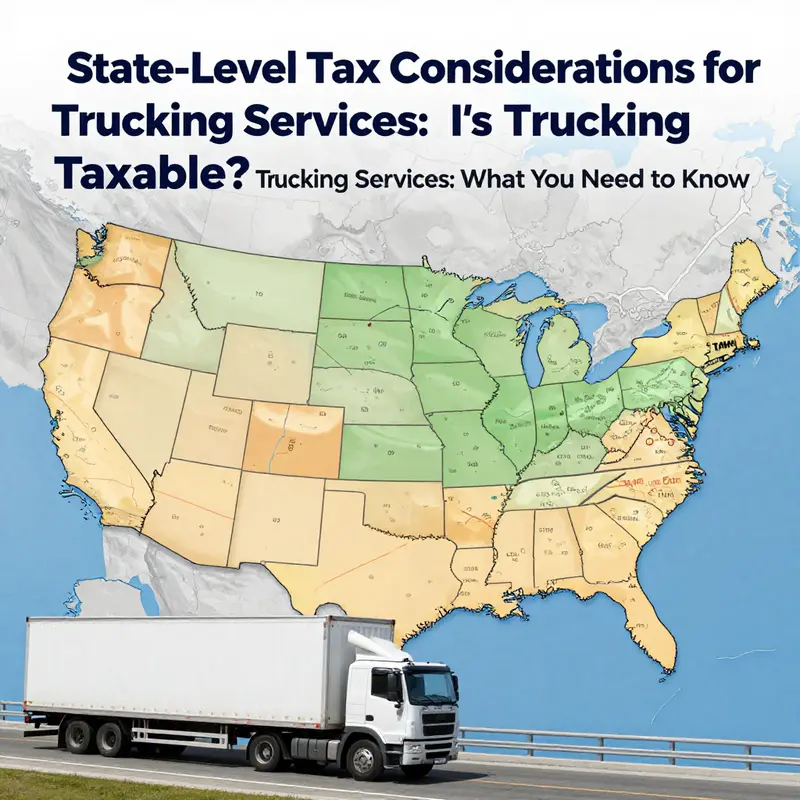
Trucking services sit at the intersection of federal regulation and state tax policy, a cross-country puzzle where the pieces often don’t line up in a uniform way. The broader question—whether trucking services are taxable—unfolds differently depending on the layer of government you’re examining, the exact nature of the service sold, and the way a carrier structures its charges. At the federal level, the Internal Revenue Service imposes specific excise taxes on heavy highway vehicles used on public roads, notably through the Federal Excise Tax on Heavy Trucks under Internal Revenue Code Section 4481. This is a distinct tax of a federal nature and is administered on a nationwide basis, with the mechanics of filing and compliance anchored in Form 2290. Yet when a carrier crosses state lines and enters the realm of state sales and use taxes, the story becomes more nuanced. States are responsible for their own rules on what constitutes a taxable sale of services, how transportation charges are treated, and what ancillary costs may be taxed or exempt. What begins as a straightforward question about whether a trucking service is taxable quickly expands into a mosaic of state-specific interpretations, exemptions, and administrative practices that can easily catch carriers off guard if they assume a one-size-fits-all rule applies everywhere they operate.
In practical terms, the New York example spotlights the essential principle that state tax treatment often hinges on the precise character of the service and how it is billed. In New York, transportation services themselves are not taxed as a separate service when the shipment of goods is taxed at the point of sale. If a delivery service is sold independently from the sale of taxable goods, it is generally not subject to New York sales tax. This core idea—that the act of transporting goods may be exempt from sales tax in itself—does not translate to an automatic exemption for every piece of the trucking operation. The nuance lies in the bundling of services and the potential taxable status of related services or charges that accompany the core transportation. For example, while the main transport may be considered a non-taxable service, charges for loading, unloading, or handling of goods may be treated differently under state rules. Some states also attach taxes to fuel, permits, or other operational costs that a trucking company incurs as part of its day-to-day activity. The implication for operators is clear: a transaction that appears as a single “ trucking service” on a bill may actually consist of multiple components, some taxable, some exempt, depending on the jurisdiction and the precise invoicing structure.
This distinction matters not only for compliance but for financial planning and contract design. When a carrier contracts to move goods across state lines, the way charges are itemized on invoices can determine whether a state sales tax applies to the service. If the carrier bills the transportation charge separately from ancillary services, a state like New York may treat the transportation portion as non-taxable while isolating a taxable component such as loading, unloading, warehousing, or handling. Conversely, if the carrier issues a bundled invoice that combines transport with those additional services into a single line, the state may apply tax to the broader charge or adopt a different approach to the bundle that changes the overall tax exposure.
Beyond the New York example, the state landscape is diverse. Some states make distinctions between the transportation of tangible property and the movement of services, and a handful apply taxes to certain trucking-related activities, such as the sale of fuel, special permits, or other regulatory costs borne by the carrier. The recurring theme across jurisdictions is not simply whether trucking is taxable but how the law defines the taxable base and what must be taxed. Carriers who operate fleets across multiple states quickly discover the risk of inconsistent tax treatment across routes, fleet types, and service configurations. A transaction that seems uniform on a single national contract may, in different states, be taxed in several different ways due to variations in tax law, exemptions, and the pace at which regulators interpret new billing structures. Faced with this patchwork, operators benefit from a disciplined approach to contracting and invoicing, one that emphasizes clarity in how services are described and priced.
For trucking companies, the implications of state tax rules extend into compliance practices and the broader governance of their business models. The federal excise tax remains a constant for eligible heavy vehicles and is filed annually through Form 2290, providing a predictable framework of compliance for the federal layer. State-level considerations, however, demand ongoing diligence. The most practical safeguard is to separate charges clearly on every invoice. When transport is sold as a service, vendors should separate the core freight movement from ancillary services like loading, unloading, storage, warehousing, or special handling. If a bundled approach is necessary, the contract should specify how each component is priced and identify which components are taxable under the destination state’s rules. Maintaining meticulous records helps ensure that if an audit or a tax authority review occurs, the carrier can demonstrate that the taxable and non-taxable components were correctly identified and billed as such.
A second key safeguard is to align invoicing practices with state guidance and to consult official sources before adopting any new billing approach. State tax authorities are the ultimate arbiters of taxability within their borders, and guidance can shift as court decisions evolve or as administrative interpretations are updated. In New York, for instance, the Tax Department’s guidance on shipping and delivery charges makes it clear that the tax outcome can hinge on whether charges are part of a taxable sale of goods or are standalone transportation services that are exempt in themselves. While the core transportation may be exempt, other components associated with the shipment could trigger tax depending on how they are bundled or billed. This underscores the necessity of preserving a contract trail, a robust invoicing schema, and a clear separation of service components whenever possible.
For carriers spanning multiple states, the conversation cannot end at a single example. The broader principle is to build tax resiliency into the business model by anticipating how different jurisdictions could tax associated services. Some states apply a tax to fuel or other operational costs that are not directly linked to the sale of goods but are essential to the carriage of those goods. Others tax specific licensing or permit fees tied to the operation of commercial vehicles. In practice, this means that a seemingly straightforward trucking engagement may involve a bundle of activities—basic transport, loading and unloading, storage in transit, fuel surcharges, and regulatory fees—each potentially subject to different tax rules. To navigate this terrain, carriers should engage in scenario planning, modeling how a given shipment could be taxed in the states it touches and how changes in the invoice structure could impact tax exposure.
A broader, forward-looking consideration is the interplay between federal and state taxation. While the Form 2290 process governs the federal excise duty on heavy highway vehicles over a certain weight threshold, state taxation operates independently of that framework. A trucking company must, therefore, manage two distinct compliance obligations that can interact in nuanced ways. For example, a fleet might incur federal excise costs based on vehicle use while simultaneously facing state-level taxes on the services rendered or on ancillary charges. In practice, this means maintaining clean separation between capital costs, operating expenses, and service charges, and ensuring that the accounting system captures these distinctions with precision. A well-configured accounting platform can tag charges by service type, route, and destination state, enabling quick and accurate tax determinations should a state tax issue arise.
From a governance perspective, this complexity also invites a culture of proactive compliance. Carriers should establish internal controls that validate the consistency of service descriptions across contracts, quotes, and invoices. When a customer contract contemplates a bundled service, the internal team should review the components, determine the likely tax treatment under the destination state, and decide whether to restructure the pricing to minimize risk or to designate separate lines for each service element. These steps can reduce the likelihood of disputes with tax authorities and improve the predictability of cash flow, particularly for larger, multi-state shipments where tax exposure could accumulate across several jurisdictions.
For organizations thinking about the broader implications, the path forward lies in cultivating knowledge about how state tax authorities interpret transportation-related charges. This includes staying attuned to guidance that clarifies when transportation itself is taxable versus when related activities are taxable, and understanding how bundling interacts with exemptions. A practical path is to reference official state resources and to leverage external expertise where necessary. In the context of this chapter, the emphasis is on building a framework of inquiry: Is the service being delivered as mere transport, or is it a bundled delivery that includes loading, unloading, and handling? Are any ancillary costs—fuel, permits, or regulatory fees—present, and how are they treated in the destination state? Answering these questions with precision helps ensure consistent tax outcomes across the fleet and across markets.
For carriers operating across state lines, it is also worth acknowledging that tax policy can evolve in response to economic conditions, regulatory reform, and political priorities. In such contexts, a steady practice of documenting service components, keeping contracts updated, and periodically reviewing invoicing practices with tax counsel can be invaluable. It allows a company to adapt quickly to changes without losing sight of the core objective: delivering goods efficiently while complying with the tax rules that govern the jurisdictions in which those goods move. The state-level intricacies are not merely administrative hurdles; they shape commercial strategy, pricing models, and even decisions about expansion, partnerships, and route optimization. In short, state tax considerations are an integral part of strategic planning for trucking services, not a peripheral compliance checkbox.
To connect this discussion to real-world considerations for fleets operating in multiple regions, consider the concept of cross-border regulatory issues as a focal point for risk management and policy alignment. The road to compliance becomes smoother when stakeholders from tax, operations, and legal teams collaborate to map out where shipments go, what services are delivered, and how charges are presented to customers. The goal is to create predictable tax outcomes that align with both the letter of the law and the commercial realities of trucking. For those exploring these cross-border dynamics in greater depth, a closer look at the broader regulatory landscape can be illuminating and practically useful. See this discussion on cross-border regulatory issues for more context.
In navigating these questions, businesses benefit from a disciplined, evidence-based approach that treats taxability not as a fixed verdict but as a function of how services are defined, billed, and delivered in each state. When a carrier foregrounds the components of transportation—identifying which elements are taxable and which are not—this clarity translates into more accurate pricing, better customer communication, and fewer compliance surprises. It also positions the company to respond to changes in state tax policy with agility, rather than with costly retrofits to contracts and invoicing systems. In a sector where margins can be tight and the speed of service is a competitive differentiator, that kind of operational resilience matters.
For readers seeking more explicit state guidance beyond a single example, the route is to consult official tax authorities and to apply the same principle across states: separate the core transport from ancillary services when possible, and if bundling is unavoidable, document the basis for the tax treatment in the applicable jurisdiction. The New York guidance on shipping and delivery charges serves as a concrete reminder that what looks like a straightforward service can carry nuanced tax implications depending on how the transaction is structured. As fleets grow more complex and routes more varied, the value of a consistent, well-documented approach to taxability grows correspondingly, turning a challenging regulatory landscape into a manageable, even predictable, aspect of doing business on the road.
For readers who want a broader view that includes operational and regulatory perspectives beyond the New York example, further exploration of cross-border regulatory issues can be especially informative. This broader lens helps align tax strategy with operational realities, enabling trucking services to navigate state-by-state differences without sacrificing efficiency or profitability. If you’re building or revising a policy framework for your fleet, consider how cross-border considerations and state-by-state tax nuances can be incorporated into your standard operating procedures, contracts, and invoicing templates.
External resources provide additional perspectives and formal guidance to support these efforts. See the official state guidance below for a foundational understanding of how shipping and delivery charges may be treated in a given jurisdiction, and how that treatment interacts with broader tax laws.
External resource: Shipping and Delivery Charges – Tax.NY.gov
Internal link reference: For organizations operating across state lines and seeking a consolidated view of regulatory considerations, explore cross-border regulatory issues.
null
null
Final thoughts
Taxation of trucking services encompasses several layers, from federal excise taxes to state-specific regulations and important filing deadlines. By understanding these elements, companies in manufacturing, retail, construction, and small business sectors can ensure compliance, thereby avoiding costly penalties and optimizing their financial operations. It’s essential for businesses to stay informed and proactive regarding their tax obligations in order to thrive in a competitive market.